

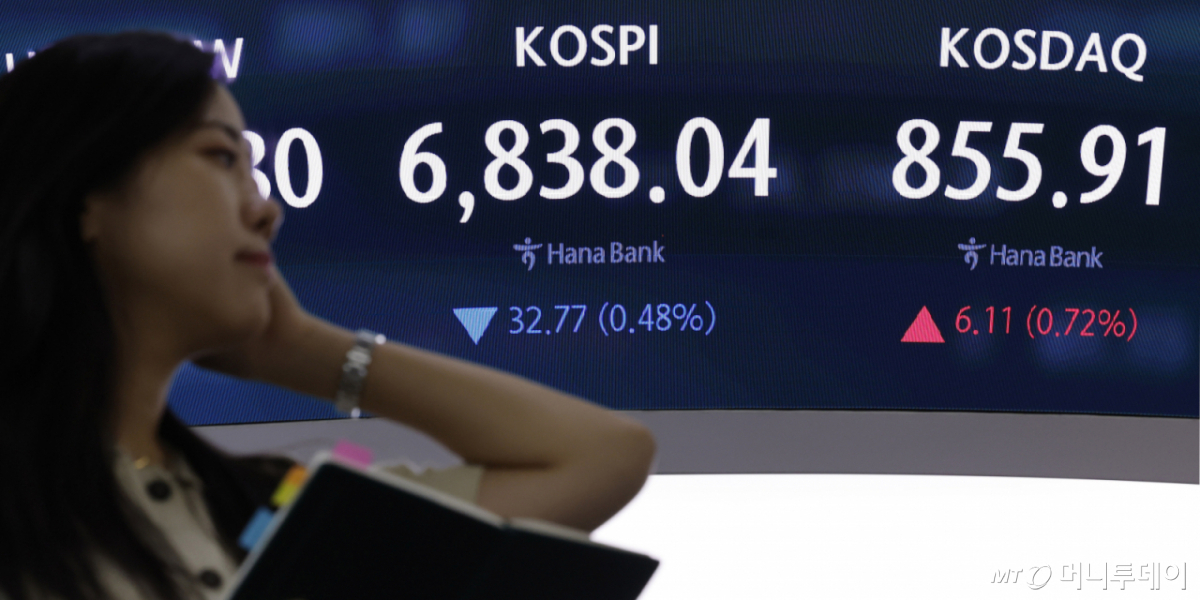
The KOSPI ended in the red. This appears to be a ripple effect from overnight adjustments in U.S. stock markets driven by rising Treasury yields. The securities industry expects volatility to revive through demand generated by Anthropic's listing and Meta's AI agent, "Muse."
On the 30th, the KOSPI index closed at 6838.04, down 32.77 points (0.48%) from the previous day. The KOSPI opened at 6943.47, up 72.66 points (1.06%), attempting a rebound for the first time in three days, but ultimately ended the session lower.
The KOSPI's movement appears to reflect conditions in the New York stock market. On the 29th (local time), the Dow Jones Industrial Average on the New York Stock Exchange closed at 51,349.92, down 131.59 points (0.26%) from the previous trading day. The S&P 500 index fell 12.85 points (0.17%) to 7670.84, while the NASDAQ Composite Index dropped 22.84 points (0.09%) to 26,797.54.
Despite this backdrop, the Philadelphia Semiconductor Index rose 1.32% from the previous close to 12,629.16. On the same day, SK Hynix ADRs, a local memory semiconductor stock, closed up 2.62% at $186.68, while Micron, a U.S. memory semiconductor company, ended trading up 1.05% at $1,065.08.
The securities industry is focusing on additional positive factors, such as the delayed listing of Anthropic and the AI agent unveiled by Meta, while anticipating a rise in the stock market.
Anthropic's listing has been gradually postponed from September to November. The fact that the scheduled date was pushed back suggests an expectation that it will resolve semiconductor supply bottlenecks. Anthropic's listing is also a factor that could attract domestic investor demand. Given that investment funds had previously flocked to SpaceX, investor sentiment is expected to be stimulated by this listing as well. In addition, Meta's Muse may increase demand for CPUs and memory.
Kim Min-gyu, a researcher at KB Securities, stated, "In a situation where a new AI narrative was needed beyond the positive factor that everyone knows—good earnings—the news from Anthropic and Meta could act as a positive element for semiconductors." He added, "If long-term interest rates calm down, even temporarily, due to an interest rate hike, it may not be bad for the stock market. It is now time to pay attention to semiconductors again."
Han Ji-young, a researcher at Kiwoom Securities, said, "Micron's earnings, ahead of its announcement, will serve as a test to see whether the entire AI and memory sector can withstand the burden of high interest rates, going beyond just one semiconductor stock." She added, "While foreign selling may put pressure on domestic semiconductors first, it is necessary to consider the possibility that the intensity will be weaker than in June."

 in STOCK
