

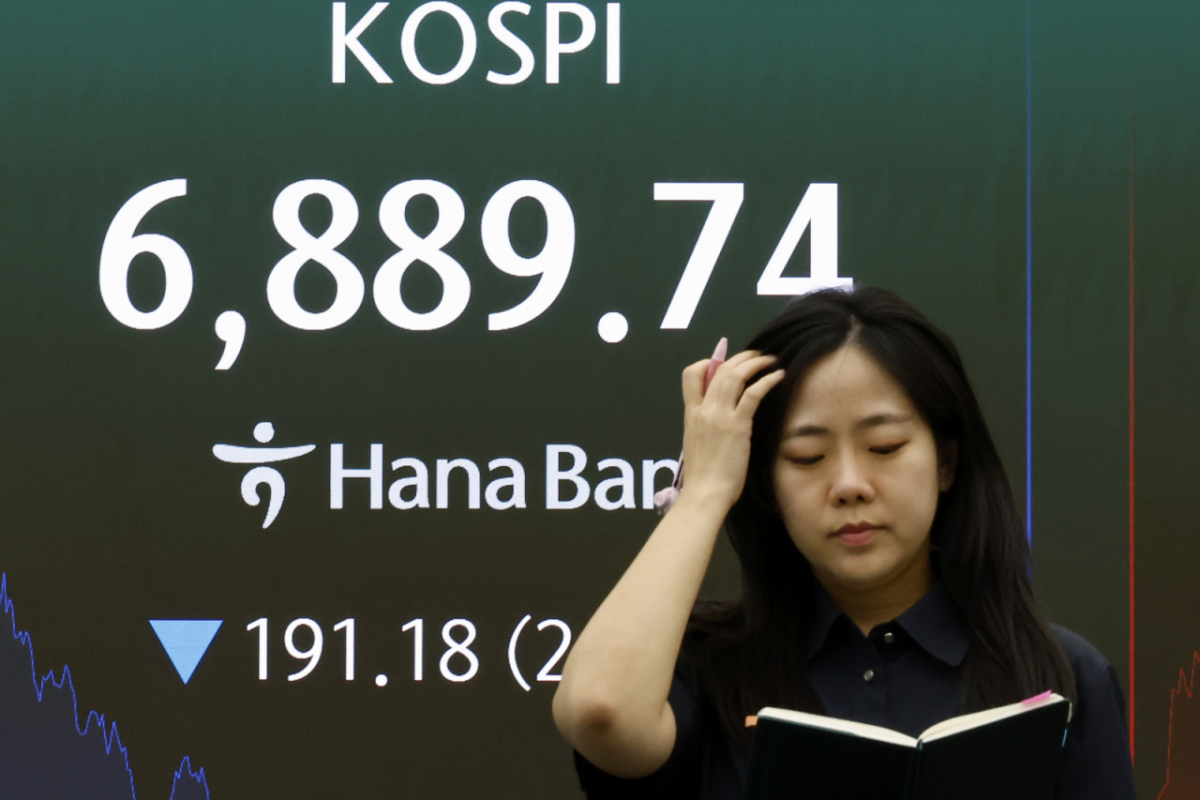
The KOSPI failed to hold the 7,000-point line on the first trading day after the Chuseok holiday and slid to the 6,800 level. Amid a sharp rise in U.S. long-term Treasury yields, experts are watching whether major economic indicators scheduled for this week can quell interest rate anxieties.
On Monday, the KOSPI closed at 6,889.74, down 191.18 points (2.70%) from the previous trading day. The KOSPI opened above the 7,000-point line on this day but saw that level break during trading, falling as low as the 6,800 line.
The KOSPI absorbed major issues accumulated during the Chuseok holiday break all at once, widening its decline. First, concerns over rising U.S. Treasury yields intensified. Yields on the 2nd-year, 10-year, and 30-year U.S. Treasuries rose to levels of 4.91%, 5.21%, and 5.52%, respectively. The confirmation of a robust economic trend, such as the September S&P Global Composite PMI (Purchasing Managers' Index) reaching 58.4—the highest since July 2021—also acted as pressure for rising yields.
Rising international oil prices also added to interest rate burdens. On the 25th (local time), Iran proposed a roadmap to the United States to normalize the Strait of Hormuz within seven days, but U.S. President Donald Trump rejected it, increasing uncertainty. However, when President Trump mentioned the possibility of further negotiations with Iran on the 27th, concerns about negotiation delays eased somewhat, and the rise in international oil prices was also somewhat limited.
At the U.S.-China summit held last weekend, major issues such as China's rare earth supply, regulations on advanced semiconductors, and AI (artificial intelligence) technology were not addressed. As a result, analyses suggest that this summit actually lowered concerns of short-term conflict escalation.
Lee Kyung-min, FICC manager at Daishin Securities, said, "Although signals appeared in the U.S.-China summit and U.S.-Iran relations, the sharp rise in U.S. Treasury yields limited risk-asset preference sentiment, offsetting positive factors." He added that regarding semiconductors, "investor sentiment contracted as concerns over rising U.S. Treasury yields intensified, compounded by news of delays in Oracle's data center business."
On this day, foreign investors and institutional investors sold 3.2403 trillion won and 1.0174 trillion won worth of stocks, respectively, on the stock market. Retail investors purchased 2.6053 trillion won worth. Other corporations made a net purchase of 1.6383 trillion won, which is interpreted as being influenced by share buybacks from Samsung Electronics and SK Hynix on this day as well.
By sector, the electrical and electronics industry fell over 4%. Manufacturing dropped more than 3%, distribution fell over 2%, and securities declined over 1%. Finance and machinery/equipment closed roughly flat, while metals, transportation equipment/parts, and general services ended with slight gains. Non-metals, electricity/gas, IT (information technology) services, pharmaceuticals, transport/warehousing, and insurance rose more than 1%. Entertainment/culture increased over 2%, while construction and chemicals rose over 3%.
Among the top market capitalization stocks in the KOSPI, Samsung Electronics and SK Hynix closed with weakness of around 5%. SK Square and Samsung C&T, which are tied to them through equity or business relationships, plummeted more than 7% and 5%, respectively. Samsung Electro-Mechanics traded roughly flat, while Hyundai Motor, KB Financial Group, and Samsung Life Insurance concluded trading with slight gains. Samsung Biologics rose over 2%, and LG Energy Solution increased over 3%.
The KOSDAQ closed at 846.58, up 2.10 points (0.25%) from the previous trading day.
In the KOSDAQ market, retail investors and foreign investors made net purchases of 21.1 billion won and 45.7 billion won, respectively. Institutional investors made a net sale of 74.1 billion won. Although retail investors and foreign investors showed net selling trends during trading on this day, they closed with net purchases.
By sector, pharmaceuticals rose over 2%. Medical devices/precision instruments, IT services, and finance increased more than 1%. General services, entertainment/culture, chemicals, electrical/electronics, and manufacturing traded roughly flat, while construction, transportation equipment/parts, and metals remained slightly weak. Non-metals, machinery/equipment, and distribution fell more than 1%.
Among the top market capitalization stocks in the KOSDAQ, HLB rose 29.95% to close at the upper limit. On this day, news that HLB's cholangiocarcinoma treatment drug received approval from the U.S. FDA (Food and Drug Administration) led HLB Group stocks to hit the upper limit one after another. Altogen Labs rose more than 1%. EcoPro and EcoPro BM increased more than 2% and 6%, respectively. Semiconductor materials, components, and equipment (MCE) stocks closed generally lower. Wonik IPS and Rino Industrial fell more than 7% and 4%, respectively.
Experts in the financial investment industry are focusing on major events this week. In particular, macroeconomic indicators directly linked to the Federal Reserve System's (Federal Reserve/Fed) policy decisions will be released one after another. The U.S. August PCE (Personal Consumption Expenditures) price index, the inflation indicator most favored by the Fed, and Micron's earnings results will be announced on the 30th; the U.S. ISM (Institute for Supply Management) September Manufacturing PMI and South Korea's September export-import statistics will be released on the 1st of next month. On the 2nd, U.S. September non-farm employment data and others are scheduled.
Researcher Im Jeong-jeon and Tae Yun-seon of KB Securities said, "As a week concentrated with major economic indicators and Micron earnings events, we expect continued exploration of direction while confirming interest rate and semiconductor-related materials."
On this day, in Seoul's foreign exchange market, the won/dollar exchange rate closed weekly trading at 1,365.1 won, up 7.6 won from the previous trading day's closing price.

 in STOCK
