


The best reports selected by MoneyToday's securities division for the fifth week of September (the 28th to October 2) are: Lee Jae-man, a researcher at Hana Securities, "U.S. 10-Year Treasury Yield at 5%: Are Stocks Okay?"; Lee Sang-heon, a researcher at iM Securities, "Korea-U.S. Nuclear Alliance Expands Globally: Accelerating Orders as K-Nuclear Enters Global Markets Including the U.S."; and Park Jun-young, a researcher at Hanwha Investment & Securities, "Everything You Need to Know About Materials, Components, and Equipment Right Now."
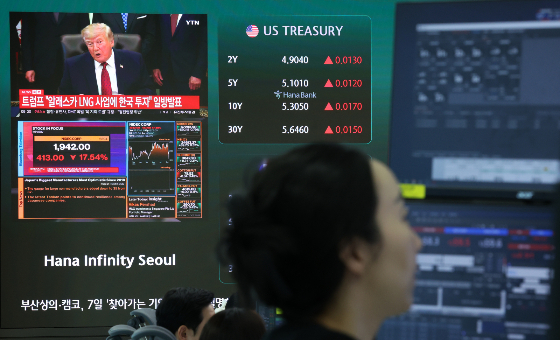
Lee Jae-man, a researcher at Hana Securities, divided interest rate scenarios into two categories based on the premise of falling international oil prices and recommended sectors with high investment appeal in each case. The first scenario is one where Treasury yields fall alongside international oil prices after they peak. The second is a scenario where market rates do not drop significantly despite falling international oil prices due to increased U.S. AI (artificial intelligence) investment.
On the 25th (local time), the U.S. 10-year Treasury yield reached 5.16% intraday, surpassing 5%. According to the researcher, the yield gap (the difference in expected returns between stocks and bonds) based on the U.S. S&P 500 index fell to 3bp (1bp = 0.01 percentage points), the lowest level since 2004. In a situation where the investment appeal of stocks relative to bonds is on the verge of disappearing, the researcher's report served as a guide for stock investors and recorded the highest number of views.
The following is a summary of the report. ()
☞ "View Original" is available only on the MoneyToday homepage, not on portal sites such as Naver or Daum.
Portfolio strategies considering the possibility that Treasury yields will fall after international oil prices peak are divided according to changes in WTI (West Texas Intermediate) prices. It is necessary to identify sectors with high stock price returns by segment when WTI prices fall from $90 to $80, from $80 to $70, and from $70 to $60 per barrel.
In the domestic stock market, it should also be considered that falling WTI prices could lead to net purchases by foreign investors (historically, there were net purchases at WTI levels of $70–80, and net sales at around $60). Taking this into account, sectors with high stock price returns based on foreign net purchases at the $80 WTI level are power equipment, semiconductors, defense, and shipbuilding. At the $70 level, it expands to consumer goods such as securities, construction, software, transportation, media, and automobiles. At the $60 level, the leading sectors shift to energy, secondary batteries, and chemicals.
Another scenario is one where the current structure driven by increased U.S. AI investment continues, and market rates do not drop significantly even as international oil prices fall. In this case, it takes time to confirm a decline in interest rates. If expanded capital expenditure (CAPEX) leads rising interest rates, there is little room for rising sectors to spread. The upward trend is highly likely to concentrate on domestic sectors with high correlation coefficients between U.S. capital investment and revenue.
The forecast for this year's capital investment by U.S. hyperscaler companies was revised upward by 2.1% from the end of July to $843.7 billion as of September. Next year's forecast is $1.1 trillion, expected to increase by 31% from this year. Domestic sectors with high correlation coefficients (0.9 or higher) between U.S. hyperscaler capital investment and revenue are IT (information technology) hardware, power equipment, and semiconductors.
Lee Sang-heon, a researcher at iM Securities, predicted that domestic companies will accelerate global nuclear power plant orders by leveraging strategic investment projects for the U.S. On the 22nd, the outlines of Strategic Investment Projects No. 1 through 3 for the U.S. were revealed through the National Assembly. With Texas gas power generation selected as Project No. 1, large-scale U.S. nuclear power plant construction was mentioned for Projects No. 2 and 3. The researcher drew market attention by releasing a report on the expected effects of the Korea-U.S. nuclear alliance ahead of an official announcement by the Ministry of Trade, Industry and Energy.
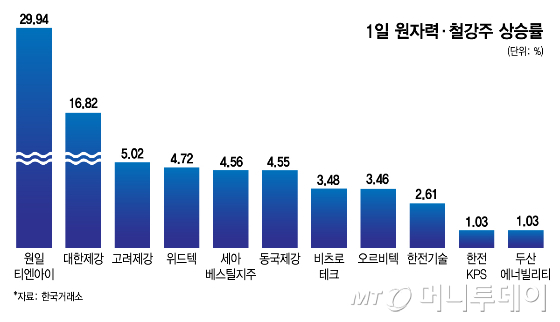
Subsequently, the Ministry of Trade, Industry and Energy officially announced on the 1st that the two countries had agreed to "Korea-U.S. Nuclear Framework" (Project Power) as Project No. 2, which involves constructing eight large nuclear power plants in the U.S. (two APR1400s and six AP1000s) using $120 billion from the Korea-U.S. Strategic Investment Fund. On that day, the stock prices of related stocks expected to benefit surged.
The following is a summary of the report. ()
☞ "View Original" is available only on the MoneyToday homepage, not on portal sites such as Naver or Daum.
As electricity demand surged due to increased AI data centers and advanced manufacturing facilities, U.S. President Donald Trump set a goal to increase nuclear power capacity to 400GW (gigawatts) by 2050. This clearly indicates the U.S. government's stance on expanding nuclear power. However, the U.S. has had virtually no new nuclear power plant construction in the past 30 years, resulting in weakened equipment supply chains and nuclear construction capabilities.
Korea has already executed numerous large-scale overseas plants and nuclear EPC (engineering, procurement, and construction) projects. Based on capabilities in technology, quality, and process management, Korea has internationally proven its "On Time, On Budget" capability to build nuclear power plants within set periods and budgets. Major domestic nuclear companies have secured manufacturing technologies and quality certifications for core components of main equipment such as reactor pressure vessels, steam generators, and turbine generators, enabling them to contribute to supply chain stabilization and improved quality competitiveness in both new U.S. nuclear construction and renovation/maintenance projects for aging plants.
As new construction and replacement/repair projects for aging nuclear power plants in the U.S. gain momentum, cooperation with Korea will appear inevitable across all stages of design, procurement, construction, operation, and maintenance. Cooperation with Korean companies that can simultaneously meet technical reliability, delivery adherence, and cost efficiency is essential. If the EPC execution capabilities of Korean companies are combined with main equipment manufacturing technologies, they can produce mutually complementary synergies across the entire nuclear ecosystem in the U.S., going beyond single projects.
Since most investments in U.S. nuclear power involve large-scale capital input into construction, securing profitability will be key going forward. Considering the supply chain for all stages of nuclear construction, including design, procurement, construction, operation, and maintenance, it is possible to proactively secure profitability as orders flow to Korean companies such as Team Korea.
Park Jun-young, a researcher at Hanwha Investment & Securities, analyzed that semiconductor back-end processes are emerging as the center of a new capital expenditure (CAPEX) cycle alongside expanded AI semiconductor investment. He diagnosed that while back-end processes were previously close to assembling and protecting completed chips, their importance has increased significantly in the AI era. This is because how quickly and efficiently logic and HBM (high-bandwidth memory) are connected determines system performance.
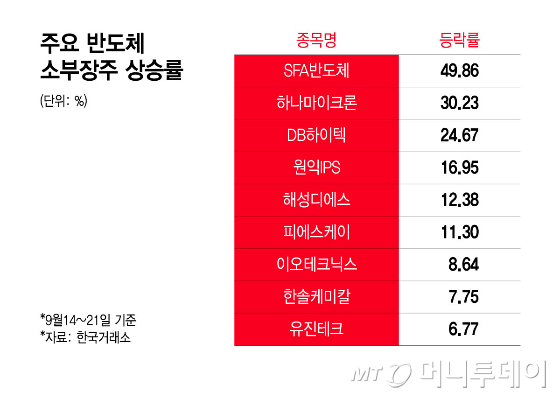
Indeed, the rise in semiconductor materials, components, and equipment stocks, including back-end process companies, is fierce in the KOSDAQ market. According to the Korea Exchange, among the top 20 stocks by KOSDAQ market capitalization at the end of last August, 10 were semiconductor materials, components, and equipment stocks, but this number increased to 13 within a month. Amid growing market interest in semiconductor materials, components, and equipment stocks, the researcher's report is evaluated as having further enhanced investors' understanding.
The following is a summary of the report. ()
☞ "View Original" is available only on the MoneyToday homepage, not on portal sites such as Naver or Daum.
From 2026 to 2028 will be a period where investment in both memory and non-memory sectors expands simultaneously. Not only memory companies such as Samsung Electronics, SK Hynix, Micron, China's ChangXin Memory Technologies (CXMT), and Yangtze Memory Technologies Co. (YMTC), but also the non-memory value chain including TSMC, Intel, ASE, and Amkor are actively increasing capital investment. This marks the beginning of a "large-scale capital expenditure cycle" where foundry, OSAT (outsourced semiconductor assembly and test), and memory sectors invest together.
Recently, following expansion of wafer production facilities, the scope of investment has broadened to back-end processes such as advanced packaging and testing. Increased shipments and generational transitions of GPUs (graphics processing units) and ASICs (application-specific integrated circuits) due to advanced AI models have driven demand for 2.5D packaging such as TSMC's "CoWoS" and Intel's "EMIB." The transition to HBM4, which has been underway since the second half of this year, has increased the need for investment in memory packaging and testing. As a result, an industrial environment favorable to back-end equipment companies that have both non-memory and memory value chains as clients has been created.

 in STOCK


