

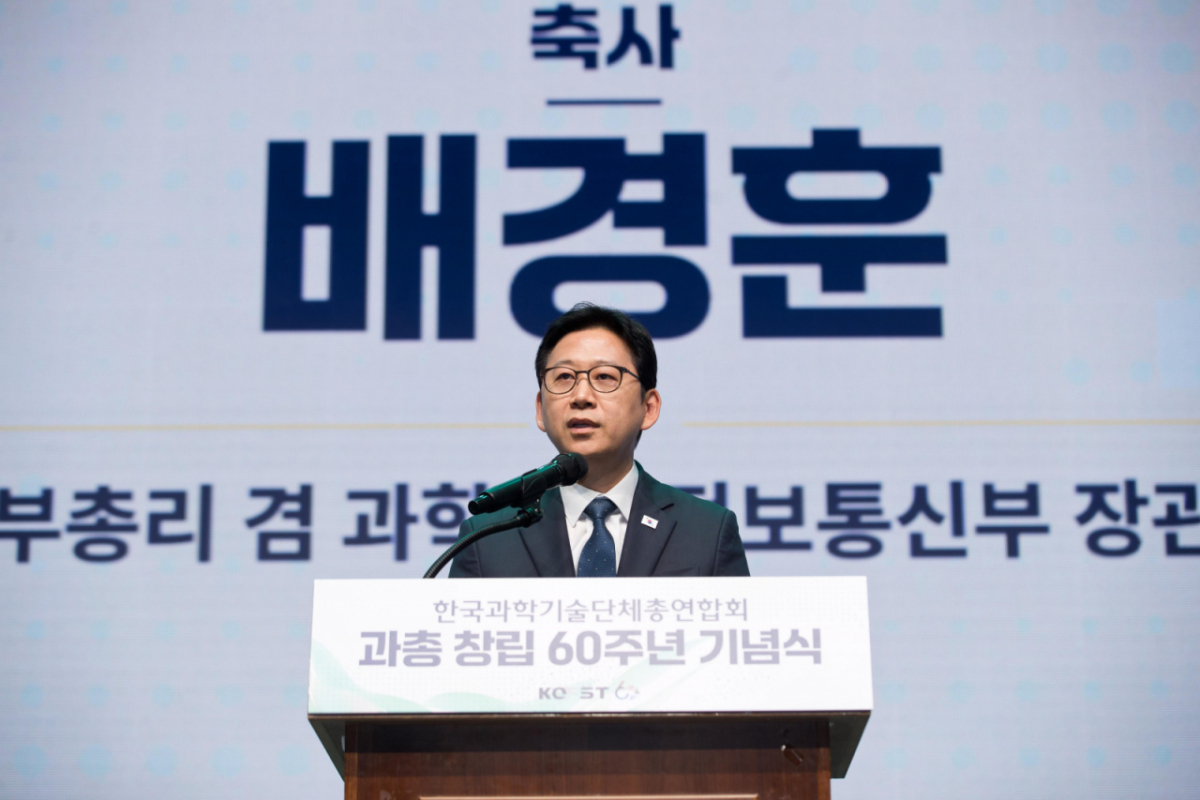
Deputy Prime Minister and Minister of the Ministry of Science and ICT Bae Kyung-hoon unveiled the "Kyoto Vision," which outlines future policy directions for science and technology, alongside science and technology leaders from major countries around the world.
The Ministry of Science and ICT announced on the 5th that Deputy Prime Minister Bae participated in the 23rd Forum on Science, Technology and Society (STS Forum) held in Kyoto, Japan, on the 4th, and jointly unveiled the Kyoto Vision for A Golden Age of Science with science, technology, and innovation ministers from major countries, including the United States.
The forum is an international platform where leaders from governments, academia, research institutions, and industry around the world gather to discuss the social role and issues of science and technology. This year's theme is "Responding to Seismic Shifts in Science, Technology, and Society," and it will run through the 6th.
The Kyoto Vision presents the direction for future science and technology policies in response to changes in the scientific research environment, such as advancements in AI. Key contents include improvements to research support methods and systems, the utilization of artificial intelligence for science, and talent development across the entire science ecosystem.
Taking this joint unveiling of the Kyoto Vision as an opportunity, the Ministry of Science and ICT plans to continue institutional and policy innovations aimed at accelerating scientific discovery and technological innovation, and speeding up technology-driven growth, while also taking a leading role in related international cooperation discussions.
Deputy Prime Minister Bae Kyung-hoon also participated in the 23rd Conference of Ministers for Science and Technology, hosted by Japan's Cabinet Office, during the STS Forum. He exchanged views with science and technology leaders from various countries on the changing role of science and technology in response to rapidly shifting social, geopolitical, and technological environments, directions for supporting basic research, accelerating the social implementation of research outcomes, and the direction of international cooperation in science and technology.
He also shared key science and technology policies of the People's Sovereignty Government, and introduced the seven major SEED projects aimed at cultivating cutting-edge technologies as future growth engines, and the K-Moonshot Project designed to swiftly resolve scientific challenges based on Science AI.
Deputy Prime Minister Bae Kyung-hoon stated, "The domestic and international environment surrounding the R&D ecosystem is changing rapidly due to AI technological innovation and shifts in industrial paradigms, making it a time when a Daejeon turn in science and technology policy is needed," adding, "We will double our efforts toward science and technology policy innovation to strengthen the fundamental structure of our R&D system and revitalize the research ecosystem."
Meanwhile, Deputy Prime Minister Bae met with Michael Kratsios, Director of the Office of Science and Technology Policy (OSTP), and exchanged views on the science, technology, and AI policy directions of both countries, including the Kyoto Vision. They discussed plans to expand science and technology cooperation, including follow-up measures to the Korea-U.S. Memorandum of Understanding on Technological Prosperity signed on the occasion of the summit between the two heads of state in October 2025.

 in TECH
