

The use of artificial intelligence (AI) is rapidly expanding across various industries. From marketing analysis to new product development and patent technology simulation, it has become difficult to find any field that does not utilize AI. The penetration rate of AI in the pharmaceutical and biotechnology sectors is also rising sharply. The speed at which new drug candidates are identified and efficacy validation is designed has already far surpassed human capabilities. Within computers, thousands of antibody and protein design blueprints are generated every day.
However, there are areas that remain beyond the reach of artificial intelligence. Even if AI generates designs for antibodies or proteins, turning those designs into actual drugs requires going through real-world laboratories. Researchers must synthesize DNA according to the blueprints provided by AI, insert it into cells to produce the protein, and then experimentally verify whether it binds to the therapeutic target. It is during this process that unforeseen shortcomings and errors in the AI are also identified.
Developing new drugs in the pharmaceutical and biotechnology sectors requires navigating a multitude of unpredictable variables, many of which are absent from artificial intelligence systems. As a result, recent efforts by pharmaceutical and biotech companies have focused on both enhancing AI's drug design capabilities and converting real-world variables that emerge during practical operations into data. The more actual measured data accumulated in the laboratory, the higher the hit rate for subsequent designs becomes.
Recently, companies specializing in this work have been emerging one after another in the United States. Among them, Twist Bioscience (hereinafter referred to as Twist) is one of the most closely watched by Wall Street investors.
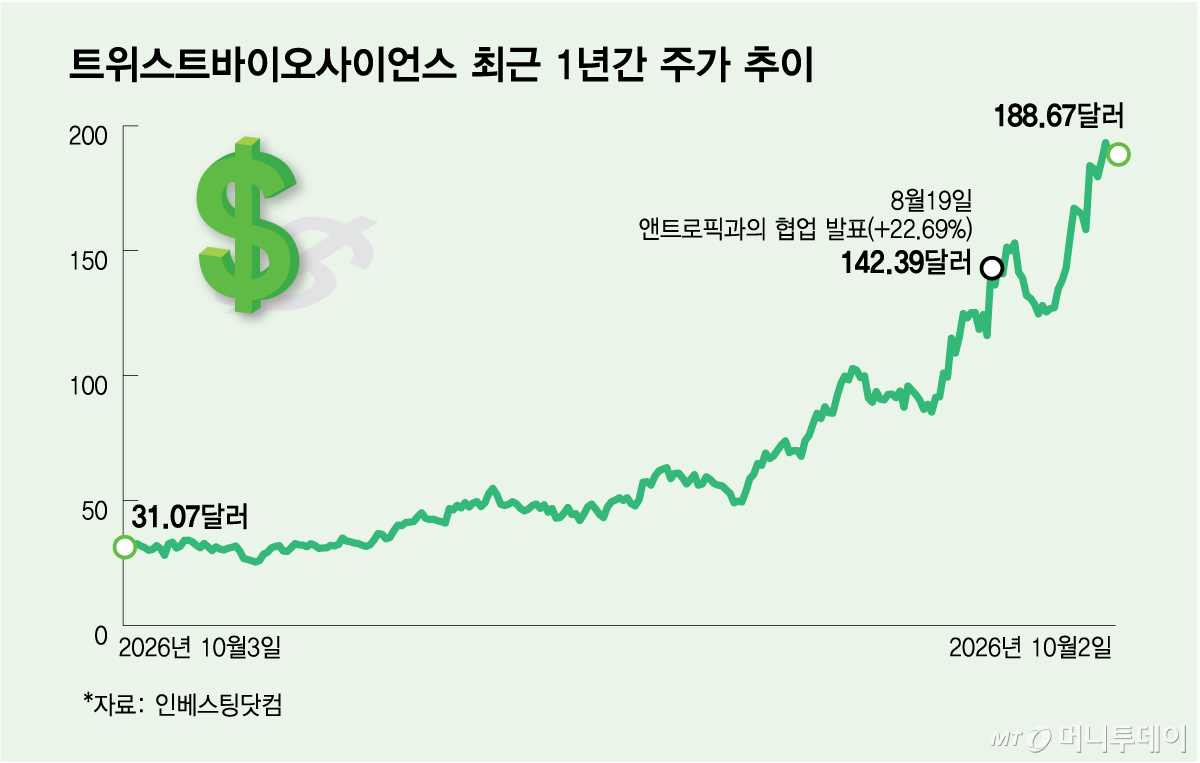
Market interest in Twist has surged over the past two months due to two announcements. On August 18, AI company Anthropic announced that it had designed 1,320 proteins using its own AI model that bind to 15 target cells. Of these, 354 successfully bound to 14 targets in actual tests. The design hit rate of 22.6% to 26.7% exceeded the industry standard of 10% to 15%.
Anthropic selected Twist as one of two external institutional investors to build and validate the design in physical form, and on that day, Twist's stock price surged by 22.6%. On September 16, Eli Lilly announced that it had chosen Twist as its preferred antibody data supplier for providing training data to its proprietary AI drug discovery platform, TuneLab. With these events overlapping, the stock price rose from $28.14 a year ago to $193.24 on the 30th (262,000 won, based on an exchange rate of 1,355 won), a 6.9-fold increase. Compared with the 52nd-week low of $23.30 recorded immediately after last November's earnings release, it represents an 8.3-fold rise. The market capitalization is approximately $12.8 billion (17.36 trillion won).
Twist is a company that manufactures and sells synthetic DNA. Synthetic DNA is a product in which the exact genetic sequence requested by a researcher is produced through chemical reactions, and it is used across various fields of biotechnology research, including drug development, diagnostics, and enzyme engineering. Twist’s greatest competitive advantage lies in its method for producing this DNA.
Existing companies synthesize DNA using 96-well plates, a technology in use since the 1950s. These plastic plates, roughly the size of two smartphones, contain 96 small test tubes, with one strand of DNA synthesized in each well. In contrast, Twist etched densely packed microscopic reaction holes onto silicon chips, similar to how semiconductors are manufactured. A single chip, about the size of a large mobile phone, can simultaneously synthesize over one million DNA strands up to 500 bases in length. The company stated in its annual report that it reduced the amount of chemicals required to produce a single gene by 99.8% compared to existing methods, as the reactions became smaller. The error rate is at a level of one per 7,500 bases per gene fragment.
The same chip technology is also used for cancer diagnosis. To isolate only cancer-related genes from a patient's blood or tissue, bait DNA (probes) that bind to those specific genes are required. Twist can produce hundreds of thousands of probes uniformly, which reduces unnecessary analysis and lowers the cost of sequencing. This is why companies specializing in liquid biopsies, which detect cancer with a single blood draw, and tests that track residual cancer cells after surgery use Twist's products. This NGS product accounted for 55% of revenue in fiscal year 2025.
The primary reason customers choose Twist is price. At the time of its listing in 2018, competitors sold genes for $0.15 to $2.00 per base pair, while Twist's standard price was $0.09 (approximately 122 won). Twist's cost competitiveness was so strong that it supplied products to four competing DNA companies. The second reason is speed. The Express gene service launched in November 2023 delivers finished products within five business days. The company explained that over the past three years, it has reduced manufacturing costs by 60%, waste by 70%, and shortened delivery times by 73%. The third reason is scale. In the third quarter (April to June), the company shipped 369,000 genes in a single quarter, a volume that represents a 56% increase compared to the same period one year earlier.
The company’s strength lies not only in gene synthesis but also in directly producing antibody proteins and measuring performance data. Customers need only send a sequence to receive both the physical product and the accompanying data. Management emphasized during its third-quarter earnings call that this turnkey service is attractive to AI drug development clients. Emily LeFroust, chief executive officer, stated when announcing the contract with Lilly, “The quality of the output from an AI model depends on the quality of the data used for training.” This means that the ability to generate millions of data points at a consistent level of quality is itself a competitive advantage.
The customer base is broad. In fiscal year 2025 (October 2024 to September 2025), the company had more than 3,800 customers, and 99% of its revenue came from repeat customers. No single customer accounts for more than 10% of its sales. Partners in antibody discovery include Bayer, Boehringer Ingelheim, Takeda, Astellas, and Ono Pharmaceutical. In South Korea as well, many companies are seeking out Twist Bioscience.
The competitive landscape is formidable, but Twist believes it has a strong chance of success. In the synthetic DNA market, it competes with China's GenScript, IDT under Danaher, GeneArt under Thermo Fisher, and Eurofins. In next-generation sequencing (NGS) sample preparation products, which account for half of its revenue, its main rivals are Illumina, Agilent, and Roche. In the antibody discovery field, Acceleron and Adimab are cited as competitors. Most of these companies are larger and have longer track records than Twist. The company estimates that the addressable market in NGS is $6 billion (8.13 trillion won) and that the DNA synthesis and protein market exceeds $7 billion (9.49 trillion won).
Twist was founded in February 2013 by three co-founders. The three individuals were not initially part of the same company. Leprince, who graduated from the Lyon School of Industrial Chemistry in France and earned a Yoo Gi-hwa-hak (Dr.) from the University of Houston in the United States, has been responsible for DNA synthesis research and development at Agilent, an instrumentation company, since 2000. Bill Vaney and Bill Puck served as Vice President of Hardware Engineering and Head of Fluid Systems, respectively, at Complete Genomics, a genomic analysis firm.
Bainai and Pex refined their technical ideas from 2011, while working at Complete Genomics. Their goal was to produce 9,600 times more DNA within the same area as a standard 96-well plate, while reducing the usage of the most expensive reagents by one-millionth. In an interview with GEN, a U.S.-based biotechnology publication, in 2021, Lefroust stated that the two had developed the idea for Twist in their garage.
The two found it difficult to grow the technology within the company. Complete Genomics was in severe financial distress, posting a net loss of $18.8 million (25.5 billion won) on second-quarter 2012 revenue of $8.7 million (11.8 billion won). In June of that year, as it began a strategic review that included potential sale options, the company laid off 55 employees. By September, it had agreed to sell the business to China's BGI for $117.6 million (159.3 billion won). The sale was completed in March 2013; Pech left in February and Benyaia in March. They chose independence just as the company was being transferred to a Chinese firm.
Leprout's situation was different. From 2001 to 2012, he consistently ranked in the top 10% of Agilent’s annual performance evaluations. Starting in 2006, he personally planned SureSelect, a sample preparation product for genetic analysis, which was launched in 2009 and developed into a flagship product of the genomics business unit. This is in the same field as NGS products, which currently account for half of Twist’s revenue. However, Leprout’s position at Agilent subsequently narrowed, and the company chose to invest $21 million (28.5 billion won) in Gen9, a venture company specializing in gene synthesis, rather than developing gene synthesis technology in-house.
Afterward, LeFrost left the company and, together with Puck and Bani, raised $600,000 (8.13 trillion won) to start a new venture. The team then began full-scale research on DNA synthesis. DNA is the blueprint of life. Each human cell contains approximately 30 thousand won characters worth of DNA, yet only four letters are used: A, T, G, and C. Just as computers use the two digits 0 and 1 to write all programs, living organisms record how to build their bodies using only arrangements of these four letters. A specific segment containing the instructions for producing a particular protein is called a gene. If a gene is a recipe, then a protein is the dish made according to that recipe. Muscles, hair, enzymes that digest food, and antibodies that fight pathogens are all proteins.
What matters is that cells read any blueprint, regardless of whose it is. If a human insulin gene is inserted into E. coli or yeast, the resulting Misaeng produces human insulin. The insulin administered to diabetes patients has been produced in this manner since the 1980s. Inserting a desired blueprint into cells to have them produce a specific substance is the fundamental principle of the bio industry.
Technology for handling DNA is broadly divided into reading and writing. Reading refers to determining the sequence of letters in existing DNA, which is what genetic testing entails. Writing, conversely, involves creating physical DNA with a letter sequence desired by humans. This is DNA synthesis, and it is Twist's core business. When researchers order a letter sequence via the internet, Twist sends them DNA made according to that sequence.
If DNA can be wrapped and rapidly printed, the number of experimental iterations changes. Biomedical research is a continuous process of trial and error. To find an antibody that binds to cancer cells, researchers must create thousands or tens of thousands of slightly different designs and test them one by one. In the era when a single gene was expensive and took a long time to receive, it was impossible to do anything but select and test a few candidates. As prices fall and delivery times shorten, the number of candidates that can be tested within the same budget and timeframe increases accordingly.
The applications are also extensive. Pharmaceutical companies use synthetic DNA to develop antibody drug candidates. Diagnostic firms create bait DNA that selectively isolates cancer-related genes, using it in tests that detect cancer from a single blood draw. Last quarter, researchers in the Democratic Republic of Congo used Twist’s viral testing product to identify a rare Ebola variant that had been missed by conventional PCR tests. Chemical and materials companies insert blueprints into Misaeng water to produce spider silk fibers, nylon, rubber, fragrances, and food additives. In agriculture, it is used to develop crops that are drought-resistant or contain higher levels of vitamins. This is why the U.S. Emerging Biotechnology National Security Committee has identified synthetic DNA as a critical point in multiple industrial supply chains. Synthetic biology is expected to grow into a market worth $2 trillion to $4 trillion (2,710 trillion won to 5,420 trillion won) between 2030 and 2040.
The problem is that making DNA has long been a labor-intensive process. DNA synthesis is a chemical reaction in which letters are linked one by one in sequence, much like threading beads onto a string. After fixing the first letter to the base, the reagent corresponding to the next letter is added and attached, then washed off, and the process of attaching the next letter is repeated. This method, published in 1982, remains the industry standard today.
Existing companies conduct this reaction in 96-well plates, a laboratory tool consisting of a plastic tray the size of two smartphones with 96 small test tubes embedded in it. When a reagent is poured into one well, the same letter attaches to every DNA strand inside it. As a result, only one sequence can be created in a single well, and a different well is required to create another sequence.
This is compounded by a length limitation. Because errors accumulate slightly each time characters are added, the maximum length that can be synthesized in a single run is around 200 characters. A single gene typically exceeds 1,000 characters. Consequently, approximately 100 short fragments must be produced separately and then assembled to complete one gene. This means an entire 96-well plate is required to produce just one gene. The large well size necessitates the use of expensive reagents in large quantities, resulting in a yield far exceeding the required amount, with most of it being discarded. After the fragments are assembled, error-free completed products must be selected and introduced into bacteria for replication, a process that takes approximately 10 business days alone. The system was structured such that 100 plates had to be processed for every 100 orders, meaning that unit prices did not decrease significantly even as production volumes increased.
In contrast, Twist, the company founded by the three individuals, focused on research to change the platform where reactions occur. Instead of plastic plates, they used silicon chips and etched reaction sites onto the chip surface with a density so high that they were invisible to the naked eye, similar to how semiconductors are manufactured. The chip disclosed when Twist listed on the New York Stock Exchange contained 6,144 zones for producing a single gene, with each zone holding 121 reaction sites. A single reaction site serves the function of one well in a traditional test tube. This means that within the area of a single conventional plate, thousands of genes can be produced simultaneously instead of just one. Currently, a single chip the size of a mobile phone synthesizes more than 1 million DNA strands.
If the sites are this small, it is impossible to connect the piping one by one. Instead, much like an inkjet printer fires microscopic ink droplets onto predetermined spots on paper, a minuscule amount of chemical reagent for the character to be attached at each site in its turn is sprayed into each location. This is only possible through the combination of semiconductor and fluidic equipment technology that not only handles chemical reactions but also etches microstructures and precisely manipulates liquid droplets. This is why chemist LeFevre, along with equipment engineers Bani and Fek, formed a team.
The effect was evident in the cost structure. As the reaction sites became smaller, the usage of the most expensive reagent decreased to one-millionth of its previous level. When considering the total amount of chemical substances required to synthesize a single gene, there was a 99.8% reduction. In 2018, while competitors sold genes at prices ranging from $0.15 to $2.00 per letter, Twist received $0.09 (122 won) per letter. This meant that a single gene consisting of 1,000 letters cost $90 (120,000 won). Because increased orders could be accommodated by filling empty areas on the chip, unit prices dropped further as volumes rose. This is similar to how semiconductor factory costs decrease as utilization rates increase. In the previous quarter, Twist shipped 369,000 genes and delivers urgent orders within five business days.
In its early days, Twist Bioscience struggled to secure customers even after obtaining the technology. Agilent Technologies, where LeFroust had worked, filed a lawsuit against the company. In a suit filed in February 2016, Agilent alleged that LeFroust had secretly prepared to start a business as early as before February 2012, roughly a year before his departure. The company claimed he had misappropriated DNA synthesis technology developed over more than two decades at a cost of tens of millions of dollars. Weary of the prolonged litigation, Twist reached a settlement with Agilent in February 2020, paying $22.5 million (30.5 billion won) to end the lawsuit.
Doubts about Twist's technology were also significant. The logic of introducing an innovative production technology to the conservative pharmaceutical and biotechnology sectors did not resonate well. This is why its first revenue was generated only in April 2016, three years after its founding. The first customer to demonstrate that Twist's technology works outside the laboratory was Ginko Bioworks in Boston, United States. Ginko is a company that custom-orders Misaeng water. For example, if a fragrance company wants to produce rose-scented components at a low cost, Ginko designs and provides the yeast that produces those components. Fragrance, cosmetics, food, and agricultural companies are its main customers.
This business involves a large amount of DNA. It is impossible to know which blueprint will enable Misaeng-mul to effectively produce the desired substance until it is actually tested. Therefore, Ginko creates large quantities of slightly different blueprints and tests them one by one on automated equipment. Because each task involves thousands of genes, synthetic DNA serves as the raw material. After receiving and using products from Twist’s pilot production stage in 2015, Ginko announced that month that it would purchase at least 1 million won base pairs over the following year. This volume represented 10% of the global synthetic DNA market at the time. Jason Kelly, CEO of Ginko, explained that this allowed the company to secure DNA of such quantity and quality at a reasonable cost.
The contract terms also suited the circumstances of both companies. The structure was such that the more Twist lowered its unit price, the more significantly Ginko increased its purchase volume. Because chip-based methods see costs decrease as production volumes rise, an increase in Ginko's orders allowed Twist to lower prices further. Ginko stated that during the first few months of June 2016, it received millions of bases on time and according to specifications, and subsequently tripled its order to 300 million base pairs. In March 2018, it expanded the contract again to supply up to 1.3 billion base pairs over four years.
Twist subsequently gained recognition by supplying DNA for DNA data storage research conducted by Microsoft and the University of Washington. As word spread that genetic material could be obtained quickly and at a low cost, the number of customers began to grow one after another. The customer base expanded from 97 in fiscal year 2016 to 286 the following year, and DNA shipments in the fourth quarter of fiscal year 2017 reached 38,000 units, five times the level of a year earlier. In October 2018, the company listed on NASDAQ at $14 per share, raising 7 billion won (94.8 billion won).
Since its listing, Twist has experienced significant growth. In particular, riding the wave of biotech investment enthusiasm during the COVID-19 pandemic, its stock price rose to $214.07 in January 2021, but this did not last long. In November 2022, when short-selling firm Scorpion Capital released a report alleging that the company was using price dumping to attract customers, the stock price plummeted. As losses continued, the company cut 270 employees, or 25% of its total workforce, in May 2023, and around that time, the stock price fell to $11.46. This represented a drop of nearly 95% from its peak.
At the time, Twist's survival appeared uncertain, but it laid the groundwork for a turnaround by restructuring its cost base. The company consolidated overlapping production lines at its Wilsonville, Oregon plant and shut down most of its internal new drug development projects. In May 2025, it spun off its DNA data storage business into Atlas Data Storage. While cutting costs, the company largely retained its sales organization, which proved to be a significant asset.
A recent trend drawing attention is the rapid increase in orders for therapeutic products following the boom in AI-driven drug development. Candidates designed by AI must be physically produced and tested, and Twist Bioscience already possessed large-scale manufacturing facilities and a sales network. The decision to retain its sales organization during layoffs proved beneficial.
Twist's revenue for the third quarter of fiscal year 2026 (April to June 2026) was $118.4 million (160.4 billion won), a 23% increase from a year earlier. This marked the 14th consecutive quarter of growth and set an all-time high. The gross profit margin was 52.8%. By business segment, the DNA synthesis and protein segment grew by 39% to $56.6 million (76.7 billion won), accounting for 48% of revenue, while the NGS segment increased by 12% to $61.8 million (83.7 billion won), representing 52%. By customer industry, diagnostics accounted for 37%, therapeutics for 34%, and academia and government for 13%. Among these, therapeutic revenue, which saw concentrated demand for AI-driven new drugs, grew the fastest at 49% to $40.4 million (54.7 billion won). By region, based on fiscal year 2025 figures, the Americas accounted for 60%, Europe and the Middle East for 33%, and Asia for 7%.
Annual revenue increased by 20 to 28 percent each year, reaching $245.1 million (332.1 billion won) in fiscal 2023, $313 million (424.1 billion won) in fiscal 2024, and $376.6 million in fiscal 2025. The company initially projected its annual revenue for this year at $425 million to $435 million in November of last year, but has repeatedly raised the forecast, which now stands at $456 million to $457 million (617.9 billion to 619.2 billion won). This represents a 21 percent increase from the previous year. The company stated that it aims to reach break-even on adjusted EBITDA (operating profit before depreciation and amortization) in the fourth quarter, which ends in September. Management expects orders related to AI-driven new drugs to maintain triple-digit growth rates next year, following this year's performance. At its first Investor Day, the company set a goal of more than doubling revenue through organic growth alone by 2031, and achieving a gross profit margin of over 60 percent in the long term.
The company had a workforce of 979 employees as of the end of September 2025. This included 412 in production, 278 in sales and customer support, 198 in management, and 91 in research and development, indicating that production and sales staff significantly outnumbered R&D personnel. The staffing structure reflects a company that prioritizes reducing costs through process automation and mass production over basic technology development. Founder Leprout has led the company for 13 years. In 2020, she received the Rosalind Franklin Award from the U.S.-based Biotechnology Innovation Organization (BIO), which is presented to female leaders in the industrial biotechnology sector. Among the executive team, Patrick Finn, who served as vice president of sales in 2018, currently holds the position of President and Chief Operating Officer (COO).
Research and development expenses decreased from $120.3 million (163 billion won) in fiscal year 2022 to $80.3 million (108.8 billion won) in fiscal year 2025, yet revenue increased by 85% over the same period, rising from $203.6 million to $376.6 million (510.3 billion won). This demonstrates that the company maintained growth while reducing costs.
Wall Street assessments are divided. While a majority of analysts have issued buy recommendations given the positive medium- to long-term outlook, a minority have issued sell recommendations on the grounds that the current share price has risen too quickly. The average target price set by analysts is currently $105.73 (143,000 won), and the current share price stands approximately 45% higher than this level.
While the company has seen significant revenue growth riding the wave of the AI-driven new drug development boom, it remains a loss-making enterprise, a point worth noting. The net loss for the first three quarters of this year was $19.6 million (148.5 billion won). As its stock price rose, the company conducted a rights offering (paid-in capital increase) in August at $96 per share, raising $300 million (407 billion won) to secure $327.1 million (443.2 billion won). It also has an available limit of $200 million (271 billion won) for at-the-market (ATM) equity offerings. This leaves open the possibility of further share dilution due to additional capital increases.
The first hurdle that will determine the direction of the stock price is expected to be the earnings release for the fourth quarter (July–September) of fiscal year 2026, anticipated in November. The key issues are whether the company actually achieved a break-even point on adjusted EBITDA, and how much the revenue outlook for fiscal year 2027 reflects demand for AI-based new drugs.
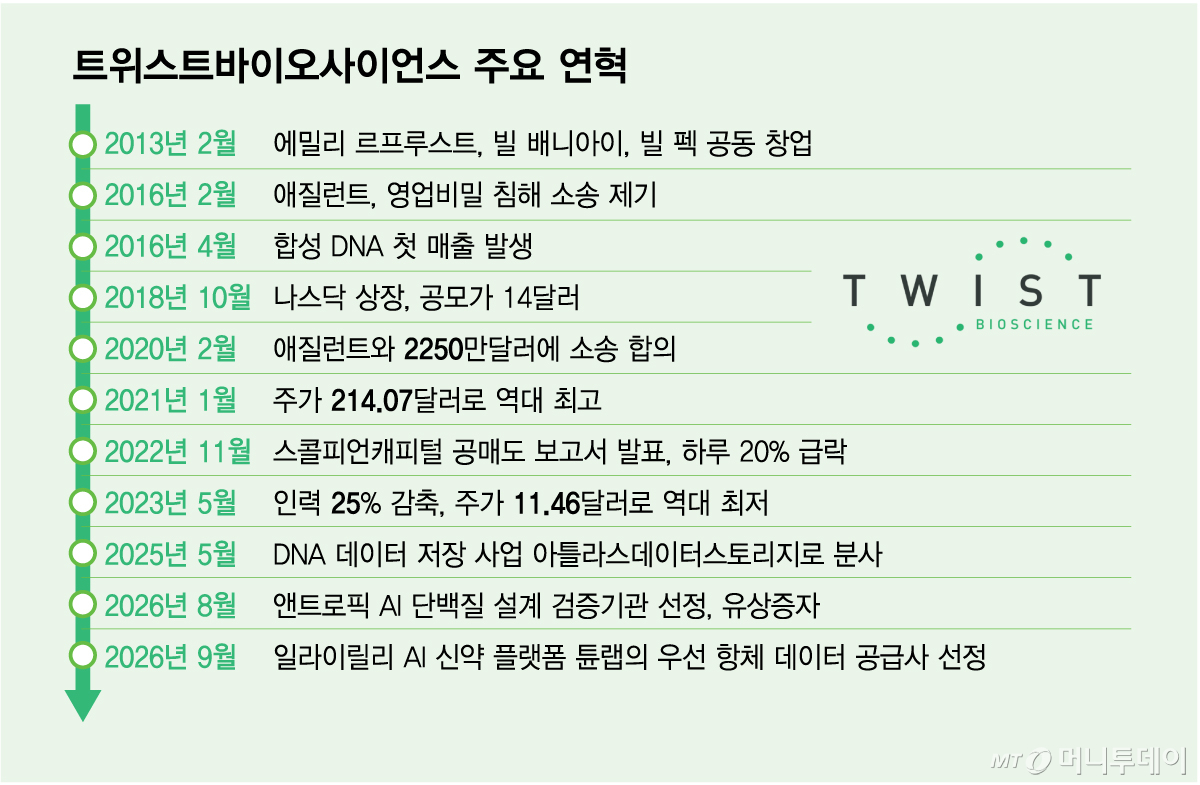
◇ Key milestones of Twist Bioscience
February 2013
Emily LeFroust, Bill Vaney, and Bill Puck co-founded
February 2016
Agilent files lawsuit alleging trade secret infringement
April 2016
First revenue generated from synthetic DNA
October 2018
NASDAQ listing, IPO price $14
February 2020
Agilent and $22.5 million lawsuit settlement
January 2021
Stock price hits all-time high of $214.07
November 2022
Scorpion Capital Short-Selling Report Triggers 20% One-Day Plunge
May 2023
Headcount cut by 25%, stock price hits all-time low of $11.46
May 2025
DNA data storage business spun off as Atlas Data Storage
August 2026
Anthropic AI protein design verification institutional investor selection, rights offering (paid-in capital increase)
September 2026
Eli Lilly’s AI drug discovery platform TuneLab selects preferred antibody data supplier

 in STOCK


