

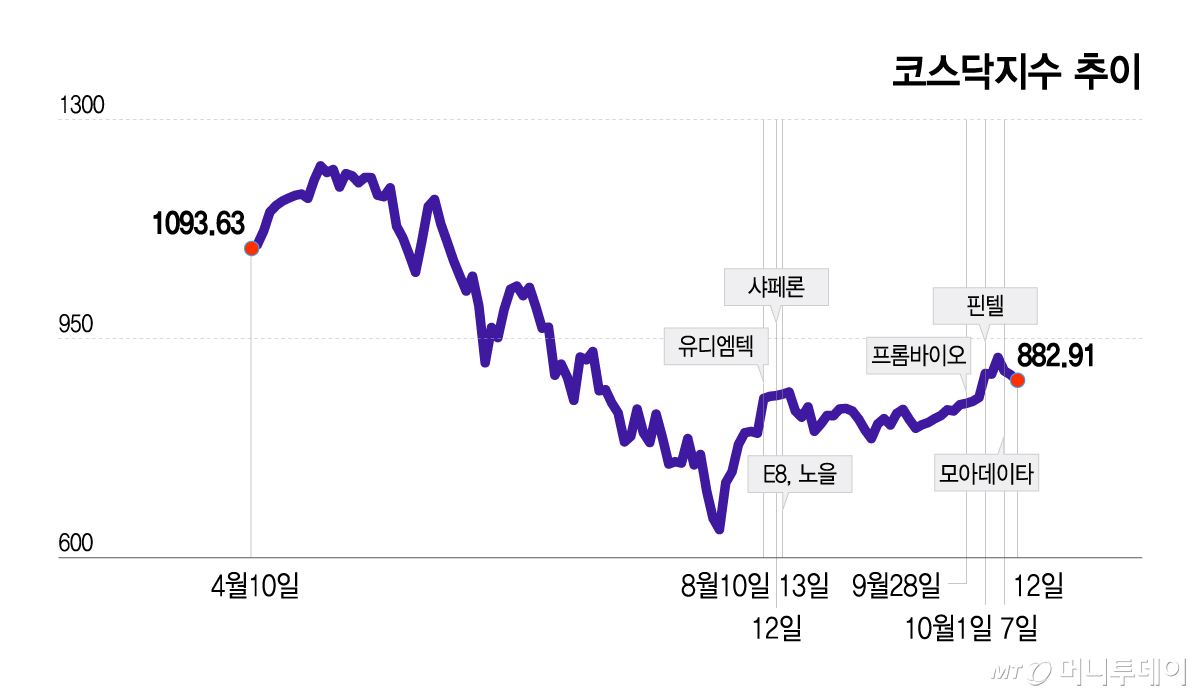
Some technology special-listing companies that entered the KOSDAQ after being evaluated on their technological capabilities and growth potential have been designated as speculative stocks and placed under delisting review before even proving their profitability. This is due to the exchange strengthening its market capitalization-based delisting criteria. Given that stock prices fell sharply during the stock market crash in June and July, concerns are rising over losses for retail investors. As courts have also intervened against formalistic delisting standards, there are calls to consider the intent behind special listings and assess each company’s fundamental financial health on a case-by-case basis.
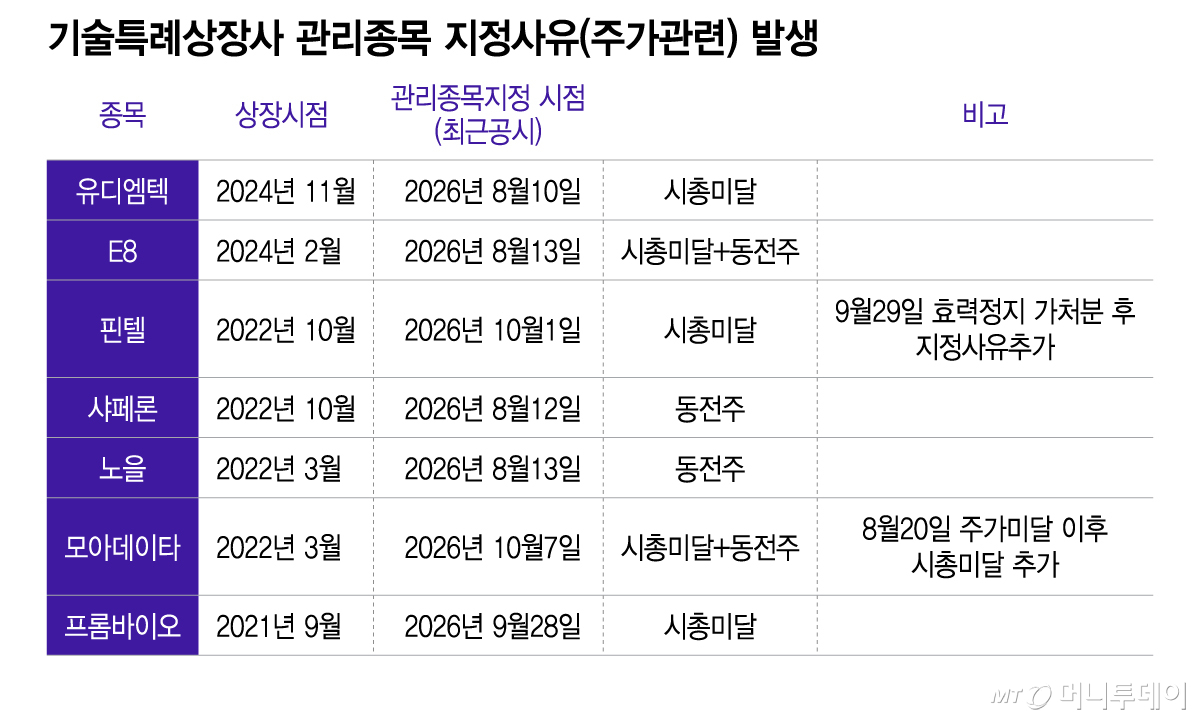
According to the financial investment industry on the 12th, seven companies that entered the KOSDAQ through technology special listing—Chaperon, E8, Noreul, Moadata, Prombio, Pintell, and UD Mtech—are currently designated as speculative stocks. These companies listed between 2021 and 2024, meaning most have been on the market for less than five years.
The designation of technology special-listing companies as speculative stocks runs counter to the purpose of the system. Technology special listing is a regime that permits listing based on an evaluation of the competitiveness of held technologies and future growth potential, rather than current revenue and profits. Accordingly, grace periods are provided: five business years for insufficient revenue after listing, three business years for large-scale losses after listing, and up to one year as an improvement period before substantive delisting review.
All seven stocks were designated as speculative stocks recently, between August and October. The KOSDAQ experienced a slump, falling by approximately 33% from June to July, which also dealt a blow to the stock prices of the seven technology special-listing companies. Furthermore, the exchange’s decision in July to uniformly designate all companies with a market capitalization below 20 billion won as speculative stocks has put the brakes on their growth.
The market cap delisting criteria have been inconsistent this year. The KOSDAQ market cap delisting threshold was raised from 4 billion won at the beginning of the year to 15 billion won, and then to 20 billion won in July. Regulations were amended in May to move the effective date forward by two months to July, which is six months earlier than originally planned. The exchange accelerated the change to exit criteria, stating it would speed up efforts to enhance market transparency. However, the plan to raise the “market cap delisting threshold to 30 billion won,” scheduled for implementation in early next year, has been postponed by six months to reflect market conditions.
The seven stocks do not qualify for the grace period on delisting requirements for technology special-listing companies established by the exchange. Only companies that applied for pre-listing review after July 2 and have publicly disclosed plans to enhance corporate valuation are eligible for delisting grace benefits. Existing listed companies cannot enjoy such benefits.
Market observers point out that the exchange’s measures are excessive. In fact, Pintell, which was designated as a speculative stock in July due to insufficient market capitalization, filed an application for an injunction suspending the effect of the designation decision in September, objecting to the exchange’s judgment. The delisting procedure is currently temporarily suspended.
Recent court rulings have also been negative toward the exchange’s market cap delisting criteria. In a ruling on the 2nd regarding an application by KM Pharmaceutical for an injunction suspending the effect of its speculative stock designation decision, the Seoul Southern District Court determined that classifying insufficient market capitalization as a formalistic delisting cause similar to bankruptcy or capital impairment, thereby fundamentally excluding opportunities for objection or explanation, excessively infringes upon a company’s right to procedural participation. The ruling implies that companies should be given the possibility of recovery through objections or review by the Corporate Review Committee.
In the securities industry, there are concerns about a vicious cycle where retail investors withdraw due to speculative stock designation, causing stock prices to fall; investors who hastily engage in stop-loss selling then bear losses when stock prices rebound after the exchange changes its policy. Technology special-listing company E8 has suspended trading from today until the 3rd of next month for a stock consolidation. This was done to escape penny stock status (stock price below 1,000 won) by consolidating shares at a ratio of 1:5. Even after the par value consolidation, E8 must overcome insufficient market capitalization; since the tradable volume will decrease post-consolidation, the speculative stock designation could act as an even greater negative factor.
Even UD Mtech has not yet completed its lock-up period. The largest shareholder, who held approximately 55% of shares at the time of listing, and their spouse agreed not to sell their shares for three years after listing. This is a longer commitment than the typical lock-up periods for institutional investors (one month or six months).
Most of the seven technology special-listing companies that have become speculative stocks are holding cash reserves sufficient to cover deficits. Pintell raised 3 billion won through a rights offering (paid-in capital increase) last month and is understood to currently hold cash assets in the range of 9 billion won. UD Mtech appears to have secured at least 8 billion won, and Moadata approximately 5 billion won in cash. In the first half of this year, Prombio (33.8 billion won) and Moadata (10.9 billion won) exceeded 10 billion won in revenue.
A financial investment industry official stated, “It is appropriate to designate companies that have caused problems such as capital impairment, embezzlement, breach of trust, or internal transactions as speculative stocks and remove them from the market, but if delisting is decided by a simple criterion, it will be difficult to avoid criticism for hasty administration similar to leveraged ETFs.” The official added, “The fundamentals criteria for technology special-listing companies should be interpreted broadly in consideration of the system’s intent to reduce harm to 2 million retail investors.”

 in STOCK

