

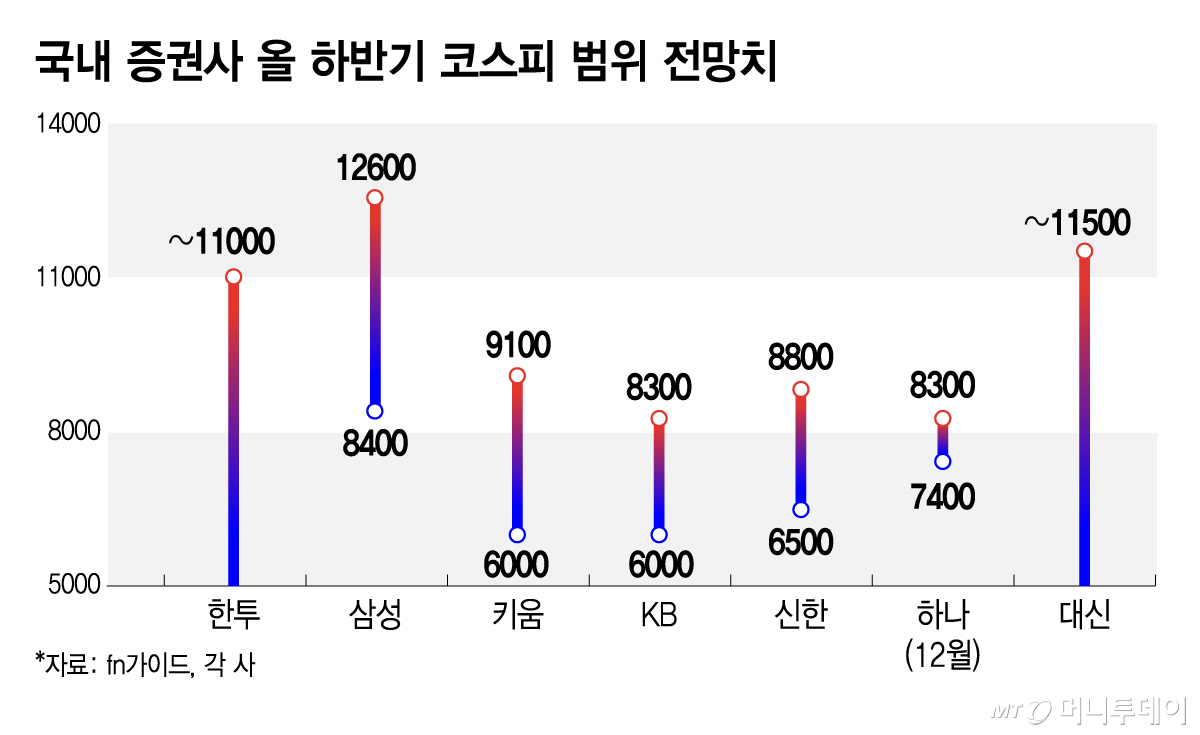
Domestic securities firms have expressed optimism that KOSPI will recover to 8,000 this month and rise to 10,000 by year-end. In particular, with demand for AI semiconductors and the resulting stability in profits coming to the fore, it is forecast that semiconductor-led stocks will rise despite variables such as U.S. interest rates and midterm elections.
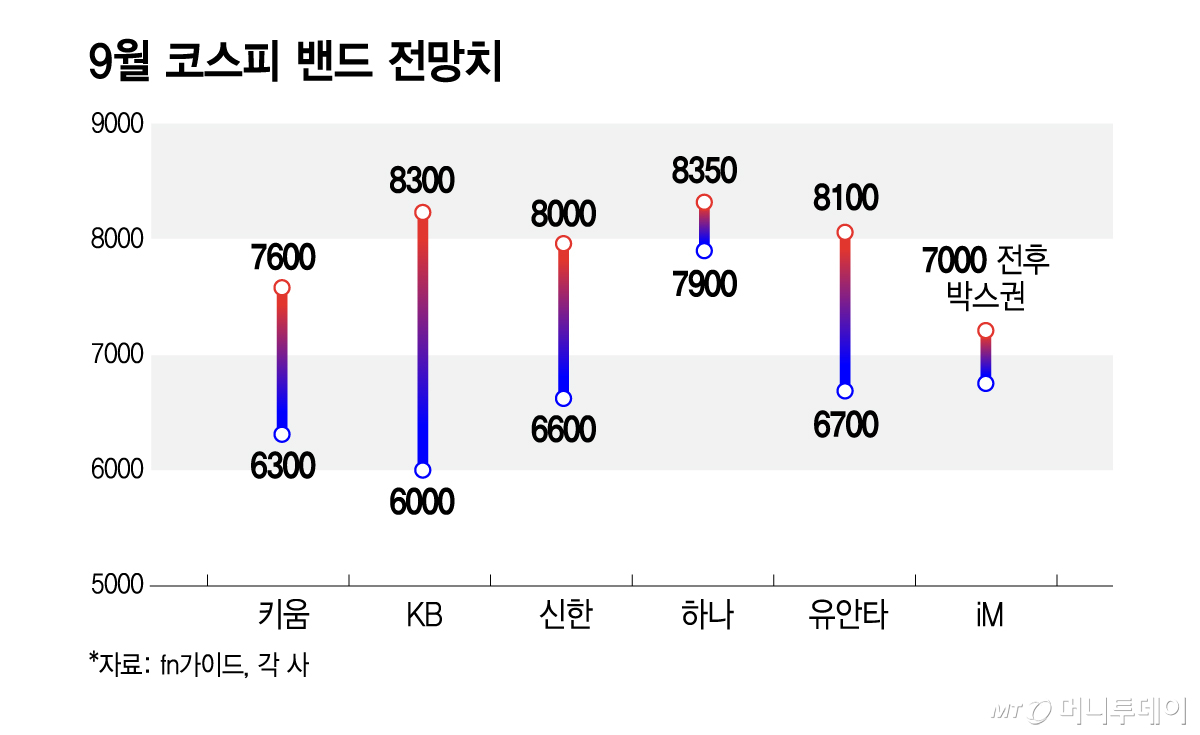
According to the financial investment industry on the 8th, domestic securities firms including KB Securities, Shinhan Investment Corp., Hana Financial Group, and Yuanta Securities have set the upper limit of KOSPI this month at above 8,000, emphasizing a rebound rather than maintaining a trading range. In a report released on the 31st last month, KB Securities stated, "While fiscal concerns and high interest rates are undoubtedly difficult problems to resolve, there is no need to view the market solely pessimistically at this moment." It further added, "Investors should also prepare to increase their stock allocation at any time in September."
Shinhan Investment Corp., which set the upper limit of KOSPI this month at 8,000, forecasts that shareholder returns from Samsung Electronics and SK Hynix will support the KOSPI index. Kim Do-gil, a researcher at Shinhan Investment Corp., noted in a September domestic stock market strategy report, "The total amount spent by Samsung Electronics and SK Hynix to repurchase their own shares from the 24th to the 28th last month amounted to 8.05 trillion won, equivalent to foreign investors' net selling of KOSPI." He analyzed that "as volatility and leverage ETF burdens ease, confirmed buying will fill the gap left by foreigners and establish a floor."
Other securities firms also anticipate a stepwise rise starting from the fourth quarter as major semiconductor stocks recover. Kim Yong-gu, a researcher at Yuanta Securities, stated, "KOSPI in September is expected to move within a neutral-to-positive range between 6,700 and 8,100 points," adding that it will gradually normalize along a stepwise upward trajectory in September and October.
Domestic securities firms are also projecting that KOSPI will exceed 10,000 by year-end based on the supply-demand dynamics of AI semiconductors, so-called "semiconductor supercycle." Among major securities firms, Korea Investment & Securities has set its upper limit at 11,000 points, while Samsung Securities has opened its ceiling to as high as 12,600 points.
The core rationale is that as semiconductor companies' profit stability increases, their market value will rise. Yang Il-woo, a researcher at Samsung Securities, said, "The market has assumed only low-level semiconductor price increases from the third quarter onward, and current market estimates are already sufficiently conservative." He forecasted, "Samsung Electronics and SK Hynix's 12-month estimated net profit sizes are 2.5 times and 1.9 times that of TSMC, respectively, which will act as valuation premium factors."
There is also a view that the market will continue in a trading range. Kim Jun-young, a researcher at iM Securities, stated in a report on the 1st, "With stagnation in semiconductor profit estimates, there is insufficient material to break through the upside, and the accumulated retail selling pressure above 7,500 points acts as a clear resistance line." He thus expected KOSPI to remain in a trading range around 7,000 points for the foreseeable future.
Securities firms' forecasts diverged regarding the impact of the U.S. midterm elections, a political event, on the domestic stock market. Kim Jae-seung, a researcher at Hyundai Motor Securities, noted, "With two major events—the listing of Anthropic in October and the U.S. midterm elections in November—concluding, investment sentiment in both domestic and global markets could recover rapidly after November." In contrast, Kim Dae-jun, a researcher at Korea Investment & Securities, pointed out in a June report that "as we move into the fourth quarter, investment sentiment may weaken due to uncertainty surrounding the U.S. midterm elections and supply-demand instability," adding that "momentum in existing leading sectors could also slow down during this period."

 in STOCK

