

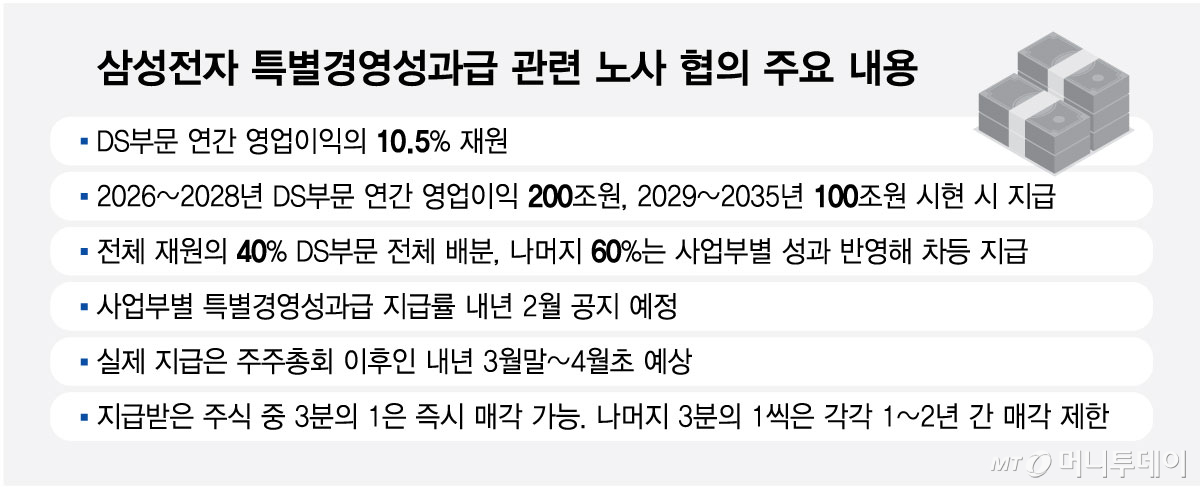
Samsung Electronics appears to have booked provisions approaching 30 trillion won through the third quarter this year to pay the 'Special Business Performance Bonus' for its DS (Device Solutions) division, which oversees semiconductor operations. This is a result of the bonus scale expanding as performance surged on the back of the memory semiconductor (hereinafter referred to as memory) 'super cycle.' The DS division is projected to far exceed the bonus payment benchmark of '200 trillion won in annual operating profit,' after accumulating 143 trillion won in operating profit in the first half alone and recording over 100 trillion won in operating profit in the third quarter.
According to industry sources on the 12th, Samsung Electronics labor and management previously agreed to pay a Special Business Performance Bonus funded by 10.5% of the DS division's operating profit. According to the detailed payment plan announced on the 7th, 40% of the total bonus fund will be distributed equally among DS division employees, while the remaining 60% will be paid differentially based on performance by business unit. Calculated based on the securities industry's forecast of 370 trillion won for the DS division's annual operating profit, the estimated Special Business Performance Bonus per employee with an annual salary in the low 80 million won range is approximately 750 million won for the memory business unit, approximately 530 million won for common organizations, and approximately 240 million won for foundry (semiconductor contract manufacturing) and system LSI.
The issue is that the bonus burden resulting from strong performance across the entire DS division also affects the profitability of individual business units. It is known that at a management briefing for employees in June, the foundry business unit explained that the timing of its return to profitability could be delayed until 2028 due to the burden of bonus provisions. This is because the bonus fund is calculated based on the operating profit of the entire DS division, but the related costs are reflected as labor costs for each business unit.
Within Samsung Electronics, there are also observations that the foundry business unit has already improved its profitability to a level where it could return to profitability if bonus-related costs were excluded. Thus, independent of improvements in core business profitability, bonus provisions have become a variable determining the timing of an accounting-based return to profitability.

The hurdle of the shareholders' meeting remains. Under the Commercial Act amended in March this year, if a company pays its own shares (treasury stock) as compensation to employees, it must prepare a plan for holding and disposing of treasury stock containing relevant details and obtain approval at the shareholders' meeting. If Samsung Electronics' treasury stock payment proposal is rejected at the shareholders' meeting, labor and management will likely need to renegotiate the payment method. In this process, there is also a possibility that the union may demand cash payments. Choi Seung-ho, Ji Bu (Chairman) of the Samsung Group Early-Stage Labor Union Samsung Electronics, said in a phone interview with MoneyToday, "If it is rejected at the shareholders' meeting, we are considering demanding cash payments," adding, "However, I do not think the possibility of rejection is high."
Both inside and outside the industry place weight on the likelihood that the treasury stock payment proposal will pass the shareholders' meeting. The analysis is that if the proposal is rejected, the company's burden of cash outflow could increase, so shareholders have little reason to oppose treasury stock payments, which can be expected to raise corporate valuation through expanded investment. Jeong Heung-jun, Gyeong Yeong-hak-gwa (Prof.) at Seoul National University of Science and Technology, stated, "Since cash is a resource that can be used for technology development or M&A (mergers and acquisitions), treasury stock payment is more advantageous from the shareholders' perspective," adding, "The possibility of rejection at the shareholders' meeting is low."
Micron and SK Hynix Also Ponder Bonuses… Large-Scale Compensation Becomes 'New Normal'
The cost burden from large-scale bonus payments is spreading beyond Samsung Electronics to the entire memory semiconductor industry. At its earnings announcement conference call for the fourth quarter of fiscal year 2026 on the 30th of last month, Micron announced that "additional costs of approximately $1 billion (approximately 1.3353 trillion won) will be incurred next quarter for performance-based compensation," and stated that "(due to burdens such as performance bonuses), the first quarter of fiscal year 2027 will be the bottom for gross profit." The forecast for gross profit margin decreased from 87% in the fourth quarter of fiscal year 2026 to approximately 86.3% next quarter.
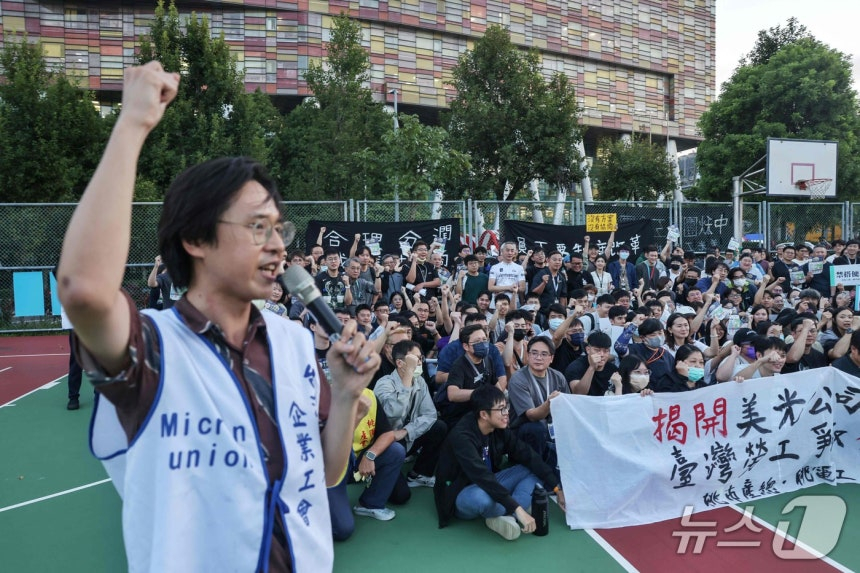
Internal backlash from employees is also continuing. The union at Micron's Taoyuan factory in Taiwan has launched collective action, demanding the establishment of a performance bonus system linked to operating profit, similar to Korean semiconductor companies like Samsung Electronics and SK Hynix. The union is demanding the introduction of a permanent system that allocates 15% of operating profit as an employee compensation fund. In a recent vote among members, 88.3% of all members voted in favor of a strike, securing the right to strike. The union plans to hold a large-scale rally in Taipei on the 19th (local time). However, whether and when an actual strike will begin has not yet been confirmed.
SK Hynix also adjusted its bonus payment method. SK Hynix labor and management agreed last month to pay 50% of the Profit Sharing (PS) in cash and the remaining 50% in treasury stock. While maintaining the existing standard of using 10% of operating profit as a bonus fund with no payment cap, they decided to pay part of the PS, which was previously paid entirely in cash, in treasury stock. SK Hynix is also expected to reflect bonus provisions worth several trillion won ahead of its earnings announcement at the end of this month.
An industry official pointed out, "As the profit scale of memory semiconductor companies grows, large-scale bonuses are becoming a de facto permanent cost factor," adding, "From the companies' perspective, they must consider the burden of expanding compensation costs just as much as the increase in profits."

 in INDUSTRY


