

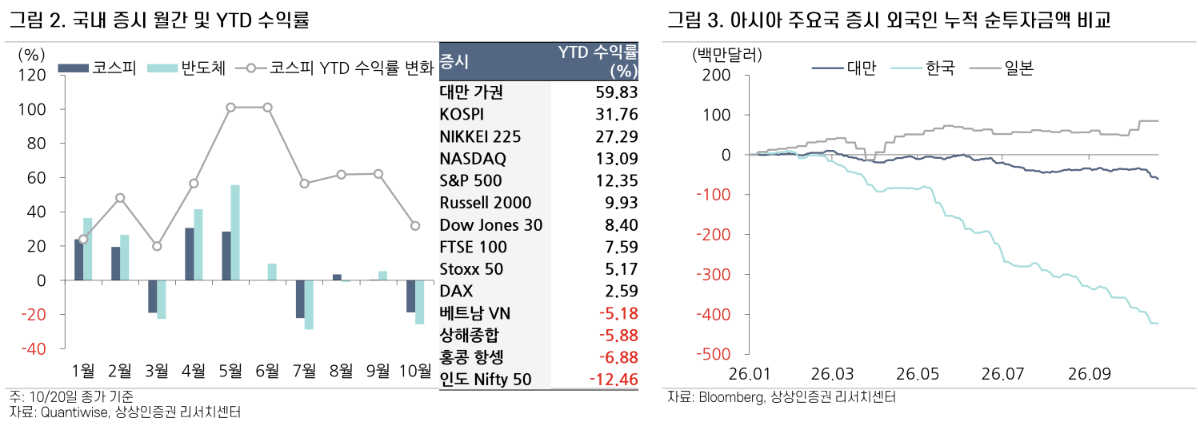
Although the two major domestic stock markets closed higher, they fell short of recovering last week’s losses, leaving investors frustrated. On the KOSPI, foreign and institutional investors made net purchases, while on the KOSDAQ, retail and institutional investors did the same. However, no capital inflows in the trillions of won occurred during regular trading hours. The securities industry advised investors to pay attention to improving sentiment among stocks related to semiconductor infrastructure investment.
On the 21st, the KOSPI closed at 5,735.66, up 182.92 points (3.29%) from the previous trading day. The index opened at 5,653.99, up 113.60 points (2.05%), and continued its upward trend. At 10:51:56 a.m., a buy-side sidecar (futures market circuit breaker) was triggered. This marks the 25th time a buy-side sidecar has been activated on the KOSPI this year.
On the day, rebound buying flowed in following the index’s drop to its lowest level in six months the previous day, resulting in significant intraday volatility. In particular, the semiconductor sector showed a clear upward trend. According to the Korea Exchange, Samsung Electronics (5.67%), SK Hynix (5.81%), Tes (2.39%), and Comico (11.16%) all closed regular trading higher.
However, the KOSPI has yet to recover after plunging on record selling last week. The debt burden from AI (artificial intelligence) investment has acted as a headwind for the domestic semiconductor sector, preventing related stocks from making up for last week’s decline.
The securities industry views the current market as undervalued, noting that AI profitability is being proven repeatedly. SpaceX announced on the 20th (local time) that it spent $19.6 billion (approximately 26 trillion won) on capital expenditures in the third quarter. This represents an 185% increase from a year earlier. The company plans to invest between $35 billion and $40 billion in the fourth quarter. Revenue from SpaceX’s SI (superintelligence) division increased by 830% compared to a year ago, surpassing its space and communications revenue. Driven by this, the company also succeeded in turning a profit.
Meta will release its earnings in the early hours of the 22nd (Korean time). In the previous quarter, Meta increased its capital expenditures, causing its FCF (free cash flow) to plummet by 91% compared to a year earlier. Experts expect that this earnings report will serve as a test of Meta’s profitability.
Senior Researcher Kang Jin-hyuk at Shinhan Investment Corp stated, “The growing market skepticism toward AI conversely means that the value of evidence to dispel such doubts has increased.” He added, “The AI value chain has responded positively, following SpaceX’s strong earnings and preliminary revenue surprises from companies such as Super Micro Computer (SMCI).”
Researcher Kang Hye-sung at Sangsangin Securities noted, “In the past, during periods of high interest rates and high oil prices, stock market returns were poor, but the market’s sensitivity to these factors has gradually decreased.” He added, “For a semiconductor-led rebound in the stock market, it is necessary for retail investors’ previously purchased positions to be absorbed, and for foreign investor sentiment to recover first.”

 in STOCK
