

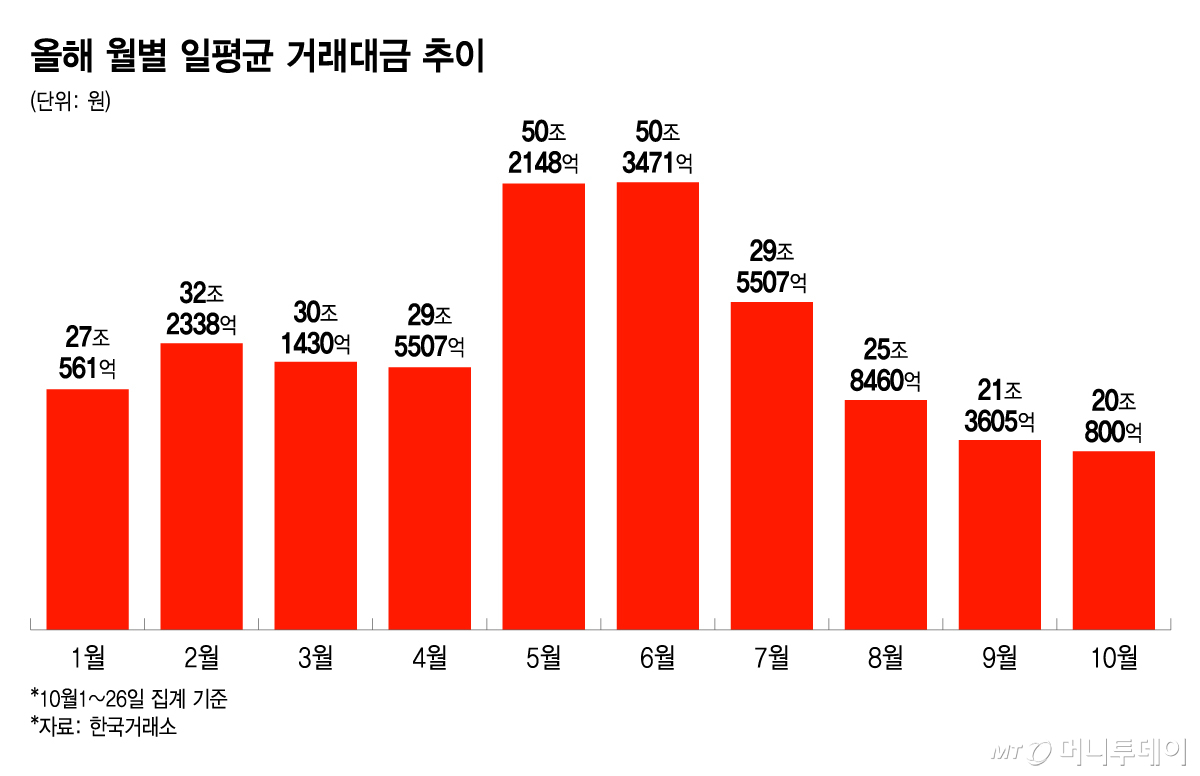
KOSPI trading volume and trading value have fallen to their lowest levels of the year, cooling the vitality of the domestic stock market. Analysts say investment sentiment has been dampened as funds of retail investors who bought stocks at peak prices are locked in due to the sharp drop in share prices, coupled with a growing sense of caution regarding artificial intelligence (AI) investments.
According to Korea Exchange, KOSPI market trading value on Monday was 12 trillion 10.8 billion won, the lowest of the year. It had consistently exceeded 20 trillion won since the beginning of the year but fell below that mark for the first time in mid-August. Trading volume was recorded at 190.46 million shares. This is the first time this year that trading volume has fallen below 200 million shares.
As investors adopted a wait-and-see stance ahead of major events, the KOSPI index retreated again, falling to its lowest level in seven months. On this day, the KOSPI index closed regular trading at 5,469.47, down 80.83 points (1.46%) from the previous trading day. A wave of selling by foreign investors continued. Foreigners sold approximately 700 billion won worth of shares. Institutional investors and retail investors made net purchases of 600 billion won and 64 billion won, respectively.
KOSPI trading value has been on a downward trend since July. This coincided with the implementation of regulations on single-stock leverage exchange-traded funds (ETFs). As barriers to entry for single-stock leverage ETFs, which had amplified trading volume and value through ultra-short-term trading, were raised, transactions decreased.
The monthly trend of daily average trading value shows a declining pattern: 50 trillion 347.1 billion won in June, 36 trillion 875.4 billion won in July, 25 trillion 846 billion won in August, 21 trillion 360.6 billion won in September, and 20 trillion 80 billion won in October.
A supply-demand mismatch is cited as a cause for the sharp drop in trading value. Investors whose funds are locked in at peak prices cannot sell or buy due to the plunge in stock prices. In June alone, retail investors made net purchases of 42 trillion won worth of shares in the KOSPI market. At that time, the KOSPI index moved between 7,400 and 9,100, which was at least about 1.3 times and at most 1.6 times the closing price on this day (5,649.47).
Caution regarding AI investments also fueled the contraction in trading. Heo Jae-hwan, Managing Director at Eugene Investment & Securities, explained, "Investors suffered significant losses as the share prices of Samsung Electronics and SK Hynix, which had seen active trading in the first half, plunged, leaving them unable to sell or buy anew." He added, "The cooling of AI enthusiasm due to concerns over profitability also directly impacted the decrease in trading value."
The decline in trading value is also a burden on brokerage revenues for securities firms. According to Hana Securities, the consolidated net income attributable to owners of the parent for five major securities firms (Kiwoom, Samsung, NH Investment & Securities, Korea Financial Holdings, and Mirae Asset) in the third quarter is projected at 1 trillion 100 billion won, a 44.9% decrease from the same period last year. This figure represents a sharp 76.6% drop from the previous quarter and falls below the market forecast of 1 trillion 500 billion won.
Go Yeon-su, a researcher at Hana Securities, said, "The slowdown in trading profits due to decreased trading value and rising interest rates will act as an earnings burden." He noted, "If domestic stock market trading value remains at current levels in the fourth quarter, there is a possibility of further profit declines." However, he predicted that "despite short-term earnings slowdown, dividend appeal will support the downside of share prices."
It is expected to take time for trading value to recover. Investors need to confirm the sustainability of AI investments through earnings announcements from major tech giants such as Microsoft, and the Federal Reserve System's (Federal Reserve) October Federal Open Market Committee (FOMC) meeting is also approaching. Concerns over high inflation and high interest rates remain due to rising international oil prices caused by the prolonged Middle East war.
Kim Dae-jun, a researcher at Korea Investment & Securities, said, "Sentiment to check domestic and foreign big tech earnings and various events during the week is strong, so the wait-and-see stance is highly likely to extend for the time being."

 in STOCK
