

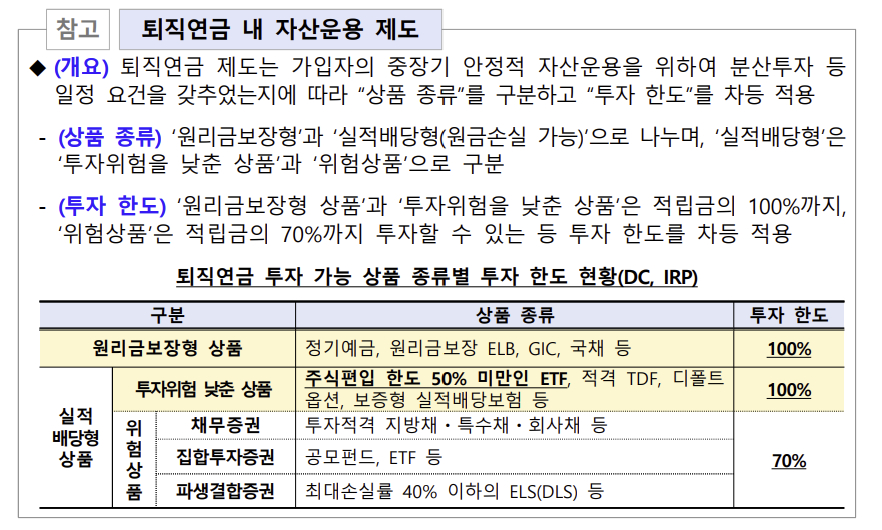
The Financial Supervisory Service warned consumers to always check the "risk rating," noting that many people mistakenly interpret an "investment limit of 100%" for Exchange-Traded Funds (ETFs) in retirement pensions as a guarantee of principal and interest.
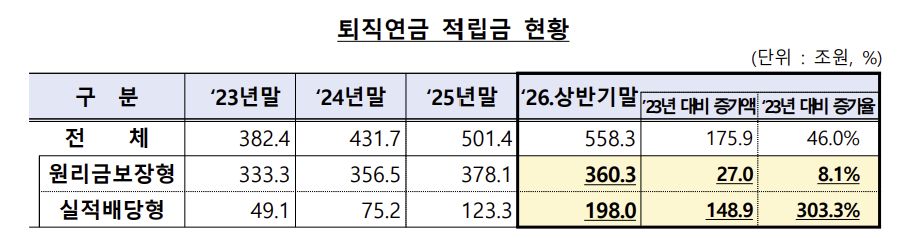
According to the FSS on Tuesday, retirement pension reserves stood at 558.3 trillion won as of the end of the first half of this year, with performance-linked products accounting for 198 trillion won. Performance-linked products increased by 14.89 trillion won (303.3%) from 123.3 trillion won at the end of last year. Principal and interest-guaranteed products totaled 360.3 trillion won; while this is a large absolute amount, the growth rate was much smaller at 8.1%.
In particular, ETF investment scale reached 99.8 trillion won, accounting for more than half (50.4%) of performance-linked products. This represents a surge of over 10 times compared to the end of 2023, indicating that performance-linked investments have grown primarily through ETFs.
The issue is that retirement pension operators, such as banks, securities firms, and insurance companies, often provide only the "investment limit" when explaining ETF products, making it difficult for consumers to immediately determine whether the principal is guaranteed. Although an investment limit of 100% does not guarantee the principal, many consumers have misunderstood "investment limit of 100%" as a principal-guaranteed type.
The FSS advised that the phrase "investment limit of 100%" does not imply product stability or a guarantee of principal and interest, and emphasized the necessity of checking the risk rating. A Financial Supervisory Service official explained, "An investment limit of 100% simply means that up to 100% (the full amount) of the reserves can be invested; it does not guarantee the principal or secure a fixed return." The official added, "Products allowing investment of up to 100% of reserves are distributed across various risk ratings, so making investment decisions based solely on investment limit information is risky."
Consumers can also verify information regarding potential profits and losses, as well as risk rating information, through product proposal documents. Additionally, it is advisable to regularly check the risk ratings of held products via the Reserve Operation Status Report and utilize this as a tool for portfolio management.
The regulator will improve the product guidance system starting next January to enable retirement pension subscribers to make investment decisions while considering product risks.
Product sellers must display both the investment limit and risk rating simultaneously so that consumers can easily check the risk level of a product at a glance. The format of the Reserve Operation Status Report will also be revised to require listing the risk ratings alongside the list of products held by subscribers.
Furthermore, the FSS plans to publish a retirement pension guidebook in November to support asset management for subscribers across different life cycle stages.

 in STOCK

