

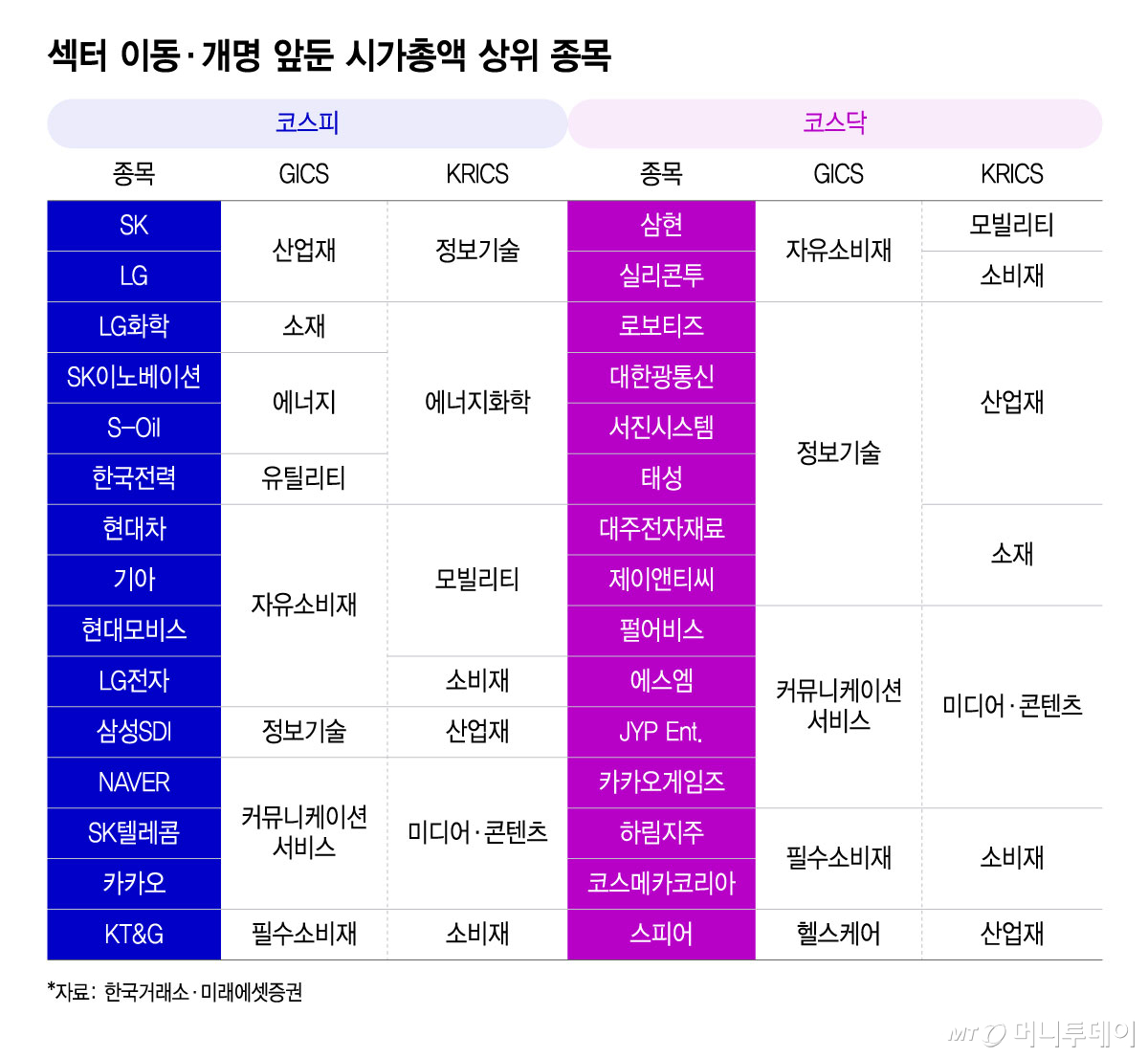
Semiconductors, biotechnology, and secondary batteries, which have been heating up the domestic stock market yet were difficult to spot at a glance in industry classifications, will finally receive their official labels. This is due to Korea Exchange's overhaul of its industry classification system. Beyond changes in sector names, the interplay between index constituent changes and ETF (Exchange-Traded Fund) rebalancing is expected to have a significant impact on passive fund flows in the year-end stock market.
According to the financial investment industry on the 28th, Korea Exchange will finalize its classification after completing the opinion-gathering process for KRICS (Korea Exchange Industry Classification Standard) by the end of this month. This is a follow-up measure following the public release of the four-tier classification results on the 26th, which consist of sectors (9), industry groups (24), industries (60), and sub-industries (129).
In KRICS, industries familiar to investors in the 2020s, such as semiconductors, batteries, biotechnology, shipbuilding and vessels, renewable energy, displays, game services, and cultural entertainment, have been subdivided into separate items. Mobility has been added to the top-level sectors, and it is notable that memory, system semiconductor design, and manufacturing (semiconductors) are clearly separated from solar equipment and component manufacturing (renewable energy) in the sub-industry definitions.
For some time, there have been continuous criticisms regarding the lack of intuitiveness in industry classifications in the domestic stock market. This is because GICS (Global Industry Classification Standard), which the exchange had been using, was jointly developed by Standard & Poor's (S&P) and Morgan Stanley Capital International (MSCI) in 1999 and primarily reflected the U.S. industrial structure. As fragmentation emerged in the domestic securities industry, with some applying FnGuide's WICS (WISE Industry Classification Standard) or developing independent systems, the exchange began developing a classification system starting with an external research commission in 2024.
Changes in industry classifications are drawing attention from market participants as they lead to revisions in index methodology, changes in index constituent stocks, and rebalancing of ETFs and index funds. The exchange has announced that it will apply KRICS before the regular change announcement for constituent stocks of the KOSPI 200 and KOSPI150 indices, which represent the stock market, scheduled for mid-to-late next month, signaling a revision to its index methodology. According to Mirae Asset Securities, the scale of assets tracking the KOSPI 200 index is estimated to reach 140 trillion to 160 trillion won when considering direct and indirect products, as well as index funds and pension funds.
The fact that large-cap stocks are largely included among the reclassification targets is also a factor to watch. SK and LG, which were grouped under Materials in the GICS system, will move to Information Technology as their IT subsidiaries' weight is reflected. Conversely, Samsung SDI, which belonged to Information Technology, is expected to shift to Materials based on its secondary battery weight. LG Chem and Hanwha Solutions, previously classified as Materials, and KEPCO and Korea Gas Corporation, previously Utilities, will be integrated into Energy Chemicals.
Discretionary consumer goods companies Hyundai Motor and Kia will move to the "Mobility" sector along with Korean Air, which is under Capital Goods. Some analysts have suggested that passive selling demand of 204.4 billion won could arise from Samsung SDI alone as it is removed from the KOSPI 200 Information Technology index, which tracks approximately 2.4 trillion won in sector indices, along with LG Electronics (Free Consumer Discretionary → Consumer Goods), while SK and Daedeok Electronics are newly included.
The effective date for the regular change of the KOSPI 200 has been announced as December 11, which is the day after futures and options expiration. The KOSPI 200 selects constituent stocks based on criteria such as cumulative market capitalization and trading value weight by industry group. It is also predicted that if large-cap stocks move, the inclusion or exclusion of mid-cap stocks could change in a chain reaction. The securities industry reports that 10 stocks, including Daedeok Electronics, Iljin Electric, and Doosan Fuel Cell, will be newly included, while 11 stocks will be excluded, with approximately 40 stocks expected to see changes when combined with the KOSPI150.
Im Gyun, a researcher at Samsung Securities, stated, "The change in sector weights is not significant," but added, "Large-scale replacement is expected in Energy Chemicals, where the number of included stocks has increased. As large-cap stocks move, new inclusion of mid-cap stocks in Capital Goods, Materials, and Consumer Goods will proceed. Most stocks expected to be excluded will also come from Energy Chemicals, Materials, and Capital Goods."

 in STOCK
