

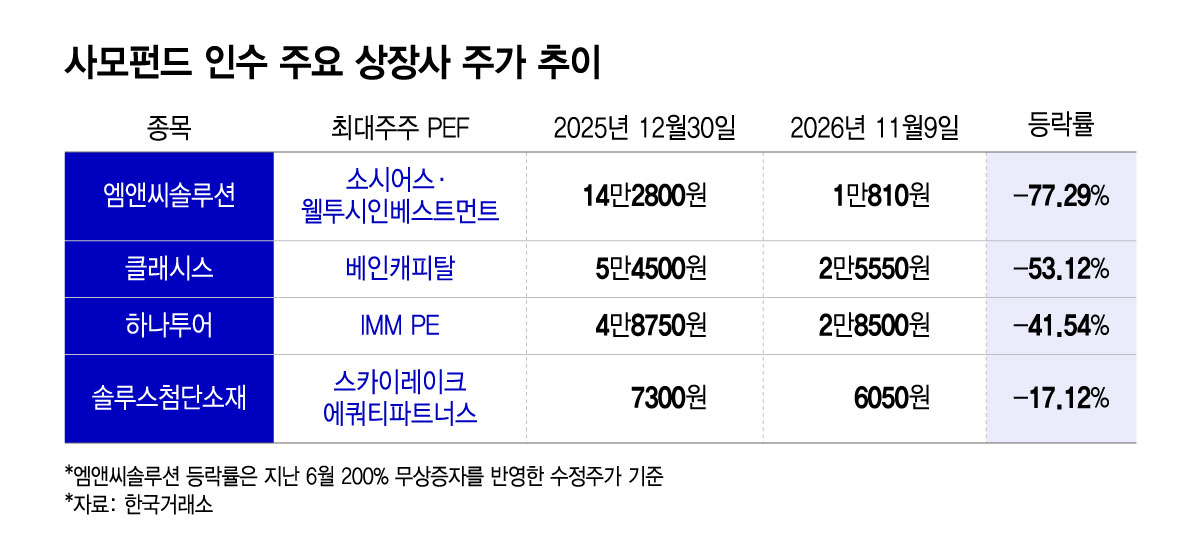
The share prices of listed companies with private equity funds (PEFs) as their largest shareholders have fallen by up to 77% this year, emerging as an unexpected obstacle to capital recovery.
Because a company's stock price serves as the benchmark for determining control transaction prices, sale negotiations are repeatedly falling through. PEFs that have delayed exits find it difficult to avoid pressure from limited partners (LPs), such as the National Pension Service, if fund returns deteriorate. Some PEFs are accelerating capital recovery through share sales and dividends.
Sale talks collapse amid sharp stock price drop…Valuation calculation becomes key issue

According to investment banking (IB) industry sources on the 9th, the share price of defense parts maker MNC Solution stood at 18,110 won on that day, down 77.29% from the start of the year after reflecting a 200% bonus issue in June.
The consortium of private equity firms Socius and Well2i Investment, which is the largest shareholder of MNC Solution, acquired Motrol, the predecessor to MNC Solution, from Doosan for approximately 453 billion won in 2021.
After acquiring control, the consortium sold Motrol's civilian division to Doosan Bobcat, securing 242.1 billion won, and recovered 78 billion won through the sale of existing shares during MNC Solution's listing process.
Adding approximately 70 billion won in dividends received from 2022 through early this year, total recoveries are estimated at 390.1 billion won.
Combining the amount already recovered with the value of remaining shares yields approximately 609.1 billion won, exceeding the initial acquisition price of 453 billion won. However, sale negotiations conducted with Korea Investment Partners in August collapsed as the exclusive negotiation period ended.
The IB industry views the valuation burden resulting from the stock price decline as a stumbling block for the deal. The current share price is 36.3% lower than on August 11 (16,960 won), when MNC Solution disclosed the end of its share sale negotiations.
An executive at a major PEF stated, "Unlike non-listed companies where financial statements such as EBITDA are central in control sales of listed firms, the stock price is the key variable," adding, "Even if a PEF has a desired valuation, it is difficult to close a sale if the stock price does not support it."
Stock price halved from initial acquisition price…Burden of reporting to LPs such as National Pension Service

The share price of travel agency Hana Tour fell 41.54% year-to-date, reaching 28,500 won on the 9th. IMM Private Equity (IMM PE) participated in Hana Tour's rights offering in 2020, purchasing shares at 55,500 won per share, and invested a total of approximately 146.4 billion won including its participation in the 2022 rights offering.
The share price on the 9th is 48.6% lower than the initial acquisition price. IMM PE began efforts to sell Hana Tour in 2024 but announced via a disclosure in May that it would not proceed with the sale.
At the time, Hana Tour stated, "The largest shareholder selected Citi Global Markets Securities as the selling advisor and considered various strategic options including share sales, but the contract with the advisor has now ended," adding, "We plan to continue reviewing various strategic options through consultations among shareholders."
According to Hana Tour's semi-annual report, the shareholding ratio of largest shareholder Harmony No. 1 Limited Company was 17.28% as of the end of June.
The sole investor in Harmony No. 1 is Harmony No. 2 Limited Company, and the sole investor in Harmony No. 2 is IMM PE's fourth blind pool fund (a fund that raises capital before determining investment targets), "IMM Rose Gold 4 Private Investment Limited Partnership." Since the National Pension Service is an LP in Rose Gold No. 4, the sale of Hana Tour is also tied to the recovery of national pension funds.
The share price of foil maker Solus Advanced Materials fell 17.12% year-to-date, reaching 6,050 won on the 9th. Sky Lake Equity Partners acquired control shares of Doosan Solus (now Solus Advanced Materials) from Doosan Group in 2020 at 43,152 won per share, for approximately 700 billion won. Reflecting a 100% bonus issue in 2024, the initial acquisition price was 21,576 won, and the closing price on the 9th was 72.0% lower than that.
Defending fund returns is key, even without exit plans
The share price of aesthetic medical device maker Classys, with Bain Capital as its largest shareholder, fell 53.12% year-to-date, reaching 25,550 won on the 9th. Bain Capital acquired 60.84% of Classys shares for approximately 670 billion won in 2022.
The acquisition price per share at the time was 17,000 won, and the share price on the 9th is 50.3% higher than the acquisition price despite this year's sharp drop. Bain Capital secured approximately 550 billion won by selling shares twice last year and this year. The market value of its remaining directly held shares is approximately 768.4 billion won.
Bain Capital also recovered funds through refinancing of acquisition loans and dividends. However, since it increased its stock-collateralized borrowings to 950 billion won in September last year, it appears that repayment of these borrowings will need to be considered during future sale processes.
The IB industry assesses that conditions for forming buyout (corporate acquisition) funds have worsened, as the National Pension Service, the country's largest institutional investor, halted new investments following last year's Homeplus incident, and major pension funds have shown a conservative trend regarding investments in project-type funds. Whether the stock prices of companies acquired by PEFs recover is expected to be a variable for capital recovery and the formation of next funds.
A source at a major PEF said, "Even PEFs without immediate exit plans cannot avoid the burden because a decline in the share price of an acquired company affects fund returns. If the exit timing is approaching, the stock price is a factor that strongly influences deals, regardless of financials."

 in STOCK


