


An analysis revealed that one in three adults in South Korea is obese. In particular, as obesity rates increased most significantly among those in their 20s for both men and women, the medical community is emphasizing the need for active management starting from childhood and adolescence.
Professor Yoon Young-sook of the Department of Family Medicine at Inje University Ilsan Paik Hospital stated during a regular back briefing by KDCA on the morning of the 9th, "The sharp rise in obesity rates among those in their 20s is not unrelated to the rapid increase in obesity rates among adolescents," adding, "Obesity prevention and management policies covering from childhood to adulthood are needed."
According to the analysis of domestic obesity behaviors released by the Korea Disease Control and Prevention Agency on this day, the adult obesity rate in South Korea last year was 35.4%, an increase of 7.5 percentage points (p) compared to 2016 (27.9%). Over the past decade (2016-2025), the relative change rates in obesity rates for men and women in their 20s were 43.4% (12.9%p) and 60.8% (6.2%), respectively, showing the largest increase among all age groups.
Professor Yoon noted, "Attention should be paid to the fact that obesity rates among young people in their 20s are increasing rapidly," pointing out, "The obesity issue in one's 20s does not suddenly begin at this stage; it is a problem continuing from the previous childhood and adolescent period." In fact, according to the Ministry of Education's 2025 sample statistics on health examinations for elementary, middle, and high school students, the proportion of students in the obese category (overweight + obese) last year was 29.7%, equivalent to 3 out of 10.
In particular, men showed the highest obesity rates in their 30s (52.1%) and 40s (53.1%). This is interpreted as a result of simultaneous factors contributing to weight gain, such as sleep deprivation due to long working hours and frequent after-work meals and drinking, given that this is the period of most active socioeconomic activity. Professor Yoon pointed out, "There are also research results showing a significant correlation between obesity onset and heavy drinking at least once a week or sleeping less than 7 hours," adding, "It is due to the interaction of complex factors such as occupational characteristics and dietary habits."
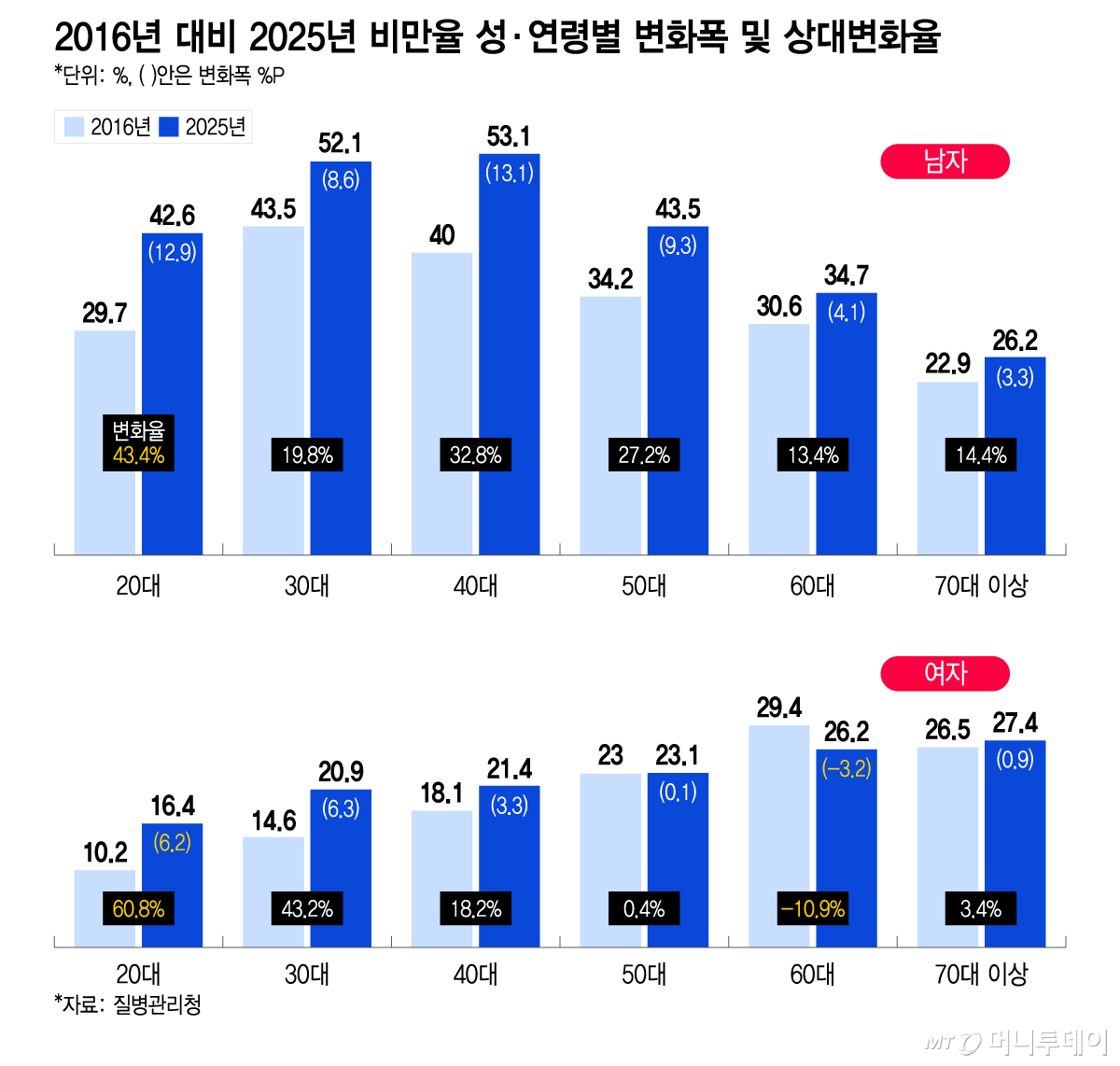
Conversely, female obesity rates increased with age, reaching their highest point among those aged 70 and above (27.4%). Professor Yoon stated, "In women, body shape changes due to hormonal changes occur as menopause progresses after the age of 50," adding, "While weight itself increases, an increase in abdominal obesity and visceral obesity is also a cause of rising female obesity rates."
Regional differences in obesity rates were also distinct. The metropolitan city/province with the highest obesity rate was Ulsan (38.2%), while the lowest was Sejong (29.4%). Compared to 2016, obesity rates increased in all metropolitan cities and provinces except Sejong. Regional obesity rates were influenced by monthly household income, exercise practice rates, and chronic disease diagnosis rates.
During the briefing on this day, Professor Yoon also emphasized the need for health insurance coverage for GLP-1 (glucagon-like peptide-1) drugs. This is because, although long-term management is important as obesity is associated with various complications, there are many cases where treatment is abandoned or discontinued due to high costs.
In fact, research results also show that weight and major metabolic indicators return to their original state when obesity treatment is discontinued. According to a meta-analysis by researchers at the University of Oxford in the UK on GLP-1 obesity treatment studies conducted on 9,341 people, it was predicted that weight reduced during medication would return to its original level within one year and seven months after discontinuation. Cardiovascular metabolic indicators such as glycated hemoglobin, cholesterol, and triglycerides, which had improved, were also found to revert to their original state within one year and four months after discontinuing medication.
Professor Yoon stated, "Since the improvement effect on chronic diseases accompanying obesity has been confirmed, health insurance coverage for GLP-1 treatment agents is needed even for the sake of patients," adding, "Policies for high-risk groups requiring treatment and those hesitating to undergo treatment due to high costs should be prioritized."
Kim Yu-mi, Section Chief of the Chronic Disease Management Division at the Korea Disease Control and Prevention Agency, stated, "The Korea Disease Control and Prevention Agency, Ministry of Health and Welfare, public health centers, and other related agencies and institutional investors are conducting activities for obesity prevention," adding, "The Korea Disease Control and Prevention Agency will continuously monitor health disparities between regions through annual community health surveys and utilize them in policy."

 in THEBIO

