

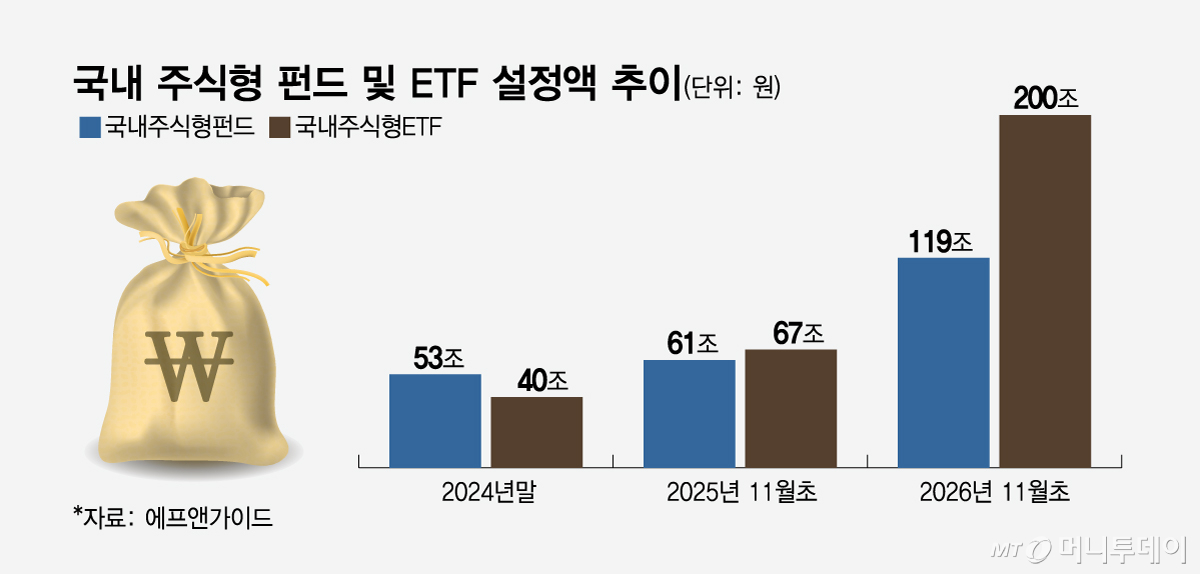
While domestic equity ETFs have grown fivefold in less than two years, public funds have expanded at a much slower pace.
Calls are growing to revive public funds to attract long-term investment and strengthen the stock market's foundation. Revitalizing public funds was also raised as a key task at a capital market meeting presided over by the president on Nov. 13.
According to financial information platform FnGuide on Tuesday, the size of domestic equity funds stood at approximately 119 trillion won, roughly doubling from about 61 trillion won during the same period last year in just one year.
The recent increase was significant compared with approximately 53 trillion won at the end of 2024.
However, growth in the domestic equity ETF market over the same period was even steeper. The size increased from about 40 trillion won at the end of 2024 to about 67 trillion won during the same period last year, and swelled to approximately 200 trillion won by early this month. This is five times the level at the end of 2024.
This is interpreted to mean that while demand for traditional publicly offered funds is recovering somewhat, the investment market is being restructured around ETFs. Investor capital is flowing into ETFs relatively quickly.
The concentration on ETFs is drawing attention because the two products have different investment methods. In a traditional equity-type publicly offered fund, investors entrust their capital to an asset management company, and its professionals diversify investments across multiple stocks. If investors hold their funds for a long period, the asset manager can secure a relatively stable investment base.
In contrast, ETFs can be traded in real time on the market like stocks. Investors can buy and sell quickly according to market conditions. Recently, products that focus on specific sectors or stocks, as well as leveraged ETFs, have also been introduced one after another.
While investors seeking to respond to short-term market trends have a wider range of options, concerns are emerging that this shift in investment structure is becoming a factor increasing stock market volatility.
If the role of long-term capital through traditional publicly offered funds weakens and funds with a short-term trading tendency increase, supply-and-demand changes in response to market conditions could accelerate.
For this reason, some in the capital market sector believe that while acknowledging the expansion of ETFs' share—whose strength lies in real-time trading—it is also necessary to consider how to broaden the foundation for inflows of long-term investment capital.
At the roundtable held at the Korea Exchange in Yeouido, Seoul, Kim Hak-gyun, head of the Research Center at Shin Young Securities, proposed revitalizing publicly offered funds, expanding long-term and systematic investment, and enhancing the functions of ISA (Individual Savings Account) as well as expanding education on long-term and systematic investment as institutional improvement tasks to expand long-term investment demand.
The core message is that an environment must be created in which investors can stay in the domestic stock market for a long period and achieve investment returns.
The financial investment industry suggests that policy support, such as tax benefits or reductions in sales commissions and fees for publicly offered funds, should also back efforts to revitalize equity-type publicly offered funds and guide investors toward long-term investment.
An official at a securities firm said, "Tax benefits or reductions in sales commissions for publicly offered funds are intended to lower investment costs for investors engaging in long-term investment through such funds, thereby increasing incentives for long-term investing."
The official added, "For the revitalization of publicly offered funds to lead to substantive improvement in stock market supply and demand, the task is not merely to increase fund size but to establish institutional incentives that allow investors to entrust their capital for long periods."

 in STOCK
