

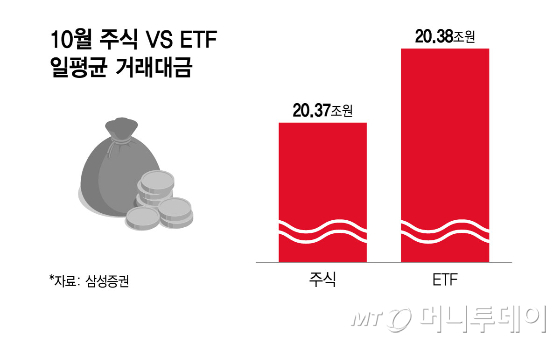
Last month, the daily average trading volume of exchange-traded funds (ETFs) in the domestic stock market surpassed that of individual stocks for the first time. This is interpreted as a sign that the influence of ETFs has expanded to that extent. Although stock trading volume has regained the lead since the start of this month, analysts say changes are emerging in the supply and demand structure of the domestic stock market as investment methods focused on indices and entire industries spread.
Daily average ETF trading volume exceeded stocks last October… Investment flows shifting from individual stocks to basket investing
According to data from Korea Exchange (KRX) and Samsung Securities released on the 19th, the daily average ETF trading volume in October was recorded at 20.38 trillion won, slightly exceeding the KOSPI's daily average trading volume of 20.37 trillion won. This marks the first time since domestic ETFs were first listed in 2002 that the monthly daily average trading volume of ETFs has surpassed that of the KOSPI.
As of the 18th of this month, the KOSPI's daily average trading volume based on Korea Exchange data was 18.88 trillion won, once again surpassing the ETF daily average trading volume of 17.91 trillion won. Nevertheless, interpretations are emerging that domestic investors' preference for ETFs has grown to the point where ETF trading volume is approaching that of the KOSPI.
Han Su-jin, a research analyst at Samsung Securities, said, "This appears to be the result of a shift from individual stock-centric investing to index- and theme-centric basket investing," adding, "The mechanical supply and demand resulting from ETF inclusion and weight adjustments could have a greater impact on the liquidity and price formation of individual stocks."
At the center of ETF growth is a change in the investment tendencies of retail investors. From the beginning of this year through the 18th, net purchases by financial investment firms among institutional investors reached 77.64 trillion won, more than double the total for last year (29.88 trillion won). Because ETFs are structured so that securities firms trade on behalf of individuals, net purchases by financial investment firms are considered to reflect the supply and demand of retail investors' ETF investments. Demand for investing in ETFs, which bundle multiple stocks into a single product, has increased.
Such changes could also affect the supply and demand structure of the domestic stock market. In the past, trading by investors who analyzed corporate performance and growth potential was a major factor moving individual stock prices, but as the ETF market grows, index inclusion status and ETF fund flows are becoming important variables as well.
The fact that ETF investing is not leading to an expansion of direct investment in listed companies is a variable… "Need to monitor supply and demand impact"
However, analysts say that as investment flows change, investors are facing situations where they must consider various new variables. In particular, it has been pointed out that if buying pressure concentrates on certain stocks included in ETFs, companies not included may be relatively neglected by investors.
There are also indications that the increase in ETF trading volume is not translating into a direct expansion of investment in domestic listed companies. Domestic ETF products include not only those investing in domestic stocks but also those investing in overseas stocks, bonds, and commodities.
In fact, as the domestic stock market recently undergoes correction, investments in overseas stock-type and bond-type ETFs are increasing. According to data from financial information platform FnGuide, the net assets of overseas stock-type ETFs, which were 110 trillion won in April, increased to 130 trillion won in early this month. During the same period, the net assets of domestic bond-type ETFs rose from 68 trillion won to 75 trillion won. In contrast, the net assets of domestic stock-type ETFs actually decreased slightly from 176 trillion won to the 174th trillion won range.
This is why it is difficult to interpret the growth of the ETF market solely as an expansion of the base of the entire domestic stock market. While the trend of expanding diversified investment through ETFs is positive, if investment funds concentrate on overseas assets or certain popular indices and themes, the spread of funds across all domestic listed companies will inevitably be limited.
An official in the securities industry said, "Since the single-stock leverage ETF incident that heated up the domestic stock market in the first half of the year, expanding the foundation for long-term investment, such as revitalizing public funds, has been mentioned as a major task in the capital markets recently to establish a stable growth foundation for the domestic stock market," adding, "While the growth of the ETF market is positive in broadening investor choice and spreading a culture of diversified investment, its impact on overall market supply and demand needs to be continuously monitored."

 in STOCK
