

The "era of $1 trillion in exports" is an achievement reached by adding the semiconductor supercycle to the results accumulated over the past several decades by Korean manufacturing. While it is clear that this was a great feat achieved through the combined efforts of the government, business leaders, and workers, there are also bright and dark sides. This is because the reality is deepening in which more than 40% of export value is concentrated in semiconductors, while nearly all industrial sectors are allowing China to catch up quantitatively and qualitatively.
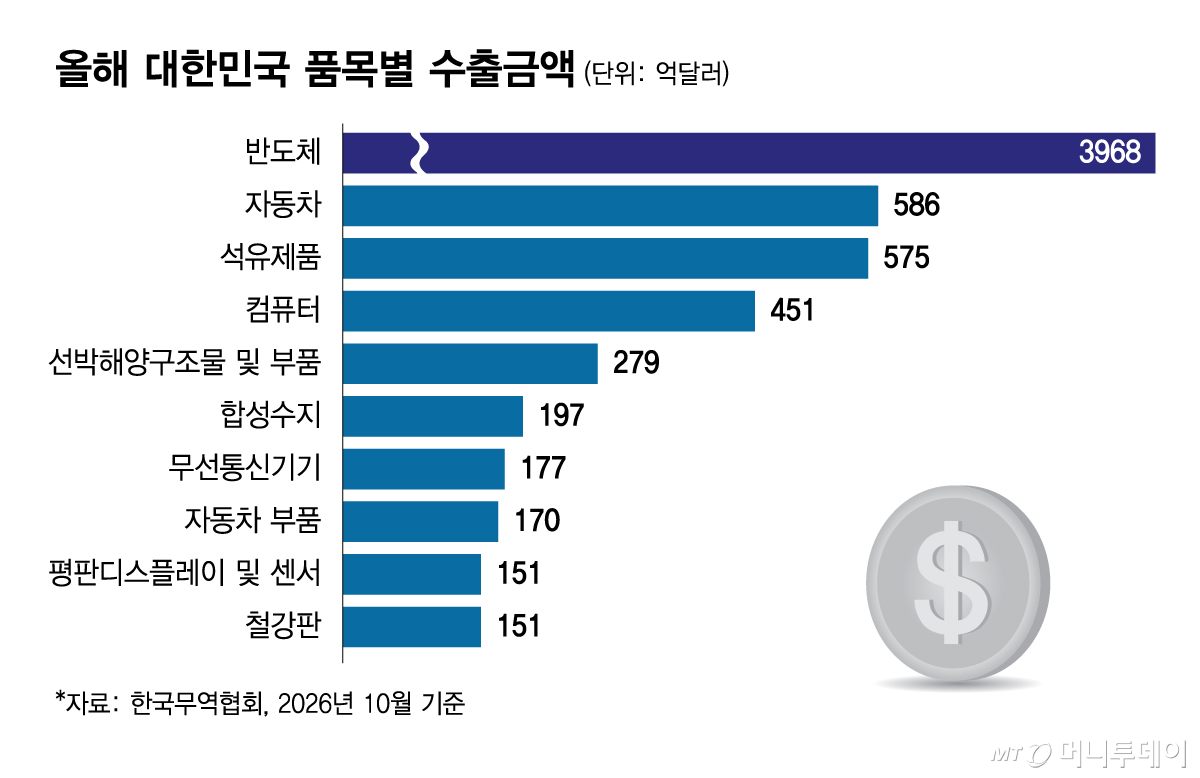
According to the Korea Trade-Investment Promotion Association on the 19th, South Korea's top export item as of last October was semiconductors ($396.8 billion). Following this were: automobiles ($58.6 billion), petroleum products ($57.5 billion), computers ($45.1 billion), ships and offshore structures and parts ($27.9 billion), synthetic resins ($19.7 billion), wireless communication devices ($17.7 billion), auto parts ($17.0 billion), flat panel displays and sensors ($15.1 billion), steel sheets ($15.1 billion), soap, toothpaste, and cosmetics ($12.5 billion), storage batteries and materials ($12.1 billion), gold, silver, and platinum ($11.1 billion), semiconductor manufacturing equipment ($10.5 billion), and pharmaceuticals ($10.0 billion).
The statistics show the reality that South Korea has risen to become a global leading country in all fields, from advanced industries to traditional manufacturing such as automobiles, shipbuilding, petrochemicals, and steel, as well as beauty and bio sectors. Based on this diverse industrial portfolio and competitiveness, it finally opened the era of $1 trillion in exports this month. This is the result of efforts that have continuously sought new sources of income from the infancy of manufacturing in the 1960s and 1970s until the arrival of the AI (artificial intelligence) revolution in the 2020s.
In particular, the increased dependence on semiconductors is noticeable. The share of total exports this year was 42.7%, a significant expansion compared to the previous year (24.4%). The cumulative semiconductor export amount through last October was $173.4 billion, but this year added another $223.4 billion on top of that. This is due to memory semiconductors produced centered on Samsung Electronics and SK hynix selling briskly as the AI era fully blossomed. In fact, the cumulative operating profit of these two companies was 254 trillion won and 181 trillion won as of last quarter, surging by 980% and 547%, respectively, compared to the previous year.
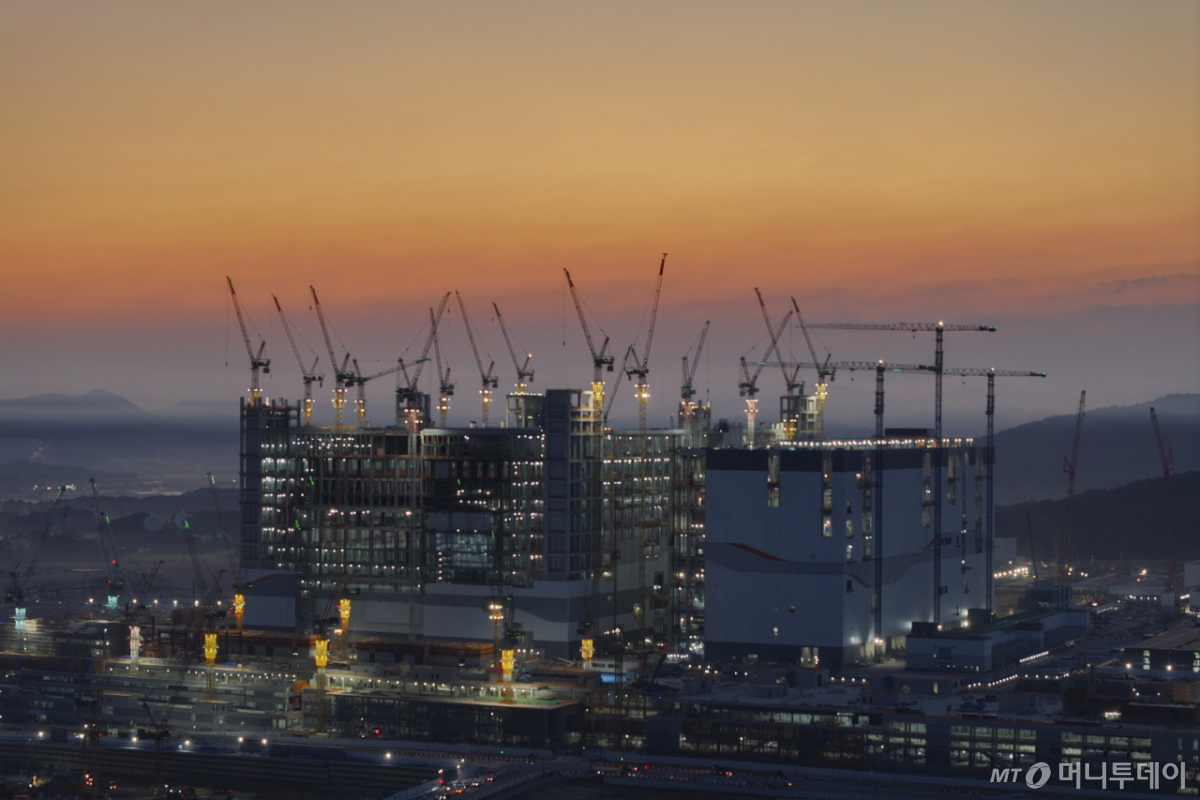
The semiconductor rally is expected to continue for the time being. In the Export Business Survey Index (EBSI) for Q4 this year compiled by the Korea Trade-Investment Promotion Association, semiconductors recorded 140.7, appearing as the item with the highest expectation of export improvement for the sixth consecutive quarter. The EBSI is an indicator that surveys and analyzes domestic exporters' outlook on the export economy. It has a value greater than 100 if it is expected to improve compared to the previous quarter, based on a baseline of 100.
The sprint of "Made in Korea" semiconductors is welcome, but the excessively high export dependence is a burden. In this year's exports as well, manufacturing industries such as automobiles (-1.8%), auto parts (-4.1%), and steel sheets (-3.6%) are showing negative growth. In the EBSI index, petroleum products (99.5), automobiles and auto parts (93.9), chemical industry (92.5), steel and non-ferrous metal products (87.7), and daily necessities (79.0) fell below the baseline (100). This is why concerns are emerging that the diverse industrial portfolio, one of the driving forces behind the era of $1 trillion in exports, could be shaken.
China's rise lies in the background. In the case of national key industries such as petrochemicals and steel, they have been struggling through a lean period for several years caught up in China's "low-price mass production" strategy, and even face a situation where restructuring is unavoidable. In fields such as automobiles, batteries, and shipbuilding, China has technically caught up to a considerable extent. If semiconductors also allow technical pursuit by China, the status of South Korea as an export powerhouse could be shaken from the ground up.
A business official said, "What is as important as achieving the era of $1 trillion in exports is maintaining it," and suggested, "In the midst of the rise of Chinese manufacturing, national consideration is needed on what companies and workers must do to keep pace with the AI era." A Korea Trade-Investment Promotion Association official emphasized, "We must build a virtuous cycle structure where profits during boom periods are connected to future competitiveness such as R&D (research and development), talent, industry, and infrastructure."

 in INDUSTRY


