

Analysts say the securities market stabilization fund (SMSF), revived by the government for the first time in 18 years, may not be enough to stem foreign investors' selling spree.
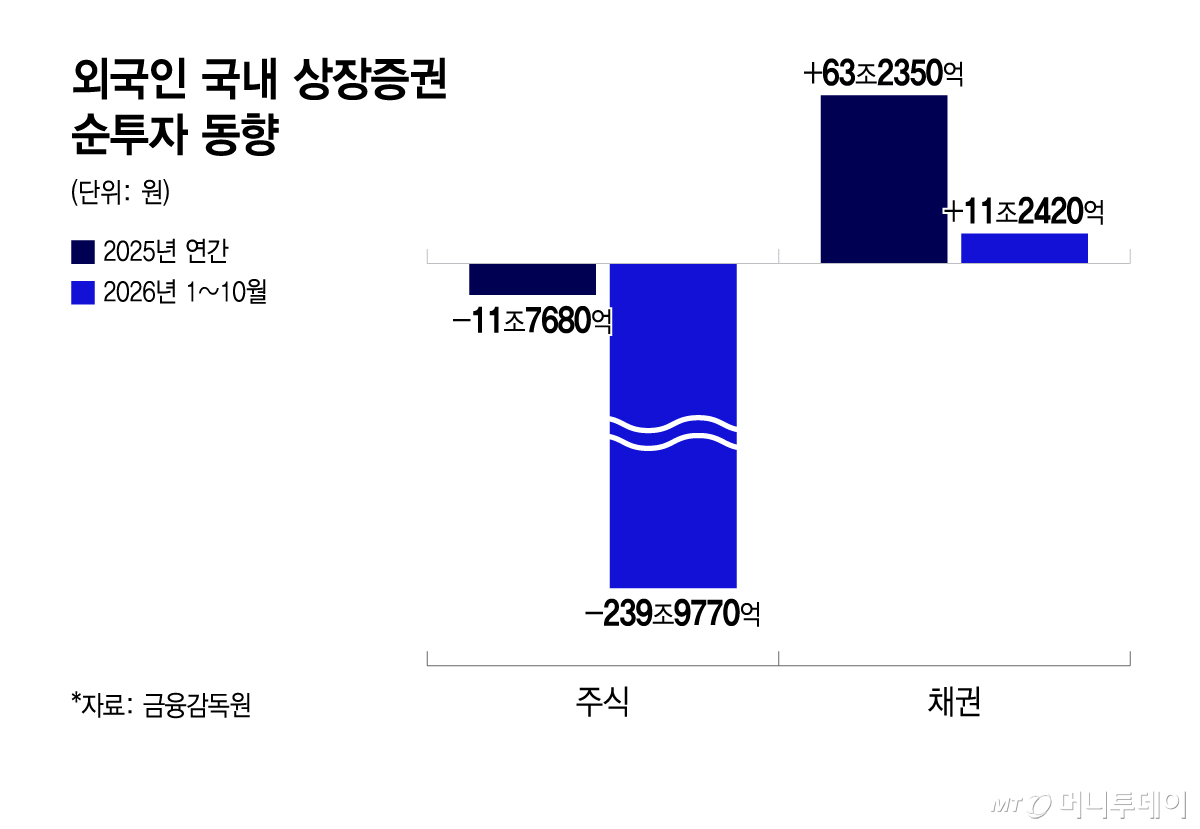
Foreign investors' net sales of South Korean stocks this year, estimated at 240 trillion won, are about 22 times the fund's committed size of 11 trillion won, underscoring the scale of the selling pressure.
Brokerages say foreign capital is unlikely to return until uncertainties surrounding U.S. interest rates and AI investment are fundamentally resolved.
Finance Minister Lee Hyoung-il said Monday that the government has begun preparations to activate the SMSF in response to stock market volatility, saying, "In addition to the fund, there are contingency plans already in place."
The market stabilization fund is a fund established by financial institutions such as securities firms and banks, along with related agencies, to stabilize the securities market during periods of sharp price declines.
Previously, in 2020, when the stock market crash worsened due to the COVID-19 crisis, financial institutions and securities-related agencies agreed to contribute 10.76 trillion won according to the SMSF formation plan. If the SMSF is actually activated, it will be the first time since the global Financial Services Commission era in 2008, marking an 18-year gap.
However, the SMSF's committed amount of 10.76 trillion won accounts for only 0.28% of the KOSPI listed market capitalization (386.03515 trillion won) on the 23rd. It is a similar scale to the amount foreigners net sold in the KOSPI over the five days from the 2nd to the 6th of this month. With foreign selling continuing, even if the entire SMSF were deployed now, it would only be enough to absorb five days' worth of foreign selling volume.
According to the Financial Supervisory Service, foreigners net sold 239.977 trillion won in domestic listed stocks from January to October this year. August was the only month in which foreigners made net purchases.
As of the end of October, foreigners' holdings of domestic listed stocks stood at 189.9 trillion won, a decrease of 17.3% over one month. Foreigners continued net selling in the KOSPI market for seven consecutive trading days from the 13th to that day.

Foreign selling was concentrated in large semiconductor stocks. From the beginning of this year until the 17th, SK hynix and Samsung Electronics accounted for 85.5% of foreigners' net selling in the KOSPI.
The securities industry cites high interest rates, concerns that the semiconductor cycle has peaked, AI bubble controversies, and a strong dollar as background factors for foreign outflows.
A researcher at a major securities firm said, "The absolute volume is not enough to significantly impact the market, but the announcement of preparations can serve as a psychological defense."
He added, "Ultimately, for foreign investors to return in a meaningful way, doubts regarding AI circular financing, which is the cause of the decline in U.S. tech stocks, must be resolved." Another official at a securities firm said regarding the SMSF, "It seems we need to watch the situation due to AI issues, but it can be understood as demonstrating minimal will."
Hwang Su-uk, a researcher at Meritz Securities, stated, "In both Korea and the U.S., AI infrastructure stocks are leading stocks, and it is true that related stocks' valuations have dropped significantly compared to earnings forecasts."
However, he analyzed that in a situation where trust in earnings forecasts has been damaged, it is difficult to time purchases based solely on whether stocks are undervalued. Researcher Hwang explained that market concerns will ease only if AI companies prove they can secure profitability sufficient to offset massive investment costs, or if their investment plans are lowered to a realistic level of funding.
Kim Jae-seung, a researcher at Hyundai Motor Securities, said, "I judge the point when the FOMC (Federal Open Market Committee) on December 9 and the rebalancing related to major index inclusion in mid-to-late December are completed as an important turning point for easing foreign selling pressure."
The securities industry is also watching whether Samsung Electronics' share buyback next year will improve foreign investor sentiment.
Researcher Kim said, "If Samsung Electronics' share buyback after February next year is implemented at a daily average of 50 billion won, similar to the purchase scale from August to October last year, it could partially alleviate concerns about supply-demand gaps in the domestic stock market."
Minister Lee explained regarding the actual activation scale of the SMSF, "Matters related to the scale will be reviewed while observing the situation as it unfolds."

 in STOCK

