

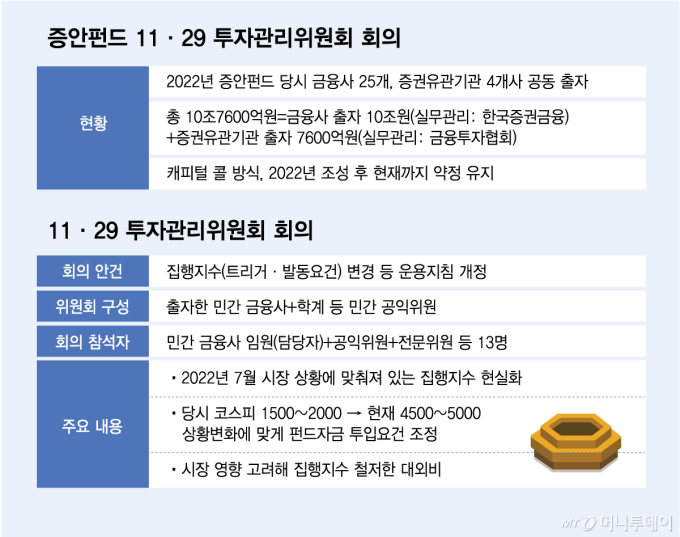
Observations suggest that the size of the Securities Market Stabilization Fund (hereinafter, the fund) could expand from its current 10.76 trillion won to the 20th-trillion-won range. As the five major financial groups (KB Kookmin, Shinhan, Hana, Woori, and NH Nonghyup) consider increasing their committed capital contributions by up to 2 trillion won per group, President Lee Jae-myung also stated on the 29th, “Volatility is abnormally high, so we must try everything we can.” An emergency market situation review meeting scheduled for the morning of the 30th, chaired by Financial Services Commission Chairman Lee Eui-won and attended by the chairs of the five major financial holding companies and the Korea Development Bank, is expected to be a turning point for the stock market.
According to financial industry sources on the day, the review of increased contributions by the five major financial groups follows inquiries from the Korea Development Bank to participating financial institutions regarding their capacity for additional capital contributions. A financial industry official said, “I understand that specific figures will be guided by the financial authorities,” while adding, “We internally anticipate an increase of about two times.”
In a Q&A session held on the 29th while climbing Bukak Mountain near Cheong Wa Dae with press corps members, President Lee stated, “Improving the market’s fundamental structure is important,” and noted, “It is questionable whether it can produce substantive results compared to the overall size of the market.” However, he added, “Psychologically, it may help in the short term,” and said, “Experts will review what level is appropriate.” Consequently, interpretations are emerging that momentum is building for expanding the fund’s size.
The Fund Investment Management Committee held a meeting at 5 p.m. on the day to revise its operational guidelines. This marks the first change to the execution index in approximately four years. It comes one week after the F4 meeting, where four heads of economic and financial authorities gathered, mentioned preparations for the immediate activation of the fund. Under current operational guidelines, the execution index was set at the KOSPI 1,500–2,000 range, calibrated to market conditions in the second half of 2022, making actual execution virtually impossible. With the change in the execution index, the conditions are now in place to immediately inject fund capital when the KOSPI plunges. The execution index is managed strictly confidentially, as disclosing it to the market could diminish its policy effectiveness.
The financial authorities are also reviewing the funding plans of financial institutions that have committed to contributions. The fund operates on a capital call basis, where financial institutions contribute amounts equal to their commitments when specific conditions are met. At the meeting on the 30th, the rapid execution of existing commitments and the scale of additional contributions will be key discussion topics. It is known that financial holding companies are expected to request a reduction in the risk weight applied to contributed capital to mitigate the capital burden associated with additional contributions.
The total commitment for the fund made by financial institutions and securities-related agencies during the 2020 COVID-19 crisis was 10.76 trillion won. KB Kookmin, Shinhan, Hana, and Woori Bank each committed 1 trillion won, while NH Nonghyup Financial affiliates committed 700 billion won. If increased to 2 trillion won per group, the share of the five major financial groups would rise from 4.7 trillion won to 10 trillion won, bringing the total size to 16.06 trillion won. If the Korea Development Bank, securities firms, and insurance companies commit an additional 4 trillion won or so, the total will reach the 20th-trillion-won range.
The domestic stock market is closely watching whether the authorities can deliver messages commensurate with expectations in a timely manner. This is because expectations for the fund’s activation have already been reflected in stock prices. On the 27th, just before the weekend, the KOSPI index surged by 204.47 points (4.34%) and the KOSDAQ index rose by 53.28 points (8.13%) compared to the previous day. If the fund actually proceeds with stock purchases, it will be the first time in 18 years since the global Financial Services Commission crisis in 2008. Although the activation of the fund was promoted during the 2020 COVID-19 crisis and the 2022 Legoland incident, it did not lead to actual stock purchases on either occasion.
The KOSPI market capitalization, which was 998 trillion won on March 23, the day before the fund was established in 2020, has more than quadrupled to 4,030 trillion won as of the 27th. Given that the size of the stock market has expanded rapidly since last year, centered on semiconductor stocks, the consensus among securities firms is that the core effect lies not in directly lifting the index with fund capital alone, but in stabilizing sentiment by declaring a firm response.
Jung Da-un, a researcher at LS Securities, stated, “Even if the fund increases to a maximum of 20 trillion won, it represents only 0.46% of the stock market’s total market capitalization and is not a direct driver for lifting the index.” However, he added, “It is highly likely to function as a psychological safety net to prevent panic selling, coinciding with the period when supply and demand for dividend reinvestment flows in, starting with Samsung Electronics’ quarterly dividend payment around year-end.”
The banking sector, a major contributor, is in a difficult position. It must meet its BIS (Bank for International Settlements) capital adequacy ratio ahead of year-end accounting settlements, while also considering funding needs in the range of 1 to 2 trillion won and the possibility of additional contributions. The Korea Development Bank also has precedent from when it secured capital through a supplementary budget after its BIS ratio declined during the establishment of the fund in 2020.
Although the stock market has plunged in the short term, it is at a level twice as high as two years ago on a long-term basis. Consequently, concerns about losses from further declines are significant amid the emergence of major variables related to AI (artificial intelligence) stocks. The stock market has partially reflected these concerns, with bank stock prices falling.
Choi Jung-uk, a researcher at Hana Securities, stated, “If the fund is actually deployed in the stock market, gains and losses from stock price fluctuations will be reflected in the quarterly consolidated earnings of financial groups, likely increasing earnings volatility.” He added, “A risk-weighted asset (RWA) ratio of 40% is applied merely based on the commitment, but if actually used, it rises to 100%. If the committed amount doubles, RWA will increase further due to the additional commitment alone.”
Observations also suggest that if banks reduce bond purchases to secure contribution capacity, and if the stock market rises, weakening the recently growing preference for safe assets, the impact could spill over into the bond market. Lim Jae-gyun, a researcher at KB Securities, stated, “Depending on the scale of additional contributions to the fund, banks will purchase bonds more conservatively to manage their Common Equity Tier 1 (CET1) capital ratio.”
Suggestions are also emerging that, rather than mechanically purchasing representative indices such as KOSPI 200, the proportion of purchases for stocks included in the value-up program index should be increased. Park Se-yeon, a researcher at Hanwha Investment & Securities, said, “If policy funds purchase companies engaged in dividends and share buybacks, it provides one more reason for those companies to increase shareholder returns.”

 in STOCK
