

[For more diverse corporate information on startups mentioned in this article, visit Unicorn Factory's big data platform 'Data Lab'.]
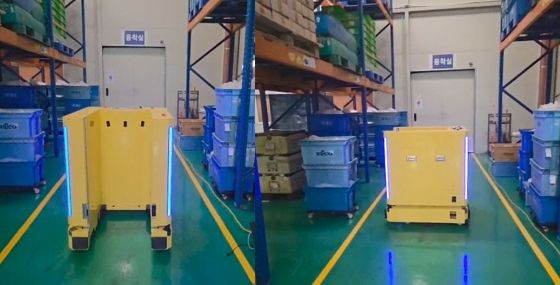
"The results of a three-month pilot test have been released. We expect this to become a key turning point for our expansion into Japan."
Recently, Choe Nak-eun, CEO of O Logistics, met at Signiel Busan in Haeundae-gu, Busan, and introduced 'Screener', a new type of logistics robot. He emphasized that "this model differs structurally from our first-generation robot" and described it as "a completely redesigned solution developed to address on-site challenges."
Screener is the result of a precise analysis of the characteristics of transport carts widely used in automotive parts manufacturing sites. The design overcomes the difficulty of transporting low-height carts with conventional forklifts by fundamentally rethinking the robot's structure. Its core innovation lies in adopting a side-opening mechanism that lifts and carries the cart as if cradling it.
This evolution builds upon the foundational concept of 'Fiverter', our first-generation autonomous articulated forklift robot deployed in small and medium-sized manufacturing sites, while incorporating direct feedback from field operations. Choi (CEO) stated, "The fact that transport carts with identical specifications are used across global supply chains—including by Japanese companies—supports Screener's scalability." He further noted, "Rising labor costs, stricter industrial safety regulations, and advancing robot technology maturity have simultaneously made unmanned forklift adoption not just an option but a necessity in Japanese manufacturing sites. This is the most appropriate timing for entry."

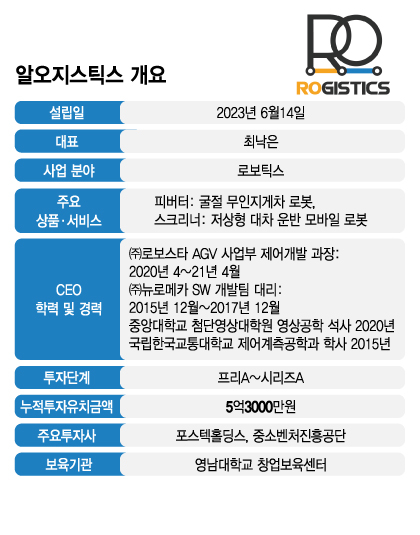
O Logistics has grown rapidly since its incorporation in June 2023, focusing on robotics and logistics automation as core pillars. The company first connected with MoneyToday startup media platform 'Unicorn Factory' in August 2024, following the completion of Fiverter development.
Conventional forklifts are designed with wide turning radii and assume straight-line movement, resulting in reduced efficiency in narrow aisles or complex structures. Fiverter overcomes these limitations by adopting a body structure capable of articulating up to 105 degrees left and right. This reduces the driving radius by approximately 50% compared to conventional models and enables autonomous operation even in narrow passages as narrow as 1.9 meters.
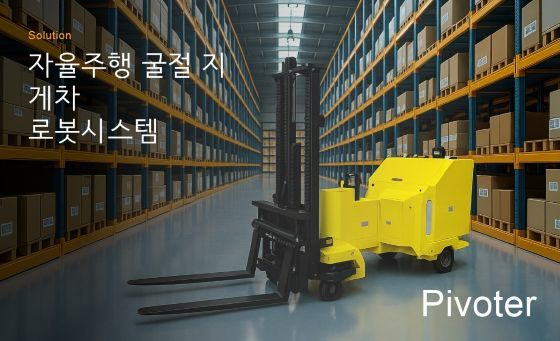
Another strength lies in its ability to accurately recognize pallets based on computer vision and AI (artificial intelligence). Choi (CEO) explained, "By implementing a side-entry pallet algorithm rather than front-facing approach, we enable stable loading and transport even in confined spaces. The system achieves autonomous operation in areas as small as approximately 15 pyeong."
Fiverter has conducted validation tests and open innovation collaborations with Hyundai Motor vendors such as Myeongsin—a small and medium-sized enterprise based in Gyeongsan—as well as POSCO and Samick THK. Choi (CEO) stated, "We went beyond simple pilot testing to verify applicability in actual production and logistics environments. Positive feedback from one partner has increased the likelihood of finalizing a formal contract around March."
An upgraded version of Fiverter is also scheduled for release this year. It can handle loads up to 1 ton (t) and supports stacking heights of up to 2 meters. He emphasized, "We will systematically secure technologies for high-load handling robots, outdoor autonomous driving, and global standard compliance."
Fiverter's technological competitiveness has been validated through external evaluations. In the Startup-Focused University Support Program, which typically allocates around 100 million won in subsidies, O Logistics secured the maximum amount of 200 million won after being recognized for its region-specific robotics capabilities. The company was also selected for the Korea Robot Industry Promotion Agency's service robot validation support program. Choi (CEO) remarked, "The Busan-Ulsan-Gyeongnam region is densely populated with small and medium-sized warehouses managed by long-established SMEs (small and medium-sized enterprises), which aligns precisely with O Logistics' technological direction."

Choi (CEO)'s goal for 2026, the Year of the Fire Horse (Bingwu Year), is 'expansion into Silicon Valley'. He noted, "During our market research in the U.S., we were impressed by a culture that prioritizes potential over existing references when forming collaborations." He added, "Large warehouse companies in logistics hub cities, including Memphis, Tennessee, have shown significant interest."
To establish a financial foundation for overseas expansion and workforce growth, O Logistics plans to begin Series A fundraising starting this March. Choi (CEO) stated, "We aim to grow beyond being merely a robot manufacturer into a 'physical AI company' serving the Busan-Ulsan-Gyeongnam region." He further declared, "From hardware and software customization tailored to customer environments to maintenance and remote software updates, we will develop an integrated logistics robot platform that sparks the 'K-robot' boom."
[MoneyToday startup media platform 'Unicorn Factory']

 in TECH


