

Just because a company purchases an AI service like ChatGPT or Claude does not mean its work will immediately become automated. It is first necessary to determine where internal documents are stored, what information the AI is permitted to access, and how it will connect with existing computer systems.
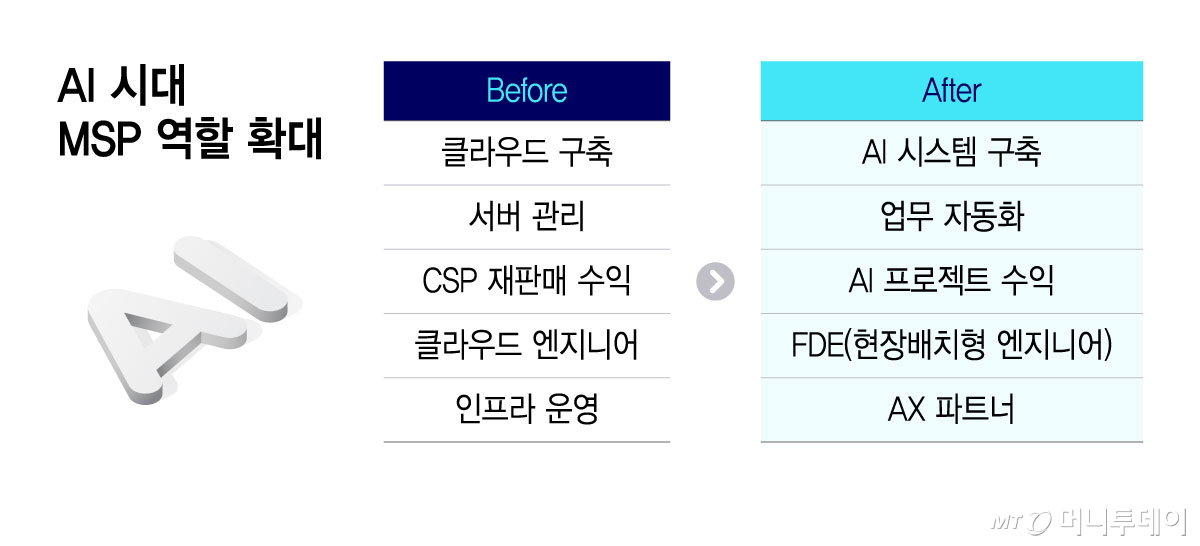
Cloud management service providers (MSPs) are stepping into this gap. MSPs that have previously selected cloud solutions for companies and managed servers on their behalf are now transforming into firms that send AI engineers directly to client sites to examine operations and co-develop tailored AI services.
This type of personnel is called FDE (Field Deployment Engineer). They are developers who sit alongside client employees and build until the AI actually functions. Amazon Web Services (AWS) announced last month that it will invest $1 billion in its FDE organization and deploy thousands of engineers directly to client sites.
The originator of the FDE model is Palantir, a U.S. data company. This firm has been deploying engineers to client sites for years, including institutional investors, and reported first-quarter revenue growth of 85% compared to the same period last year.
OpenAI established a dedicated "deployment company" in May with an initial investment of over $4 billion to handle corporate AI adoption. Anthropic also launched an independent company named "Odd" this month, specializing in corporate AI implementation, in partnership with Blackstone and Hellman & Friedman. A 2023 report by MIT's Project NANDA analyzed that 95% of pilot projects for enterprise generative AI failed to produce measurable profit-and-loss effects.
Similar changes are beginning domestically. Megazone Cloud is operating an FDE organization with a workforce of 150. LG CNS has partnered with Palantir to establish a dedicated FDE team. KT also runs a P-FDE specialized unit.
Bespin Global built a consultation-support AI for AIA Life Insurance. It refined document structures and search methods so that the AI could accurately locate approximately 1,000 manuals within a closed internal environment. At Korea Hydro & Nuclear Power, a dedicated AI was installed in an internal data center isolated from the external internet to read nuclear power plant procedures and past response cases. Functions were created for seven specific tasks including design changes, maintenance, and safety inspections, and document review time is reported to have decreased by about 90%.
Samsung SDS has gone beyond merely selling enterprise versions of ChatGPT; it has consolidated AI consulting, development and operations, cloud, and security personnel into a single team. The company describes this evolution as moving from being a "reseller" to becoming an "AX partner."
MSPs are venturing onto the front lines out of desperation. Their primary revenue source, cloud resale, yields only single-digit commission rates. As AWS restricts discount-sharing models and continues to alter compensation structures, even these margins are shrinking. Microsoft raised annual sales requirements for direct billing partners to $1 million and announced that starting in October, additional margins will be granted to partners who secure new customers and demonstrate AI adoption results.
MSPs that once managed clouds on behalf of companies are now transforming into "AI fabrication shops" tailored to each enterprise. An industry executive stated, "While anyone can access an AI model, it is difficult to possess the capability to connect it to company operations and make it actually work." This explains why AI engineers who enter client sites are emerging as a new growth driver for MSPs.

 in TECH
