

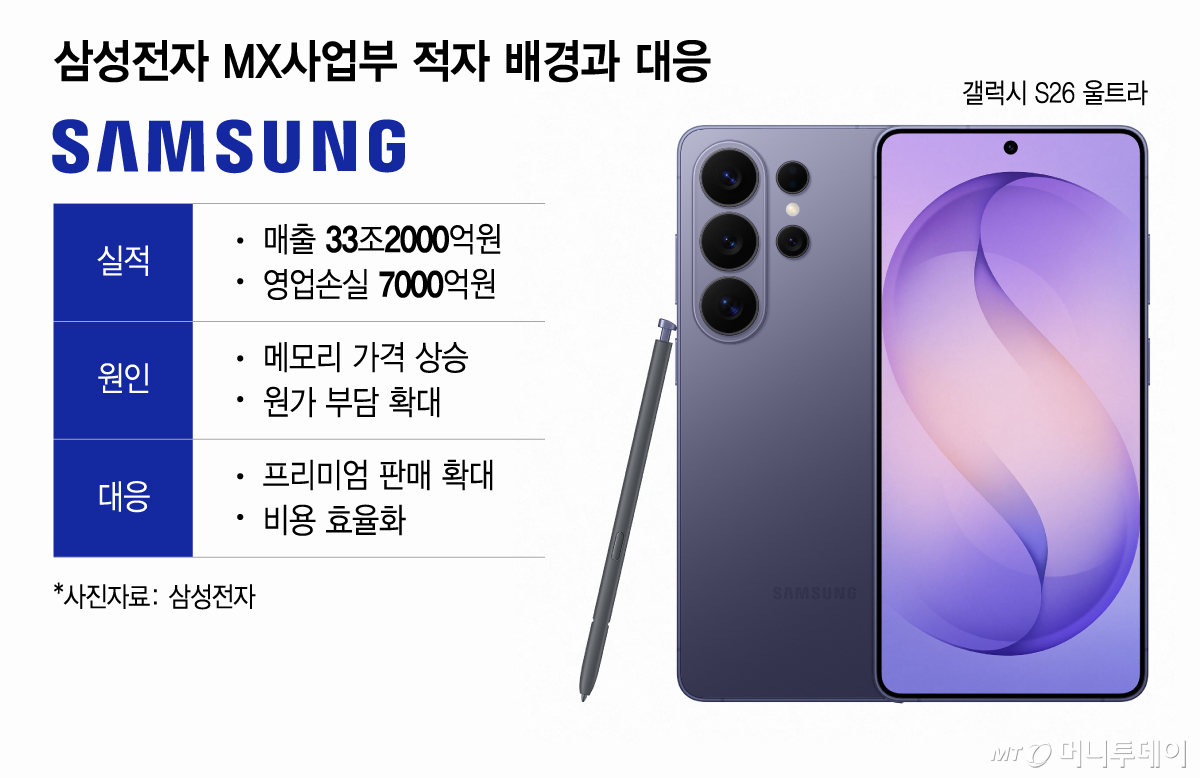
Samsung Electronics’ MX (Mobile Experience) and Network division, responsible for the smartphone business, recorded its first quarterly operating loss since its launch due to cost pressures from surging memory prices. With cost burdens expected to continue into the second half of the year, restoring profitability through cost efficiency has emerged as a key challenge.
According to Samsung Electronics’ Q2 results released on the 30th, the MX and Network division reported revenue of 33.2 trillion won and an operating loss of 700 billion won. Revenue increased by 13.7% compared to the same period last year (29.2 trillion won), but operating profit turned from a surplus of 3.1 trillion won in the same quarter last year and 2.8 trillion won in the previous quarter into a loss. This marks the first time the MX division has recorded a quarterly loss since its inception.
Samsung Electronics explained that expanded investments in AI servers have led to shortages in mobile memory supply and rising prices, increasing component cost burdens for smartphones. However, strong sales of the Galaxy S26 series and entry-level A series, along with an increase in ASP (average selling price), drove revenue growth. The company maintained its position as the global smartphone market leader even during Q2, typically a slow season when the impact of flagship launches tends to wane. Meanwhile, the network division also saw improved performance compared to both the same period last year and the previous quarter, bolstered by expansion into overseas markets.
Daniel Araujo, Executive Vice President of Samsung Electronics’ MX division, stated during the earnings announcement conference call: “Due to expanded investments in AI servers, shortages in mobile memory supply and rising prices continue.” He added, “Memory prices rose compared to the previous quarter even in Q2, worsening profitability. Cost burdens are expected to persist into the second half of the year.”
Samsung Electronics plans to restore profitability by expanding sales of premium products such as the Galaxy Z Fold8, Flip8, Galaxy Tab S12, and Galaxy Watch Ultra2 in the second half of the year, while strengthening upselling efforts for A series models like the A57 and A37. The company will also pursue cost reductions through efficiency improvements across purchasing, sales, and development operations.
Cost pressures are likely to persist for some time. Qualcomm recently announced that starting in September, it will raise prices for mobile APs (application processors) supplied to smartphone manufacturers by double digits, citing rising supply chain costs for memory and advanced packaging. With both memory and AP prices set to rise, cost burdens on smartphone manufacturers are expected to increase further.
Industry observers believe this environment will bolster Samsung Electronics’ strategy to expand Exynos adoption. The Galaxy S27 series is expected to add a “Pro” model to the existing Basic, Plus, and Ultra lineup. Samsung Electronics is reportedly considering applying its own Exynos 2700 processor not only to the Basic and Plus models but also to the newly introduced Pro model. A region-specific dual-strategy is likely, with Exynos deployed in Korea and Europe, while Qualcomm Snapdragon will be used in the U.S. The top-tier Ultra model is expected to retain Snapdragon. If memory and AP price increases continue, Exynos is anticipated to play an even larger role in Samsung Electronics’ cost-reduction strategy.

 in TECH
