

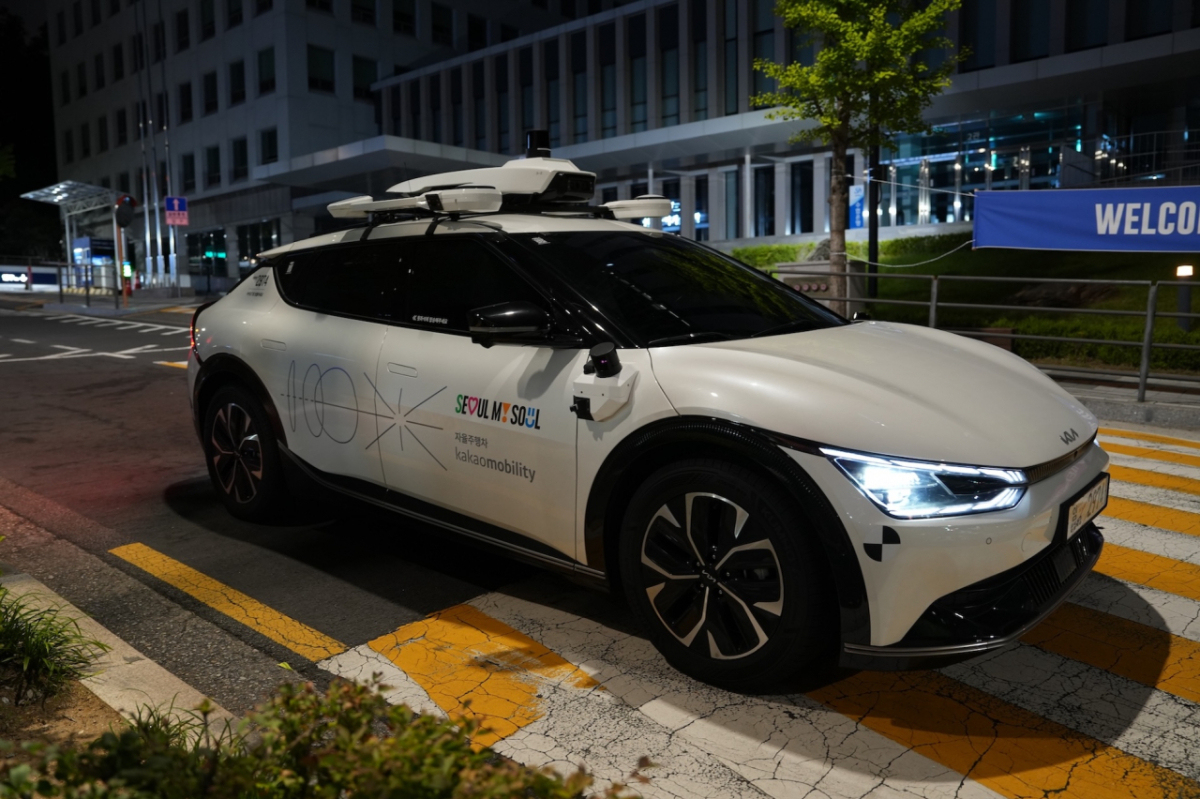
Kakao Mobility is expanding both the number and coverage area of its self-driving service, "Seoul Autonomous Vehicle," which operates in the Gangnam-gu district of Seoul. The move aims to enhance autonomous driving technology capabilities and fill scheduling gaps during late-night hours.
Kakao Mobility announced on the 19th that it will increase the number of Seoul autonomous vehicles from two to six starting on the 20th and extend its operating routes to include areas designated for the protection of vulnerable road users.
Kakao Mobility was selected as a passenger transport operator for autonomous vehicles in Seoul and began late-night operations in the Gangnam area in March. The company has played a key role in refining its autonomous driving algorithms and system stability using driving data accumulated in complex urban environments.
Gangnam is a high-difficulty zone for autonomous driving due to frequent unexpected variables such as motorcycle traffic, illegal parking, and jaywalking. Over the past five months, Kakao Mobility has validated End-to-End (E2E) technology, where a single integrated AI model handles everything from perception to control, by utilizing its city-specific "AI Planner," which serves as the brain of autonomous vehicles.
Additionally, this marks the first time in Korea that an area-based autonomous driving service has expanded its operating range to include zones for the protection of vulnerable road users. Based on safety control algorithms, Kakao Mobility applies specialized logic that reduces speed to 80% or less of the limit when entering these zones and restricts sudden acceleration to prepare for unexpected actions by pedestrians such as children. Through algorithm lightweighting and sensor optimization, it has also improved perception performance and processing speed. Furthermore, it sends visual and auditory alerts to autonomous driving managers before and after zone entry to enhance safety awareness.
Since June, Kakao Mobility has been simultaneously conducting daytime data learning in the Gangnam area to accumulate driving patterns and data from drivers during peak hours with high traffic volume and pedestrian activity.
Autonomous vehicles can be summoned by selecting the taxi icon on the "Kakao T" app, then entering the departure and destination points within the operating zone. A key advantage is that users can utilize the existing calling method without installing a separate app or completing a membership registration process.
Ryu Keung-seon of KakaoMo Bil-ri-ti (CEO) stated, "We have expanded our operational scale based on our proprietary autonomous driving technology and stable performance results." He added, "By securing data through demonstration operations, we will improve technological maturity and contribute to activating the autonomous driving ecosystem by collaborating with local governments and technology companies through platform technologies."

 in TECH
