

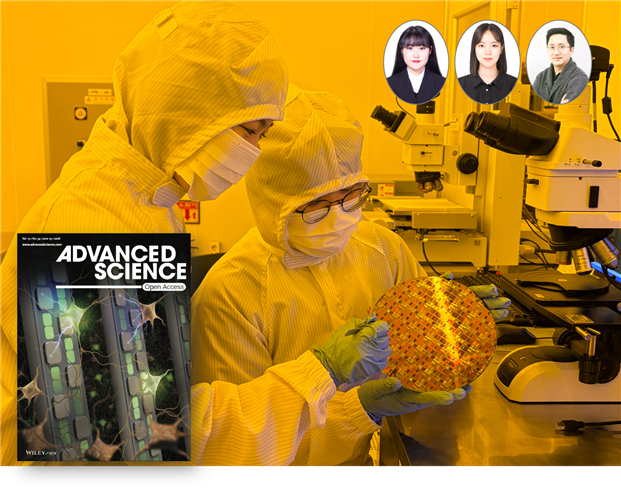
A 'cell-sized' sensor implanted in the brain can read even the information processing processes inside nerve cells. A domestic research team has developed an optoelectronic-based BCI (brain-computer interface) technology that achieves this performance while reducing production costs to 1/100th of existing levels.
KIST (Korea Institute of Science and Technology) announced on the 5th that a research team led by Lee Chang-hyuk, senior researcher at the Brain Science Institute, has developed the world's first next-generation BCI chip capable of simultaneously reading electrical and light signals within a single semiconductor chip. The research findings were published in the international academic journal 'Advanced Science'.
BCI is commonly known as a 'brain implant'. It is used to control external devices connected via IoT (Internet of Things) such as computers, robotic arms, and electric wheelchairs using only thoughts by utilizing chips implanted in the brain or to treat brain-related diseases such as dementia and Parkinson's disease by stimulating the deep parts of the brain .
Neuralink, led by Elon Musk, CEO of Tesla and SpaceX, is a representative BCI technology company. Recognized as a next-generation technology following AI (artificial intelligence), OpenAI CEO Sam Altman also founded the BCI startup Merge Labs. Jeff Bezos, chairman of Amazon, and Bill Gates, technical advisor at Microsoft, are reported to have invested in Synchrone. Synchrone is a U.S. BCI startup currently developing brainwave-based device control technology in partnership with Apple.
South Korea is in the stage of developing foundational technologies. One of the 12th key tasks of the 'K-Shot Project', launched by the Ministry of Science and ICT this year, is BCI.
Among these, KIST has developed a technology capable of simultaneously reading electrical and light signals within a single chip. This goes beyond the existing belief that brain chip accuracy can only be improved by reading every one of the hundreds of billions of nerve cell signals.
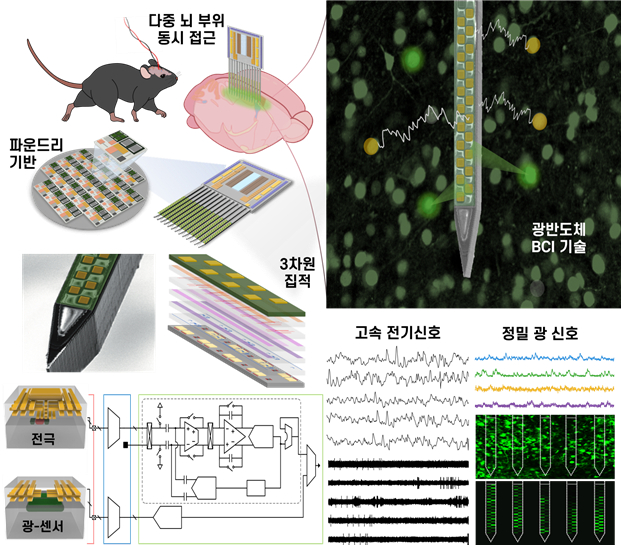
The research team compared this to 'KakaoTalk' messages. Reading all nerve cell signals is like staring at when and how many KakaoTalk messages arrive throughout the day. The team stated, "What matters more is the content of the message." It must be possible to look not only at when a nerve cell sent a signal but also into the precise information processing processes occurring inside the cell.
What makes this possible is 'light signals'. While electrical signals show the timing of cellular activity, light signals reveal the 'type of cell'. However, there was a fundamental limit to applying light signals to BCI. Light scatters as it passes through brain tissue, preventing it from reaching deep into the brain.
The research team recalled the CMOS (complementary metal-oxide-semiconductor) based image sensors they had been developing. This is standard circuit technology that places processing circuits responsible for signal amplification and conversion on a single chip, used in most semiconductor chips today. The team explained, "Instead of waiting for light to pass through the brain, we decided to directly insert the sensor into the brain to receive light right next to the cells."
The research team integrated 832 light-detecting elements onto 13 silicon needles with a thickness comparable to human hair. This is a chip capable of simultaneously reading electrical and optical signals. The team stated, "This is the first case where Korea's optoelectronic convergence has solved the 'nerve cell type distinction' limit that even U.S. Neuralink and Merge Labs could not resolve."
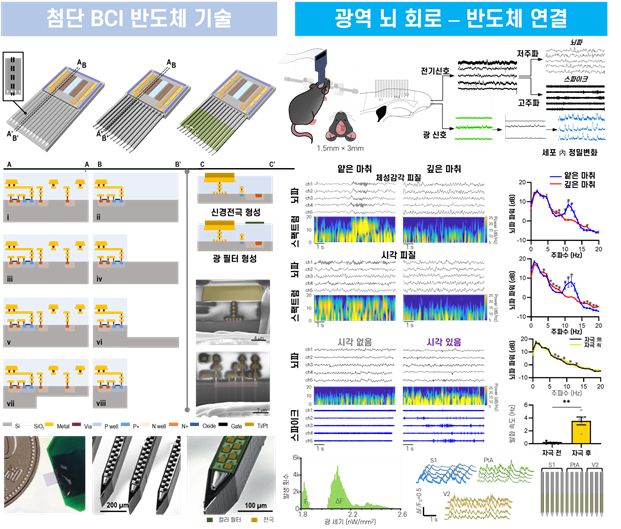
Additionally, by applying 3D printing-based post-processing technology to the general CMOS process, chip production costs were reduced to 1/100th of existing levels. Unlike Neuralink's approach of placing signal processing chips outside the brain and inserting only electrodes, the semiconductor chip developed by the research team can be implanted directly into the brain with minimal surface area. This involves placing cell-sized sensors capable of reading information processing processes inside nerve cells within the brain.
As a result of implanting the chip in three regions of an actual living mouse's brain, it was possible to simultaneously capture brainwave changes according to anesthesia depth and nerve cell responses to visual stimuli. One week after implantation, inflammatory responses and motor functions remained normal.
Senior researcher Lee Chang-hyuk stated, "Since we can simultaneously decode the type, location, and timing of nerve cells, this will be used in the future for precise diagnosis and treatment of brain diseases such as dementia, Parkinson's disease, and depression." Meanwhile, Jo Il-ju, a professor at Korea University College of Medicine and PD (overall manager) of the K-Shot BCI mission, also participated as a co-author in this study. The senior researcher added, "We expect it to be widely utilized in the Ministry of Science and ICT's K-Shot BCI mission as well."

 in TECH


