

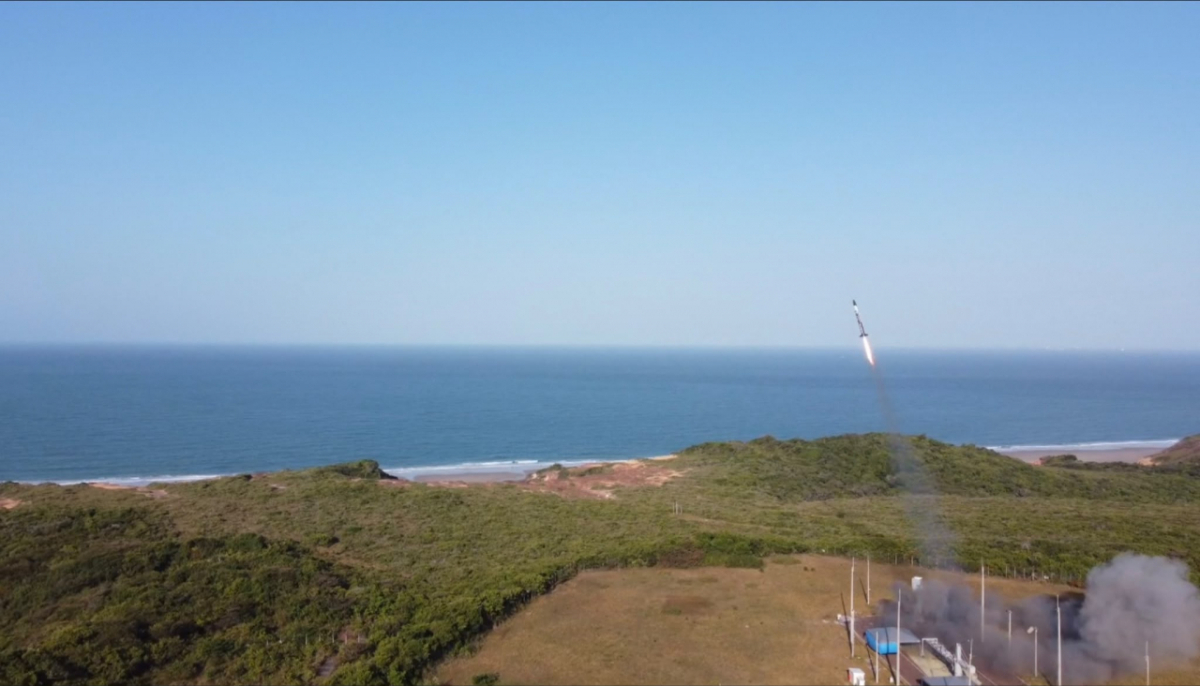
The maiden test flight of Innospace's multi-purpose suborbital rocket 'Sebit' (SEBIT) ended prematurely.
On the 20th, Innospace announced that Sebit, launched at 4:30 a.m. Korean time (4:30 p.m. local time on the 19th in Brazil) from Alcântara Space Center in Brazil, terminated its flight early.
Sebit successfully ignited from its own launch pad and lifted off that day. However, during the flight, movements deviating from the planned trajectory were detected. Consequently, the Brazilian Air Force activated the Flight Termination System (FTS) to end the flight. The Sebit vehicle fell within Brazil's maritime safety zone. No casualties or facility damage occurred.
Previously, the launch was delayed once. Sebit was originally scheduled for launch at 3:45 a.m. on the 20th, but due to delays in the high-pressure gas filling process, it launched approximately 45 minutes later than planned at 4:30 a.m.
This flight was a test mission aimed at verifying flight performance and operational stability as part of Sebit's transition to commercial use.
Innospace stated that it secured flight data on major systems including the launch pad, propulsion system, guidance-navigation-control, and tracking. Based on the collected data, it is currently analyzing detailed flight results such as precise flight altitude, distance, and time, as well as the cause of mission termination. The analysis results will be utilized for Sebit's subsequent test flights.
Director Kim Su-jong (CEO) said, "Through repeated flights, we aim to enhance service reliability and develop a mission-oriented suborbital space transport platform that customers can trust and utilize."
Meanwhile, Sebit is a rocket designed to operate at high altitudes (approximately 10 km to 100 km above Earth). It carries payloads for space experiments such as semiconductors and experiences a near-weightless "microgravity" state and a "suborbital" state for several minutes. After launch, Sebit was scheduled to fly in a parabolic arc at high altitude before descending back to the ground. This marks Innospace's first execution of a Sebit test flight.

 in TECH
