

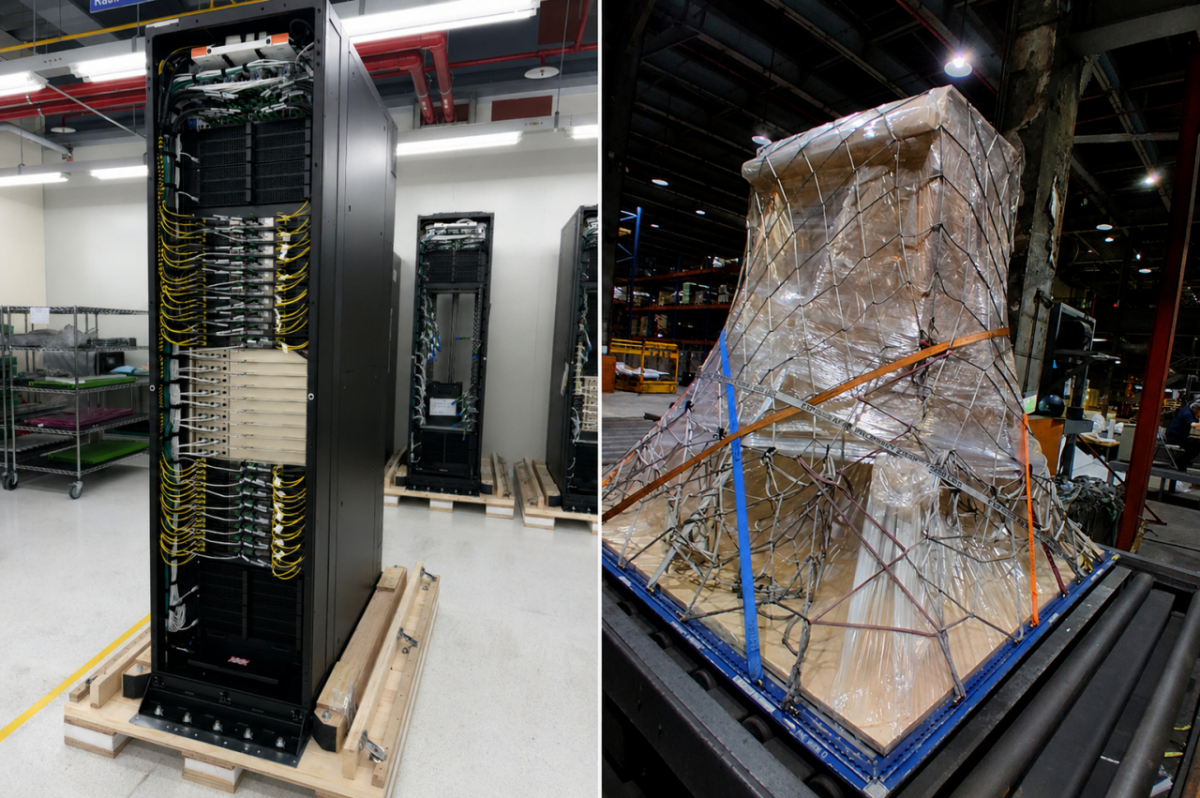
The first Yangsan model of NVIDIA's next-generation AI (artificial intelligence) computing platform 'Ver Rubin' has arrived at Microsoft (MS) data centers. Attention is also focused on when South Korea, which secured priority supply of Ver Rubin from NVIDIA, will actually receive the units.
According to industry sources on the 23rd, MS CEO Satya Nadella posted on his social media account on the 22nd: "The delivery date for the first Yangsan-type Ver Rubin arriving at MS data centers." He added, "I thank NVIDIA and the Azure hardware and data center teams for making this important milestone possible." NVIDIA also announced via its official SNS that "Ver Rubin has entered full-scale Yangsan expansion."
The 'Ver Rubin NVL72', which integrates 36 CPUs (central processing units) named 'Ver' and 72 GPUs (graphics processing units) named 'Rubin' into a single unit, increases AI inference throughput per watt by up to 10 times compared to the existing Blackwell platform and reduces cost per token to one-tenth of the previous level.
Interest is also centered on when South Korea will introduce Ver Rubin. Vice Prime Minister and Minister of Science and ICT Park Chan-woo stated after meeting with NVIDIA CEO Jensen Huang on June 8 that "South Korea has secured priority supply of Ver Rubin."
However, the specific timing and volume of actual Ver Rubin deliveries to South Korea have not yet been disclosed. The government and NVIDIA agreed last year to supply 260,000 GPUs to South Korea, but the volume of Ver Rubin supplies was not separately announced. Vice Minister Bae explained during this meeting that GPUs required for future additional projects were also "secured without any issues."
Regardless of securing supply volumes, rising prices for next-generation GPUs are expected to be a burden. Bloomberg, citing sources, reported that NVIDIA recently notified major customers of price increases exceeding 15% for AI chip systems. The increase will apply to shipments starting early next year, and it is understood that both Ver Rubin and Grace Blackwell are included in the scope.
The background behind the price hike lies in the shortage of memory semiconductors driven by a surge in AI demand. As demand for high-performance memory such as HBM (high-bandwidth memory), which is essential for AI accelerators, has skyrocketed, cost burdens have increased significantly. It is reported that NVIDIA is even considering reducing the memory capacity of 'Rubin Ultra', its next-generation high-performance AI platform following Ver Rubin, to address the shortage of HBM supply.

 in TECH
