

While the yield on 3-year government bonds has fallen over the past month, yields on specialized financial company bonds (card and capital finance bonds) issued by card and capital finance companies have declined more sharply (prices have risen). This is interpreted as the perception that rates are at their peak, combined with the inflow of surplus funds from large corporations into the bond market, rapidly lowering yields on specialized financial company bonds, a product category sensitive to bond supply and demand.
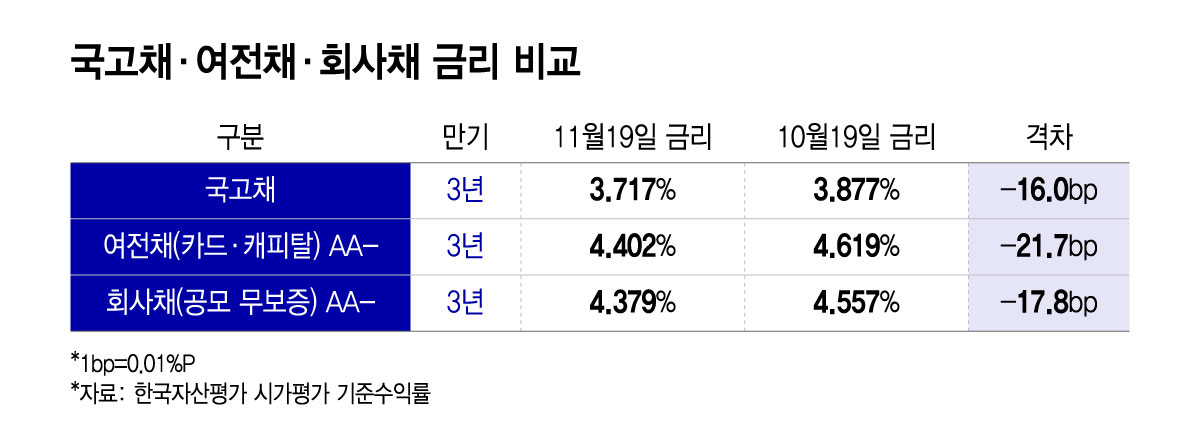
According to Korea Asset Evaluation on the 22nd, the yield on AA- rated 3-year specialized financial company bonds fell by 21.7bp (1bp=0.01 percentage points) from the previous month's 19th to 4.402% on the 19th. Over the same period, the yield on 3-year government bonds fell by 16.0bp to 3.717%, and the yield on AA- rated 3-year public corporate bonds fell by 17.8bp to 4.379%. As a result, the yield spread (credit spread) between AA- rated 3-year specialized financial company bonds and 3-year government bonds narrowed by 5.7bp to 68.5bp. The yield difference between 3-year specialized financial company bonds and corporate bonds of the same rating shrank by 3.9bp to 2.3bp.
Card and capital finance companies cannot accept deposits, so they rely heavily on bond issuance for funding and have a high frequency of bond issuance. As new bond supply continues, issuance yields are adjusted frequently according to the buying demand of institutional investors. These bonds are also characterized by a high holding ratio in actively traded investment trusts, meaning changes in market supply and demand are quickly reflected in yields.
The background behind the steeper decline in specialized financial company bond yields compared to government bond yields is cited as surplus funds from large corporations and bond fund assets. According to the financial investment industry, SK hynix reportedly entrusted a total of 3 trillion won in bond management to six asset management companies last month, with 500 billion won allocated to each. It is known that bank-affiliated card company bonds with a credit rating of AA0 or higher and maturities of 3 to 4 years were preferred as investment targets.
Analysis also suggests that bond fund assets, which were expected to decrease in the fourth quarter, have instead increased, expanding the capacity to purchase credit bonds such as corporate, bank, and specialized financial company bonds. Bond yields have risen, and stock market volatility has increased, boosting demand for bond funds. It is generally common for bond fund assets to outflow at year-end as institutional investors close their books, but it is known that this year's year-end is exceptionally seeing continued inflows into bond funds.
Corporate bond issuance decreased significantly due to the year-end off-season, but POSCO Future M (AA-) increased its issuance amount to 200 billion won after receiving orders totaling 450 billion won for a planned 100 billion won raise.
Hyundai Motor Securities analyzed that spreads with government bonds have narrowed, centered on specialized financial company bonds, and that expectations that base rate hikes will end within the first half of next year have revived investor sentiment. It was observed that although there is a high possibility of rate hikes at the Bank of Korea Monetary Policy Board meeting on the 26th and the December U.S. Federal Open Market Committee (FOMC) meeting, buying pressure for credit bonds is entering, leading to a continued trend of slight narrowing in credit spreads. However, caution remains regarding concerns over additional rate hikes due to price instability caused by war and oil prices.

 in STOCK

