

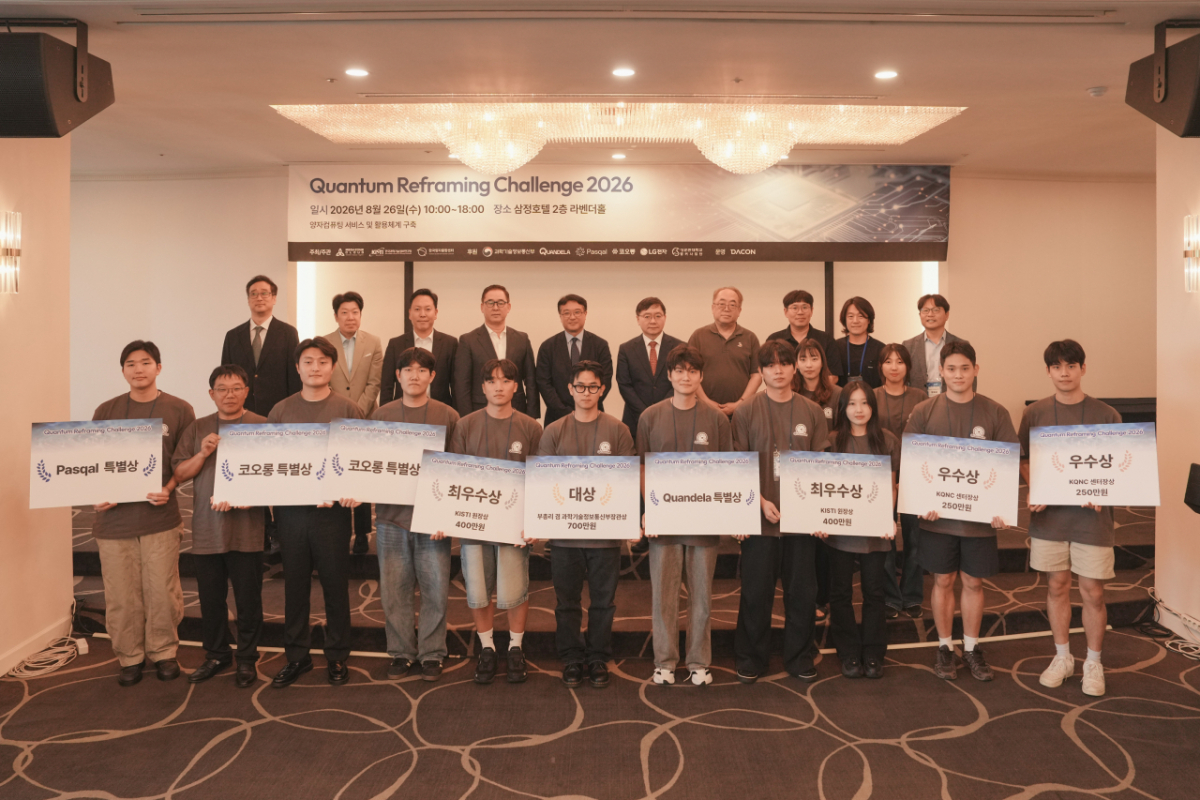
At a quantum computing hackathon jointly hosted by Megazone Cloud and the Korea Institute of Science and Technology Information (KISTI), a research project that used quantum computing to identify limitations in conventional calculation methods—thereby reducing trial-and-error in catalyst development for the chemical industry—was awarded the grand prize.
Megazone Cloud announced on the 27th that at the finals of the quantum computing hackathon 'Quantum Reframing Challenge 2026' held at Seoul Samjung Hotel on the 26th, the team 'Quanskkuad', composed of three students from the Biomechatronics Department at Sungkyunkwan University, won the grand prize.
The Quanskkuad team tackled a project analyzing the efficiency of copper catalysts in converting carbon dioxide into ethylene. By leveraging quantum computing, they proposed methods to improve the accuracy of predicting selectivity in copper catalysts and analyzed the limitations of existing calculation approaches. Their work received high praise for demonstrating the potential to reduce unnecessary catalyst synthesis and experimentation.
Choi U (수상) was awarded to the 'QAIST' team, which selected candidates for high-temperature-resistant and lightweight materials, and the 'Schrödinger's Puppy' team, which corrected semiconductor precursor calculations. The 'DEEP DIVE' team, which addressed concert hall noise control, and the 'Kim Haeng-in' team, which handled port crane scheduling, received Woo Su-sang-eul (수상).
A total of 73 teams comprising 214 participants—from high school students to university and graduate students, researchers, and industry professionals—participated in this hackathon. The event was conducted by redefining real-world industrial challenges as problems solvable with quantum computing and verifying their feasibility using actual quantum computers.
To lower the entry barrier for quantum programming, Megazone Cloud and KISTI also permitted the use of AI tools, including generative AI. The 12 teams that passed the online preliminaries implemented and validated their ideas using three distinct types of real quantum processing units (QPUs): IonQ's ion trap method, Pasqal's neutral atom method, and Quandela's photonic method.
Megazone Cloud provided participants with step-by-step training, tutorials on the quantum computing platform, and expert mentoring. KISTI supported the use of IonQ's cloud environment, while Quandela and Pasqal also offered QPU access environments and related technologies.
Both parties plan to link promising projects identified in this hackathon to follow-up proof-of-concept (PoC) studies and industrial demonstrations. They will continue to identify talent with experience in utilizing quantum computing services and real-world application cases, while expanding related education and seminars.
Lee Sik, director of KISTI, stated, "The ability to redefine on-site problems using the language of quantum computing is a core competitiveness in the era of quantum utilization." He added, "We will strengthen the quantum utilization ecosystem by building HYBE-lead services that combine quantum computer and supercomputer infrastructure."
Kim Dong-ho, CQO of Megazone Cloud, said, "We confirmed that quantum computing can offer new solutions to problems that are difficult or impossible to address with classical computing due to computational complexity." He further noted, "We will foster a virtuous cycle where outstanding projects lead to industrial demonstrations."
Meanwhile, this hackathon was conducted as part of the Ministry of Science and ICT's project titled 'Establishment of Quantum Computing Services and Utilization Systems'. The event was sponsored by the Ministry of Science and ICT, along with Quandela, Pasqal, Kolon, LG Electronics, and Sungkyunkwan University's Anchor Project Team.

 in TECH
