

The Nuclear Safety and Security Commission plans to allocate 303 billion won next year to proactively establish a regulatory framework for next-generation small modular reactors (SMRs) and strengthen public communication on nuclear safety.
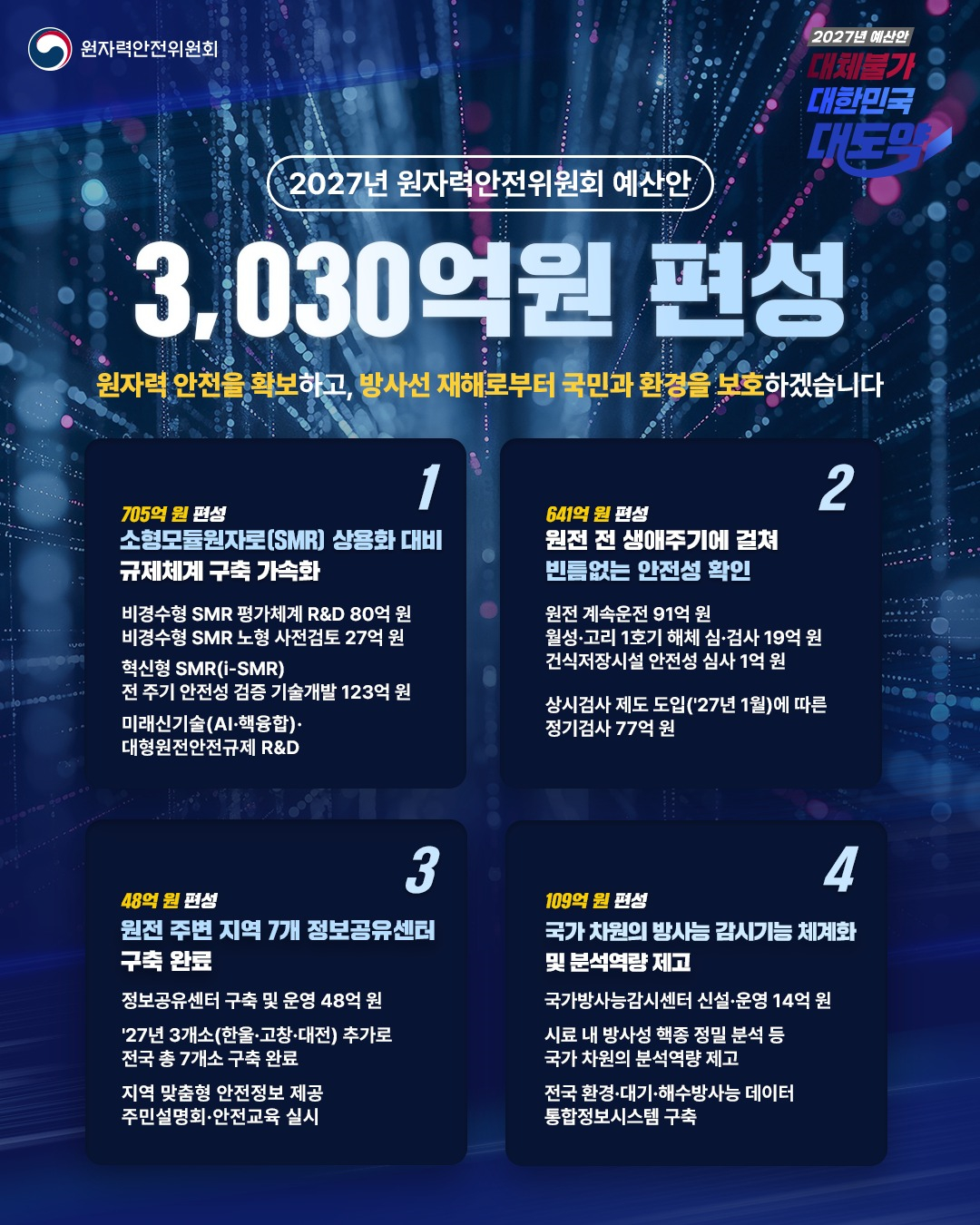
On the 1st, the Nuclear Safety and Security Commission announced that it has submitted a budget proposal of 303 billion won for 2027 to the National Assembly, representing an increase of 10.4 billion won compared to the previous year.
As the development project for non-light-water SMRs is set to move forward with the goal of obtaining permits in the early 2030s, the Nuclear Safety and Security Commission will invest 8 billion won in R&D (research and development) to build a new evaluation system. Non-light-water SMRs refer to next-generation SMRs that use substances other than water, such as sodium or molten salt, as coolants instead of water.
Additionally, 2.7 billion won has been allocated for pre-review of non-light-water SMR designs. The pre-review system allows applicants to request regulatory review of reactor designs before formally applying for permits and will take effect in November. The Nuclear Safety and Security Commission plans to submit its application in early 2027.
For the innovative SMR (i-SMR), which applied for standard design approval last February, 12.3 billion won will be invested to develop safety verification technologies in preparation for regulation covering the entire lifecycle (design, construction, operation, and decommissioning) at Jeonju.
The total amount the Nuclear Safety and Security Commission plans to invest in R&D next year is 70.5 billion won. The commission stated that it has significantly expanded its R&D investment with the goal of securing safety during flexible operation and decommissioning of large nuclear power plants, as well as in the storage and disposal processes of spent nuclear fuel, including foundational research in artificial intelligence (AI) and nuclear fusion.
Budgets have also been allocated for key issues facing review and inspection next year: △decommissioning review of Wolsong Unit 1 (1 billion won), △inspection of decommissioning at Gori Unit 1 (900 million won), △safety review for continued operation of nuclear power plants (9.1 billion won), and △safety review of dry storage facilities for spent nuclear fuel within nuclear power plant sites (1 billion won).
Notably, with the implementation of a continuous inspection system for nuclear power plants starting in January next year, the budget for regular inspections has been increased by 2.5 billion won from the previous year to 7.7 billion won. Unlike regular inspections, which are conducted only for shut-down reactors, continuous inspections verify safety during operation periods as well.
In addition, 4.8 billion won has been allocated for establishing the "Nuclear Safety Information Sharing Center," which will disclose nuclear information and communicate with local residents and the general public around nuclear facilities. Furthermore, 1.4 billion won has been budgeted for the installation and operation of the "National Radioactivity Monitoring Center," responsible for monitoring and analyzing environmental radioactivity. The National Radioactivity Monitoring Center will be installed at the Korea Institute of Nuclear Safety in Yuseong-gu, Daejeon.
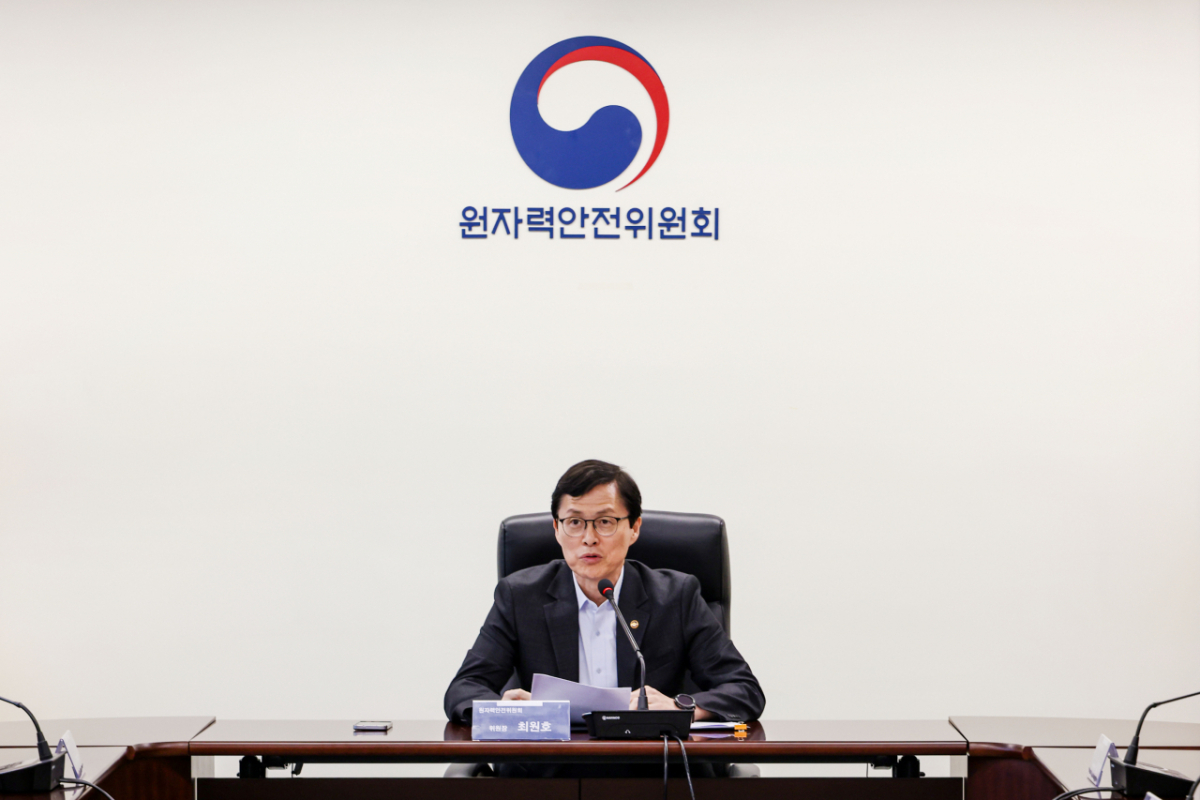
Choi Won-ho (Chairman) stated that the 2027 Nuclear Safety and Security Commission budget is essential not only for addressing current issues but also for timely response to future challenges and transparently disclosing the safety regulatory process and results to the public.
The 2027 Nuclear Safety and Security Commission budget will be finalized after deliberation and approval by the National Assembly.

 in TECH

