

South Korea's transition rate to the next-generation internet protocol (IPv6) is not only below the global average but has actually regressed over the past year.
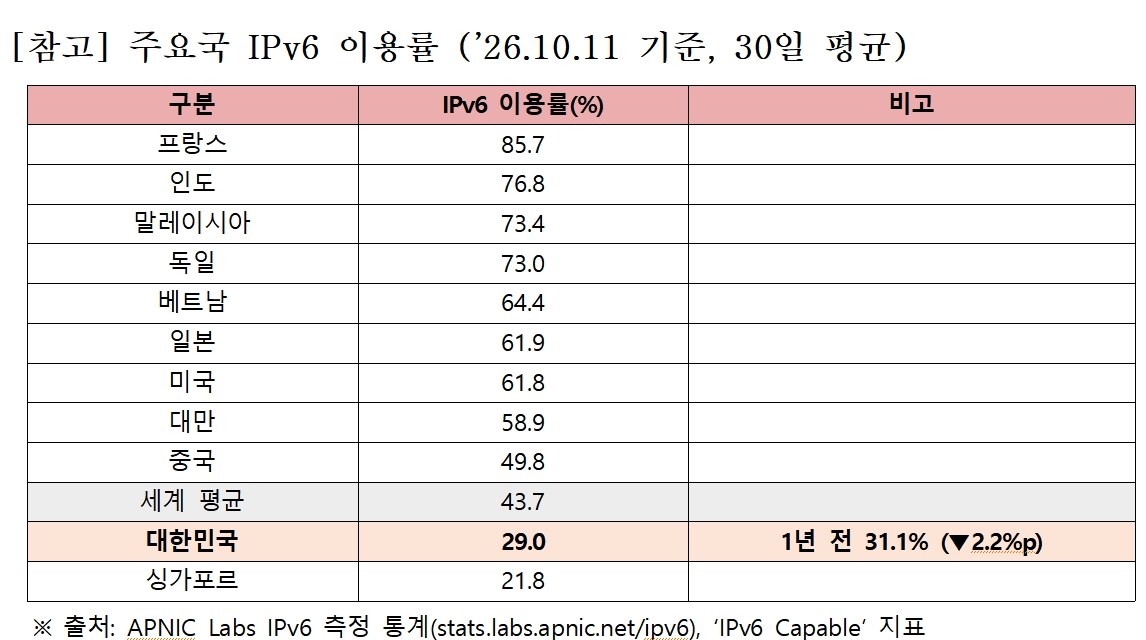
According to an analysis of data from the Asia Pacific Network Information Centre (APNIC) by Jo Gyeong-tae (Rep.) of the People Power Party, a member of the National Assembly's Science and Technology Information Committee and the Korea Communications Commission, South Korea's IPv6 adoption rate stood at 29.0% as of October 2026, significantly below the global average of 43.7%.
The figure is lower than that of major countries such as France (85.7%), Japan (61.9%), and the United States (61.8%), as well as China (49.8%). Furthermore, the domestic rate has decreased by 2.2 percentage points compared to a year ago (31.1%), moving in the opposite direction of global trends.
IP addresses are unique numbers assigned to all devices connected to the internet, serving as the "home address" of the internet. The widely used IPv4 operates on a 32-bit system and can generate only about 4.3 billion addresses, which were quickly exhausted due to the surge in smartphones and Internet of Things (IoT) devices. The Internet Corporation for Assigned Names and Numbers (ICANN) declared the exhaustion of IPv4 addresses in February 2011. IPv6 is the next-generation internet protocol that replaces it.
IPv6 operates on a 128-bit system, providing virtually unlimited addresses, and is considered an essential foundation for the hyper-connected era. It offers advantages such as reduced network construction and management costs, one-on-one communication and security between devices, and quality assurance during mobility, making it an essential foundation for new industries in the hyper-connected era.
In 2008, South Korea hosted the OECD Ministerial Meeting in Seoul and promoted the early adoption of IPv6 through the "Seoul Declaration" with member countries. Additionally, out of the estimated 821.5 billion won transition cost outlined in a roadmap established in 2014, more than 600 billion won was invested to raise the readiness rate of the backbone network to over 90%.
However, even after more than 10 years have passed, full-segment interconnection (linkage) between telecommunications companies for IPv6 has not been completed. As a result, a structural inefficiency remains where traffic between domestic users is routed through overseas networks and returned. Critics point out that the network built at a cost of several trillion won is not connected, leaving it as a "half-baked investment."
Accordingly, Jo (Rep.) plans to diagnose the causes of the stagnation in IPv6 adoption rates by questioning the head of the Korea Internet & Security Agency (KISA) at the KISA national audit session held on the 15th. The official also intends to thoroughly inspect the status of inter-linkage between telecommunications companies and the current state of traffic routed through overseas networks. Furthermore, Jo (Rep.) will strongly urge the Ministry of Science and ICT to cooperate in formulating measures to promote the transition to next-generation internet, including the revision of interconnection standards.
Jo Gyeong-tae (Rep.) emphasized, "IPv6 is the foundational infrastructure that supports national digital competitiveness in the AI and hyper-connected era." The official added, "KISA, as the dedicated institutional investor for internet addresses, must accurately grasp the current situation first, work with the government to re-establish a transition plan including IPv6 interconnection between telecommunications companies, and follow through to the end."


 in TECH

