

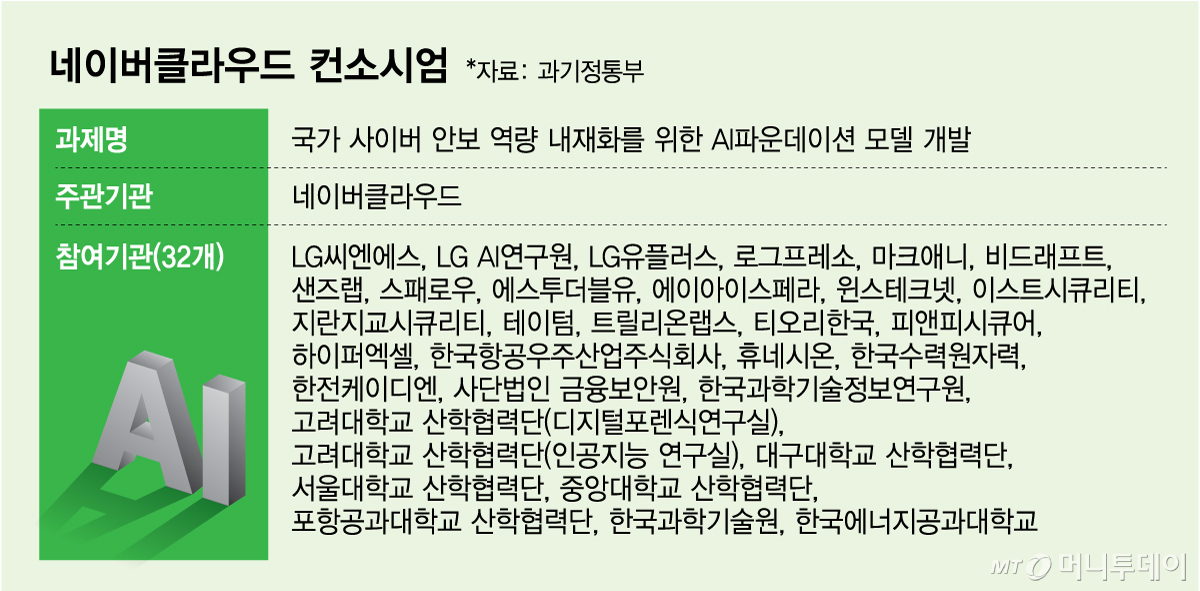
The Naver Cloud consortium has been selected as the final implementing institutional investor for the government's project to develop a 'cybersecurity-specialized AI (artificial intelligence) foundation model.' The government plans to support 256 NVIDIA 'B200' GPUs (graphics processing units) to secure an AI model specialized in cybersecurity using domestic technology.
On the 3rd, the Ministry of Science and ICT announced that after conducting presentation evaluations for two consortia that participated in the project solicitation, it selected the Naver Cloud consortium as the final implementing institutional investor. The goal of this project is to develop an AI foundation model specialized for Korea's cyber threat environment and utilize it in actual security applications. The development results will be released as open source to spread throughout the domestic security ecosystem.
The Naver Cloud consortium received high praise for forming a large-scale university-industry-government alliance with technical expertise and development experience. Its development strategy, which utilizes 'Harness'—a system where multiple AI agents divide roles to perform security tasks and connect and manage them—along with its goals also received positive evaluations. The evaluation focused on △technical capability and development experience △feasibility of the development strategy and goals △market potential and ripple effects.
The consortium includes Naver Cloud, LG CNS, LG AI Research, LG Uplus, Eastsec, Theory Korea, HyperXcel, Korea Aerospace Industries (KAI), Korea Hydro & Nuclear Power, Financial Security Institute, Seoul National University, KAIST, Pohang University of Science and Technology, and a total of 33 companies and institutional investors.
Competitor SK Telecom formed a consortium with 13 institutional investors including Upstage, SK Shieldus, AhnLab, Glue Corporation, and Genie, but did not make the final selection.
The government will support 256 B200 GPUs to the Naver Cloud consortium for 10 months starting this month. After providing them for the first five months, the decision on whether to provide the remaining five months will be made based on the mid-term evaluation results. An agreement will be signed this month, and a working group will be established to begin development.
However, there are also concerns that developing an independent AI model should not be considered the sole achievement of the project. Professor Kim Seung-ju of Korea University's Graduate School of Information Security identified the following challenges for this project: △performance capable of competing with commercial security AI △independent operational capability in defense and national security sectors △sustainable updates after the project ends, and △development of models that are actually selected on the ground.
Professor Kim stated, "While I agree with developing an independent model, if it is to be utilized in the private market, it must aim for world-class standards surpassing commercial products." He added, "Otherwise, it would be more appropriate to focus on defense and national security areas where the need for independent technology is significant."
He also suggested that government support should adopt a 'two-track' approach: developing world-class security AI by leveraging commercial AI and securing an independent model for national security. Professor Kim pointed out, "If models with inferior competitiveness are mandated for use by public institutional investors, they may remain confined to Korea like the certified authentication certificate system and become disconnected from global trends."

 in TECH
