

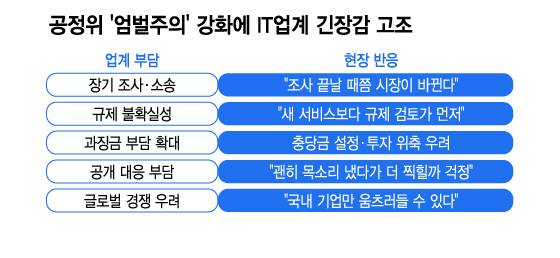
"Platforms change monthly, yet the impact of regulations from several years ago remains strong. When launching new services, there is a trend of prioritizing regulatory risks over innovation."
This was said by an executive at an IT company. The Fair Trade Commission's harsh stance is spreading across the platform and AI markets. Even when hundreds of billions in fines are overturned by courts, it takes years to reach a conclusion. During that time, investment and new business ventures come to a halt, according to industry voices.
According to the IT industry on the 6th, the Korea Fair Trade Commission has been conducting market surveys since May against 29 AI developers and 17 companies providing AI-equipped products. In July, it also began consumer surveys. A bill to amend the Fair Trade Act, raising the cap on fines for abuse of market dominance from 6% to 20% of sales and collusion from 20% to 30%, has been submitted to the National Assembly.
IT companies that have clashed with the Korea Fair Trade Commission lose time regardless of whether they win or lose. Naver received a fine of 26.7 billion won in October 2020 for favoring its own products in shopping search results. The Seoul High Court sided with the Korea Fair Trade Commission, but the Supreme Court last October sent the case back, noting there is room to view algorithm adjustments as normal business activities. The retrial has been ongoing for five years and ten months since the initial penalty.
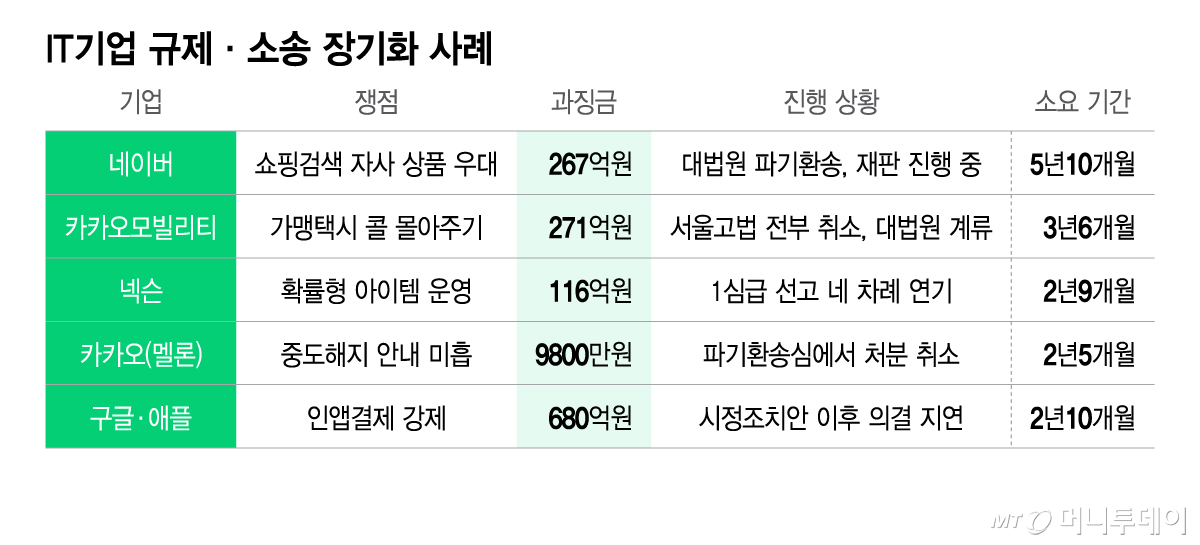
Kakao Mobility received a fine of 27.1 billion won in February 2023 for directing calls to franchise taxis, which accounted for 70% of its operating profit that year. The Seoul High Court canceled the entire penalty last May, but the Korea Fair Trade Commission appealed. No conclusion has been reached three years and six months after the penalty was imposed. Nexon was assessed a fine of 11.6 billion won in January 2024 over issues with probability-based items in MapleStory. Controversy arose regarding retroactive application, questioning whether operations were judged by current standards before the mandatory disclosure of probabilities was introduced. The Seoul High Court's verdict has been postponed four times since last December and is now scheduled for October 28. This marks two years and nine months since the penalty was issued.
According to industry sources, the Korea Fair Trade Commission refunded a total of 106.5 billion won in fines to companies from January to July this year, surpassing last year's annual refund amount of 69.8 billion won. The amount delayed by courts from being collected due to injunctions stands at 453 billion won, 2.4 times the figure for last year (187.6 billion won). During the same period, the total amount assessed reached 1.3527 trillion won, four times that of last year.
An IT industry official stated, "Large-scale fines and long-term investigations and lawsuits have placed significant burdens on new business investments and global expansion strategies," adding, "During the period when investigations continued, technological advancement stagnated, and time to build future AI competitiveness was lost." Another platform industry official said, "The problem is that while regulatory standards and boundaries remain unclear, only the intensity of post-facto sanctions continues to increase."

 in TECH

