

More diverse corporate information on the startups mentioned in this article can be found on Unicorn Factory's big data platform, Data Lab.
As a "3D blood vessel" image appeared on the ultra-large screen, judges seated in the front row of the audience simultaneously lifted their eyes from their laptops to look up at the display. Beneath the grayscale ultrasound imagery, a vivid map of capillaries unfolded, with each tiny blood vessel clearly coming to life.
Speaking at the announcement, Yang Jun-mo (CEO), a professor in the Department of Biomedical Engineering at UNIST (Ulsan National Institute of Science and Technology) and founder of the university's startup Vidal Sonic, expressed confidence: "Conventional endoscopes cannot visualize blood vessels beneath the mucosa no matter how much they are magnified, but our solution allows direct visual confirmation of blood vessels." As red capillaries emerged in three dimensions from the green tissue, short gasps of awe echoed throughout the audience.
The "2026 4th MEDITEK," aimed at commercializing technologies and open innovation in the medical devices and healthcare sectors, kicked off on the 9th for a three-day schedule at Jeju Maison Glad.
At the bio-healthcare deep-tech startup IR held that afternoon, numerous faculty and student startups born from science and technology-focused universities, including UNIST, Gwangju Institute of Science and Technology (GIST), Korea Advanced Institute of Science and Technology (KAIST), and POSTECH (formerly Pohang University of Science and Technology), took the stage. Most of the presenters were researchers who had built up their academic records with publications and patents in laboratories.
However, the judges in the audience did not focus solely on the maturity of the technology. They relentlessly probed into realistic challenges that would arise during the commercialization process, including market size, speed of entry, regulatory barriers, as well as the duration and cost involved in clinical trials. A palpable tension hung between the two groups seated face-to-face throughout the presentation.
Vidal Sonic unveiled a non-invasive diagnostic device that integrates its photoacoustic imaging technology, which combines light and sound, into an ultrasound mini-probe. Founded in August 2023, the company showcased on this stage the prototype it developed during its first year of operation. Yang (CEO) pointed out from the outset that digestive organs such as the esophagus and stomach have irregular shapes, meaning that whole-body imaging equipment like MRI, CT, and ultrasound alone has limitations in diagnosis. He also meticulously highlighted the limitations of existing endoscopes. Yang (CEO) stated, "Even magnifying endoscopy has limited resolution and cannot properly show blood vessels beneath the mucosa, while ultrasound endoscopy can determine tissue depth but fails to provide crucial vascular information regarding cancer occurrence, making it difficult to distinguish between benign and malignant conditions."
The solution lies in combining photoacoustic technology, which excels at visualizing blood vessel structures, with an ultrasound mini-probe. While green-tinted ultrasound images reveal tissue density, the underlying photoacoustic images display intricate three-dimensional capillary networks. Yang (CEO) emphasized that "when cancer develops, angiogenesis and metastasis appear first," adding that doctors can now detect early warning signs missed by conventional methods by identifying them through vascular information ahead of time. He further noted that, unlike existing photoacoustic startups limited to in vitro diagnostic devices, his company is the world's first to focus on endoscopy, introducing its extensive patent portfolio and in-house production strategy.
A judge from Future Science and Technology Holdings, watching the presentation, asked how much difference there is in diagnostic accuracy compared to existing diagnostic devices. Yang (CEO) honestly admitted that while "existing magnifying endoscopes cannot visualize capillaries, our data already makes this visible," ultimately, "for doctors to use it on the front lines, cost is a realistic hurdle just as significant as technical evidence."
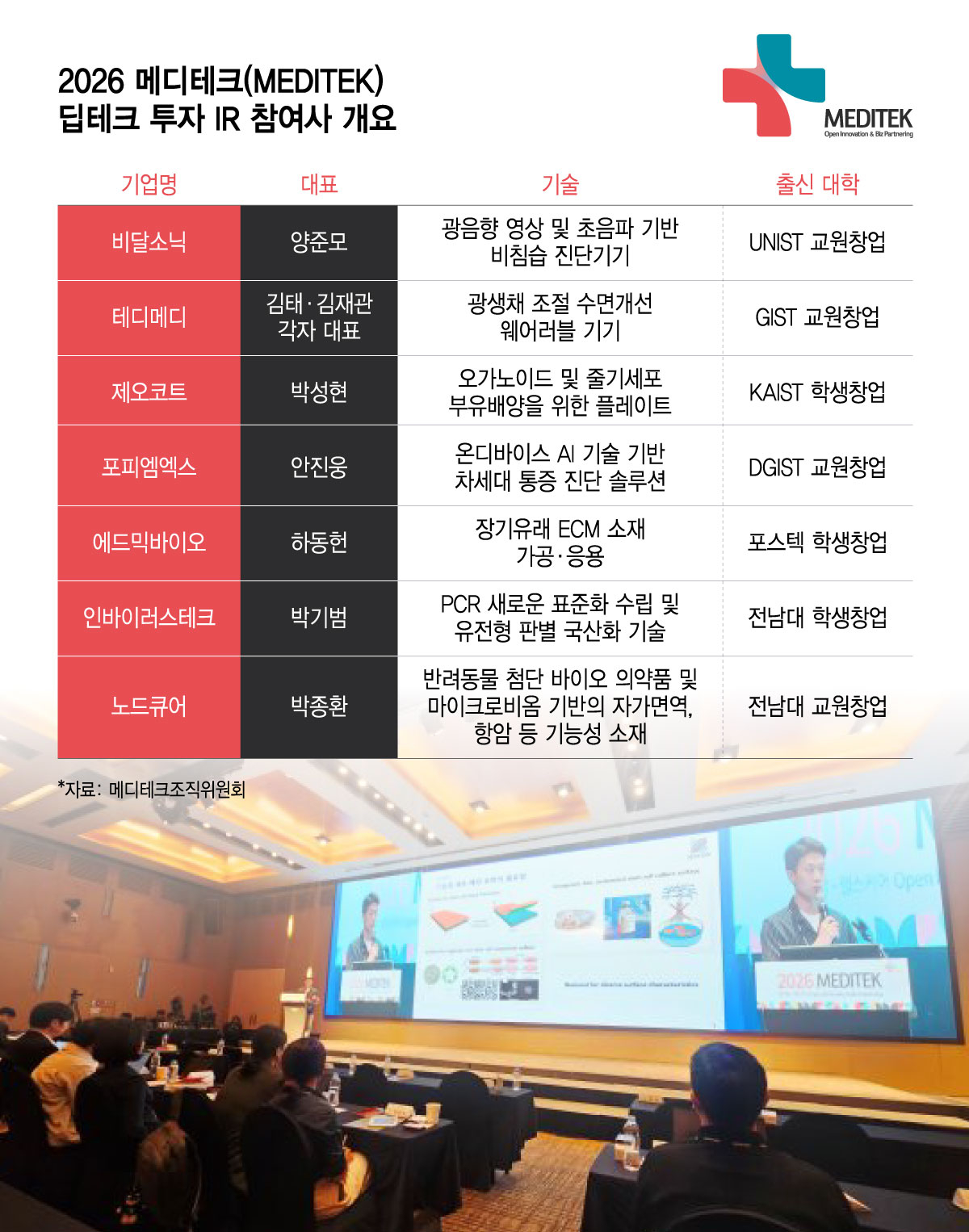
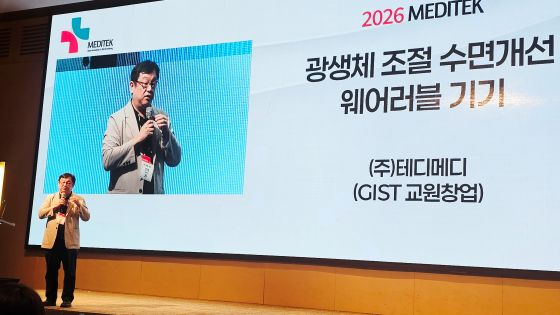
Teddy Med, a GIST faculty-founded company that took the stage next, is led by Kim Tae (CEO), a former psychiatrist who treated patients with insomnia. He introduced the wearable device "Sleep Crown," worn on the forehead, saying, "I could not find a way to solve the problems I encountered while treating patients, so I decided to start my own business."
Kim (CEO) explained the background of the startup by saying, "The insomnia patients visiting hospitals are just the tip of the iceberg; far more people below endure in silence and repeatedly try to forget," adding, "The reality is that we can help those who come to the hospital, but there is no way to reach those who do not."
He explained that the cause of insomnia is not that sleep signals are weak and prevent falling asleep, but rather that arousal signals are excessively strong, making it difficult to fall asleep. While sleeping pills suppress both arousal signals and sleep signals, disrupting normal sleep structure, Teddy Medy selectively strengthens sleep signals.
Kim (CEO) put forward three product principles: "without drugs, without additional effort to fall asleep, and without replaceable parts." He also announced that five days before the announcement, approval for publication was granted in 'Molecular Psychiatry,' a top 1% journal in the field of psychiatry. This is the result of five years of research.
Clinical results were also presented. In a randomized controlled trial, insomnia severity decreased by 26%, the sleep discomfort index dropped by approximately 30%, and the time it took to fall asleep was shortened by an average of 36.6 minutes. Kim (CEO) emphasized that "even in a state where they did not know whether the device was real or fake, the treatment group fell asleep 8.4 minutes faster than the control group," adding that this means they felt drowsy that quickly.
A reviewer listening carefully to his presentation asked, "Is falling asleep quickly like a sedative not a different issue from treating chronic insomnia?" and inquired, "Have you proven that results observed over three hours in animal experiments apply equally to humans?" Kim (CEO) acknowledged the task by stating, "There are currently no studies worldwide that have directly measured adenosine within the human brain," but replied, "We indirectly confirmed it through adenosine receptor occupancy rates and demonstrated efficacy using animal experiments and clinical data."
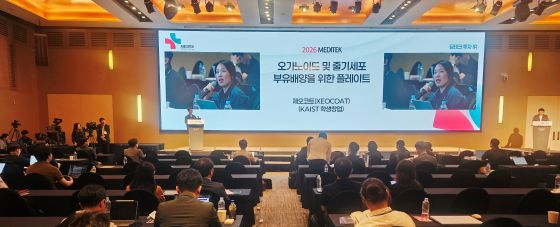
KAIST student-founded company ZeroCoat is targeting the market for "cell culture plates" used to cultivate cells in laboratories. Park Seong-hyeon (CEO) announced that it will secure price competitiveness by treating surfaces using a solvent-free vapor deposition (iCVD) method. POSTECH startup AdmixBio highlighted 3D bioprinting and organ-derived bioinks for liver cancer treatment, regeneration, and anti-cancer applications. The world's first HYBE-led printer "Ogamprint" was provided to Johns Hopkins University in the U.S. for demonstration purposes, and the company stated it is currently in discussions with pharmaceutical firm Merck regarding supply agreements.
Yong Hong-taek of Meditech Jo Jik-wi (Director), who watched the IR presentation, said, "The technologies announced today are all at a level that will succeed in the global market, but ultimately the key lies in how quickly laboratory results can be connected to commercialization," adding, "Meditech will play the role of that bridge."
[Money Today Startup Media Platform Unicorn Factory]

 in TECH


