

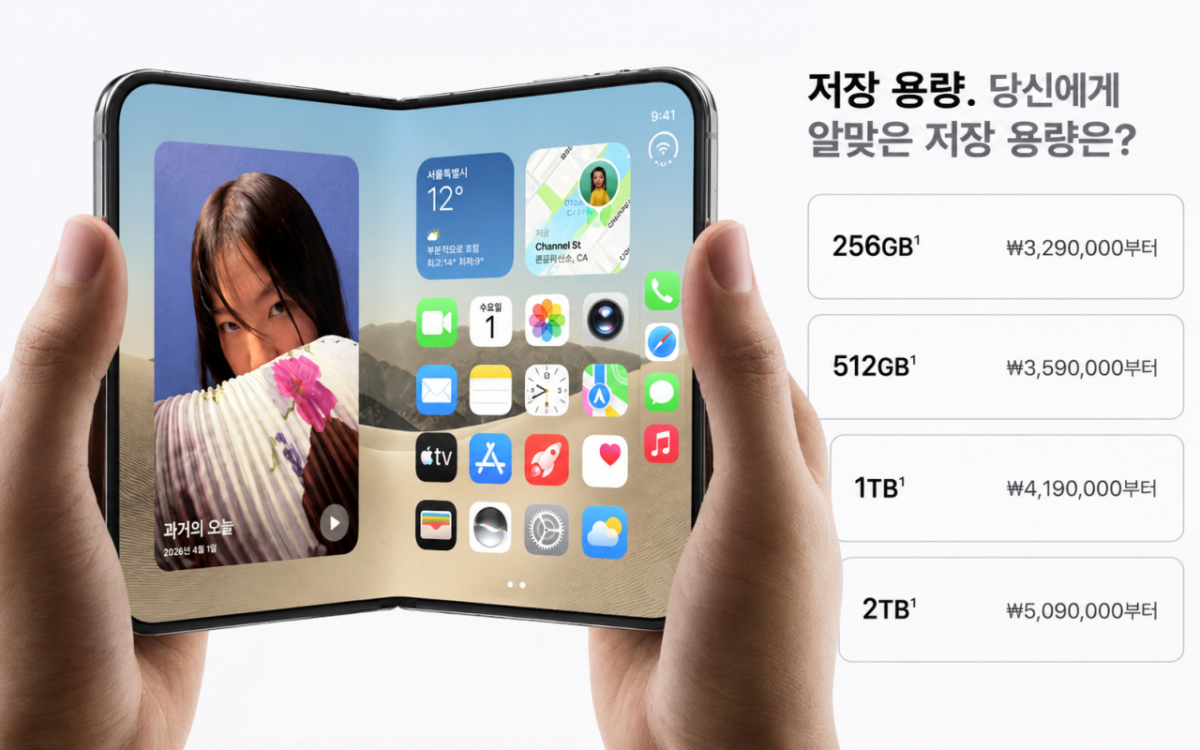
Apple's first foldable phone, 'iPhone Duo,' starts at 3.29 million won in Korea. The top-spec 2TB model is priced at 5.09 million won, pushing the price of a single smartphone over 5 million won. Although the current won-dollar exchange rate is in the 1,300-won range, the domestic price excluding taxes reflects an exchange rate level of approximately 1,450 to 1,500 won per dollar.
Apple announced the domestic base prices for the iPhone Duo on the 10th (Korea time): 256GB at 3.29 million won, 512GB at 3.59 million won, 1TB at 4.19 million won, and 2TB at 5.09 million won. In the U.S., they are sold for $1,999, $2,199, $2,599, and $3,199, respectively. Applying the current won-dollar exchange rate of 1,340.8 won, these convert to approximately 2.68 million won, 2.95 million won, 3.48 million won, and 4.29 million won.
However, U.S. selling prices do not include state sales taxes, while Korean base prices include a 10% value-added tax (VAT), making direct comparison difficult. If we remove VAT from the Korean price to align with the pre-tax U.S. standard and calculate backward, the so-called 'Apple-style exchange rate' comes out to approximately 1,450 to 1,500 won per dollar. This is more than 100 won higher than the actual exchange rate. When comparing under identical tax conditions, domestic prices are about 10% higher than U.S. prices.
On online communities, reactions regarding the domestic price include "The Apple-style exchange rate is too low," "Is the Apple-style exchange rate a joke?" and "3.29 million won is too expensive." Even considering this is the first foldable iPhone, responses continued to express concern over the heavy price burden.
Apple does not determine prices by country based solely on the actual exchange rate. It sets prices by comprehensively considering national taxes, distribution and logistics costs, and exchange rate fluctuation risks. Nevertheless, when considering current exchange rates and tax conditions, domestic prices are relatively high.
Pre-orders for the iPhone Duo in Korea will begin at 9 p.m. on October 16, with an official launch scheduled for October 23.

 in TECH
