

Smartphone prices are trending upward globally this year, driven by a sharp rise in memory costs for smartphones as AI servers absorb memory demand.
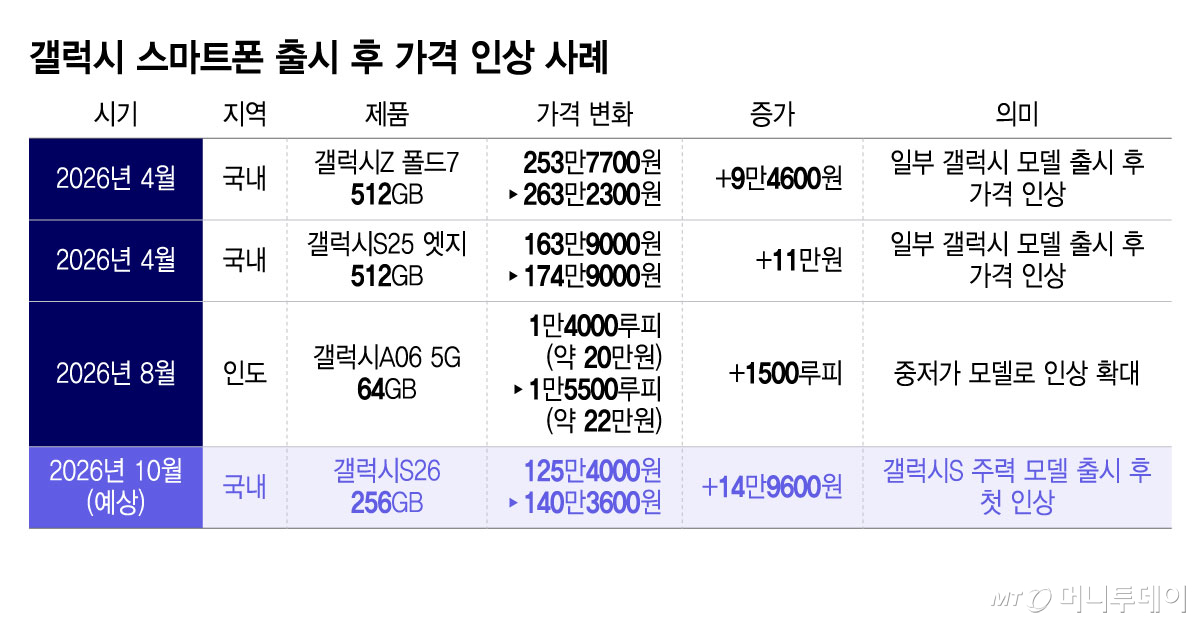
According to industry sources on the 14th, Chinese companies were the first to raise prices one after another, and following Apple, Samsung Electronics has also begun to officially increase its factory gate prices. Samsung Electronics plans to raise the factory gate price of its flagship Galaxy S26 series by 11.9% in October.
According to market research firm Counterpoint Research, retail prices for smartphones sold globally this year have risen by an average of 15% compared to the beginning of the year. This is the first time that more than 40% of all smartphone models have seen price increases. In particular, new products launched this year were priced on average 25% higher than equivalent models from last year.
Chinese companies have already raised prices multiple times this year. Huawei, Xiaomi, and Honor also adjusted the prices of key products on the 1st. Huawei increased the Mate 80 Pro and Pro Max by 1,000 yuan (about 200,000 won), while Xiaomi raised the price of the Xiaomi 17 by 300 yuan (about 60,000 won). Honor also raised prices for some products by 300 to 600 yuan (about 60,000 to 120,000 won).
The core factor behind the price hikes is memory. It was reported that the procurement cost for 12GB+256GB memory for smartphones in China surged by 340% from about 500 yuan (about 100,000 won) a year ago to recently 2,200 yuan (about 440,000 won). TrendForce forecasts that the memory cost for the 256GB iPhone 18 Pro this third quarter will also be about 40% higher than the same period last year.
This is due to a surge in demand for HBM (high-bandwidth memory) and high-capacity DRAM for servers as AI server investments increase. As memory manufacturers have concentrated their production capacity on server-grade memory, cost burdens for smartphone and PC companies have also grown.
Samsung Electronics has also successively raised factory gate prices for mid-to-low-end products such as the Galaxy A, F, and M series, along with some models of the Galaxy S25 Edge, Z Fold7, and Flip7 in both domestic and international markets this year. This is the first time since launch that factory gate prices have been increased. In particular, the Galaxy S26 marks the first time a flagship model price has been raised after its initial launch. Industry analysts note that while Samsung Electronics delayed raising flagship model prices as much as possible to expand market share, it has reached its limit.
An industry official stated, "Flagship models are equipped with high-spec components such as relatively large-capacity memory, so they inevitably face greater burdens from rising costs." He added, "This is a common issue faced by global smartphone manufacturers, and unless memory prices stabilize, the possibility of further smartphone price increases remains open."
Manufacturers are lowering cost burdens by adjusting storage capacity or camera specifications, while consumers are delaying smartphone replacements or turning to used and refurbished products. Samsung Electronics recently began selling official Galaxy S26 series refurbished products in India, France, Germany, and the UK at prices about 15% lower than new models.
Tarun Pathak, Director at Counterpoint Research, analyzed that "memory has become a key factor driving up smartphone BOM (bill of materials), reshaping the pricing structure across the industry," and added, "Manufacturers have limited capacity to absorb these increased costs on their own."

 in TECH
