

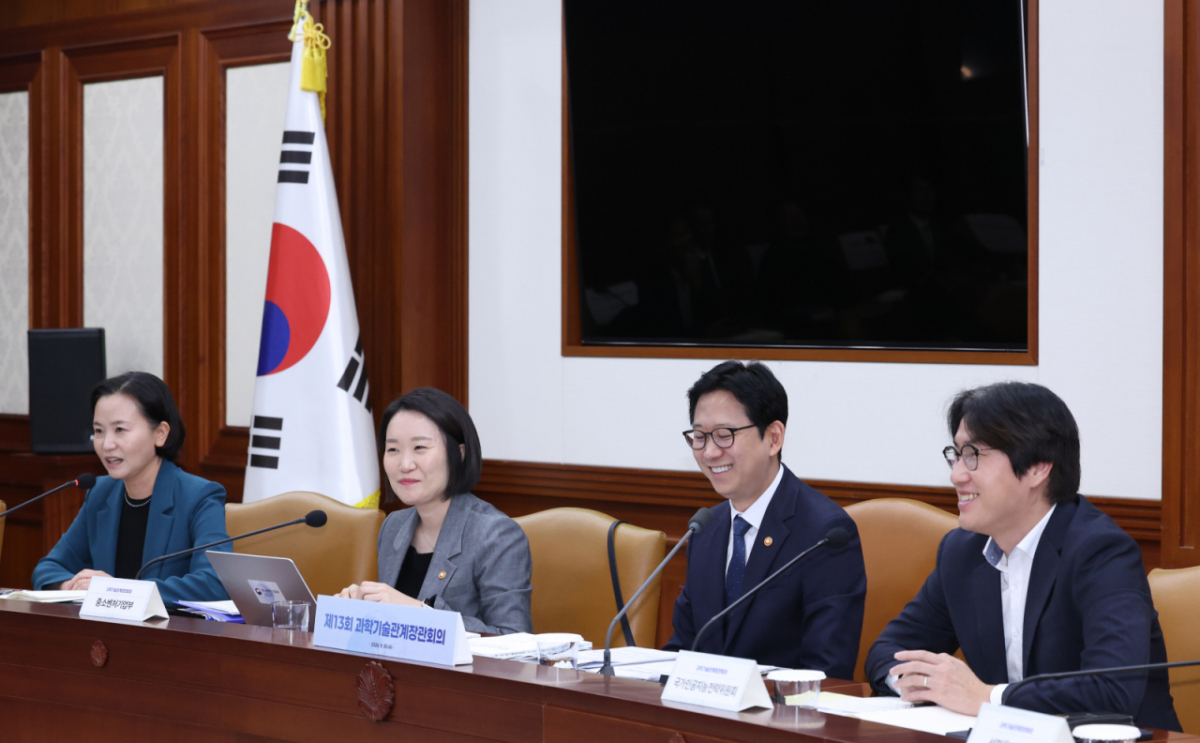
"A year ago, in the Standing Committee, I stated that inter-ministerial collaboration is crucial for science and technology, that elevation to Deputy Prime Minister was necessary, and that I would provide legislative support for it. That makes this occasion even more meaningful."
Lee Hae-min, Cheong Wa Dae AI Future Planning Chief of Staff, attended the 13th Science Gi Sul-gwan-gye (Minister) Conference held at the Government Seoul Complex on the 30th of last month for the first time and said as much. Deputy Prime Minister Baek Gye-hoon, who also serves as Minister of Science and ICT, and Ha Jeong-woo, Full-time Vice Chair of the National AI Strategy Committee, were in attendance.
The reason why three figures leading AI policy unusually attended the Science and ICT Ministers' Conference together was revealed later. They had gathered to mark the one-year anniversary of the elevation of the Minister of Science and ICT to Deputy Prime Minister level on the 1st. During his time as a National Assembly member, Chief of Staff Lee emphasized the need to elevate the Ministry of Science and ICT to the Deputy Prime Minister level and promised legislative support.
Although Bae Gyeong-hun (Minister) took office on July 17 last year, the elevation to Deputy Prime Minister occurred on October 1. This was the first time in 17 years that the Minister of Science and ICT had been elevated to the Deputy Prime Minister level. As a result, the "Science Gi Sul-gwan-gye (Minister) Conference," serving as a focal point for inter-ministerial collaboration centered on science, technology, and AI, became possible. Over the past year, Deputy Prime Minister Baek has advanced national AI policies through the Science and ICT Ministers' Conference, including securing GPUs, developing an independent AI foundation model (Dokpa-mo), "AI for All," and security-specialized AI models, thereby accelerating Korea's leap to become one of the top three AI powers. As a researcher by background, the concerns and difficulties he experienced in actual AI development were directly reflected in policy.
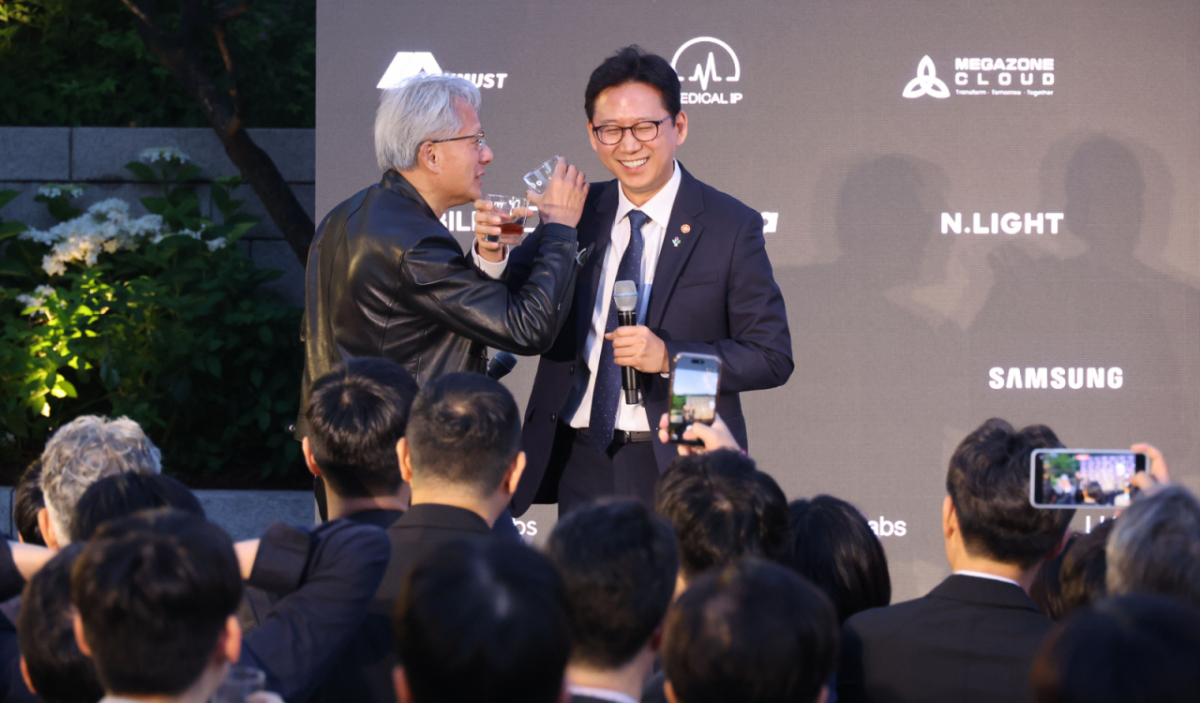
One of the first tasks pursued in the AI field was securing GPUs (Graphics Processing Units). Amidst the emergence of China's DeepSeek last year, which highlighted the shortage of domestic AI infrastructure such as GPUs, he met with NVIDIA CEO Jensen Huang at Gyeongju APEC and secured a promise to supply 52,000 GPUs by 2030. Subsequently, through cooperation with NVIDIA, the goal of securing 52,000 GPUs was moved up to 2028. Next year, 10,000 units of NVIDIA's latest GPU, Vera Rubin, will be introduced.
Through the Dokpa-mo project, AI DNA has been embedded in many domestic IT companies. Dokpa-mo is a project established for Korean IT companies that had been unable to develop AI due to GPU shortages, through which five national representative elite teams and various AI models were born. Eight models showcased by these teams were selected as "Notable Models" by Epoch AI, a non-profit AI research institutional investor, elevating Korea to the ranks of top three AI nations.
Beyond AI, three mega-projects bundling semiconductors, AI data centers, and physical AI are being pursued, along with seven seed projects including SMR, nuclear fusion, renewable energy, quantum, aerospace, advanced bio, and advanced supply chains.
The government plans to continue advancing AI and science and technology at the inter-ministerial level rather than through individual ministries. The Science Gi Sul-gwan-gye (Minister) Conference, chaired by Deputy Prime Minister Baek, plays a central role in this effort.
An industry official who participated in Dokpa-mo stated, "At first, we doubted whether we could create an AI model ourselves, but now we have achieved a shift in perception that we can do it." He added, "Above all, the significance is great because an AI ecosystem has been created in Korea, meaning students no longer need to go abroad to build AI models."

 in TECH

