

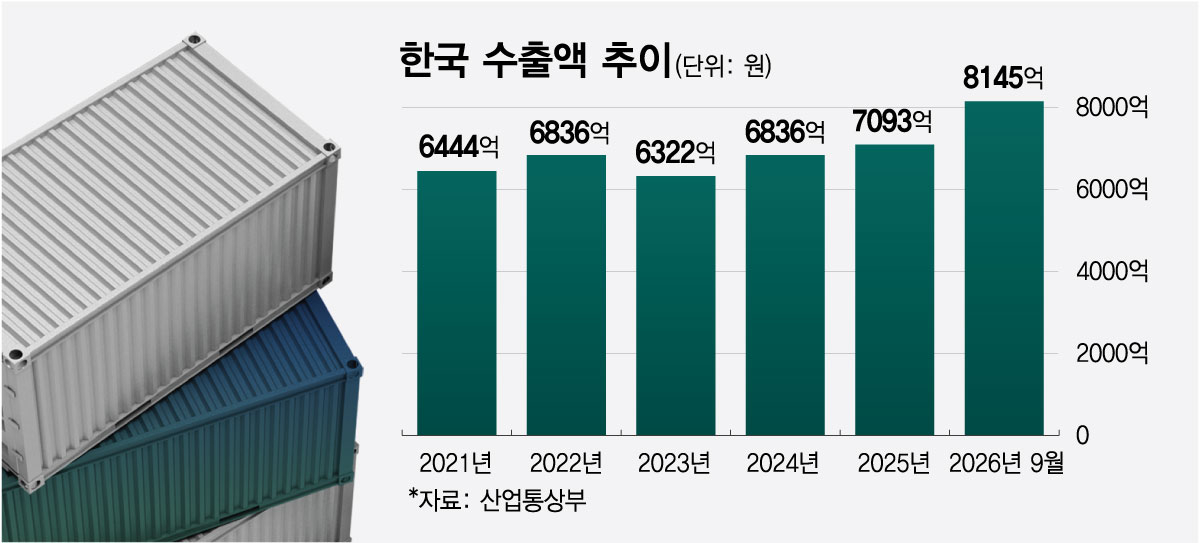
As Korea's exports are on the verge of entering a historic era of 1 trillion won in annual value, the structure of its exports is also changing rapidly. While the share of semiconductors has grown from about one-quarter of total exports a year ago to nearly half, exports of AI (artificial intelligence)-related items, ships, and cosmetics are also increasing, and the scope of export markets is expanding beyond China and the United States to major markets such as ASEAN and the EU.
According to the Ministry of Trade, Industry and Energy on the 1st, exports from January to September this year reached $814.5 billion, already surpassing last year's annual export value of $709.3 billion. September exports were $120.94 billion, an increase of 83.5% compared to the same month last year, marking the first time monthly exports exceeded $120 billion. It is also the first time that cumulative exports from January to September have surpassed $800 billion.
The key factor behind the growth in export volume is undoubtedly semiconductors. September semiconductor exports reached $60.3 billion, a 262.8% increase, surpassing $60 billion for the first time in history and accounting for 49.9% of total exports. In September last year, they were $16.62 billion, representing about 25% of total exports. In just one year, the weight of semiconductors in Korea's exports has nearly doubled.
A notable feature is that not only prices but also volumes increased amid expanding memory demand. At a briefing on the day, Kang Gam-chin, Director of the Trade and Investment Division at the Ministry of Trade, Industry and Energy, explained that September semiconductor export volumes increased by more than 10%. This means that actual demand expansion, in addition to price increases, supported the growth in exports.
The growth is not solely dependent on semiconductors. September computer exports surged 435.3% to $7 billion, driven by the spread of agentic AI and increased demand for AI infrastructure. Electrical equipment exports also rose 23.4% to $1.83 billion. Excluding semiconductors, exports increased by 23%, and excluding both semiconductors and computers, they grew by 12%. While semiconductors are driving overall export growth, the upward trend is spreading to other items as well.
Traditional manufacturing industries and consumer goods also contributed. Ship exports increased by 29.9% due to a rise in delivery volumes for LNG carriers and ultra-large gas carriers, while steel rose by 3.3% on the back of demand related to data centers. Cosmetics exports hit an all-time high of $1.51 billion, up 31.4%. Automobiles decreased by 5.5% due to factors such as a reduction in operating days caused by the shift in the timing of the Chuseok holiday and sluggish used car exports, but daily average exports increased by 5.5%.
Changes were also seen in export markets. Exports to China rose 122.7% to $26.01 billion, and exports to the United States increased 137.0% to $24.33 billion, both surpassing $20 billion. Exports to ASEAN also grew 92.6% to $21.29 billion, breaking through $20 billion in a single month for the first time, while exports to the EU increased by 20.9% to $8.65 billion. While existing markets such as China and the United States expanded significantly, the growth trend continued into regions like ASEAN and the EU.
However, export growth was not evenly distributed across all items. Among the top 20 major export items in September, exports of 11 items increased, while some items such as auto parts, displays, general machinery, and bio-health declined.
The background behind the increase in export value also varied by item. Petroleum products saw a 72.0% increase in export value, but volume decreased by 6.9%, and petrochemicals saw a 5.1% rise in export value, while volume fell by 19.1%. This reflected the impact of rising international oil prices due to factors such as reduced vessel traffic through the Strait of Hormuz and expanded shipping risks in the Red Sea. In contrast, semiconductors saw an expansion in export volumes alongside rising memory prices.
The government plans to promote measures such as strengthening export finance and trade finance, expanding the export capabilities of SMEs (small and medium-sized enterprises), diversifying items, and entering new markets ahead of the 1 trillion won export era. The challenge for exports after reaching 1 trillion won remains how much the semiconductor-centered boom can be expanded to other items and markets.

 in ECONOMY
