

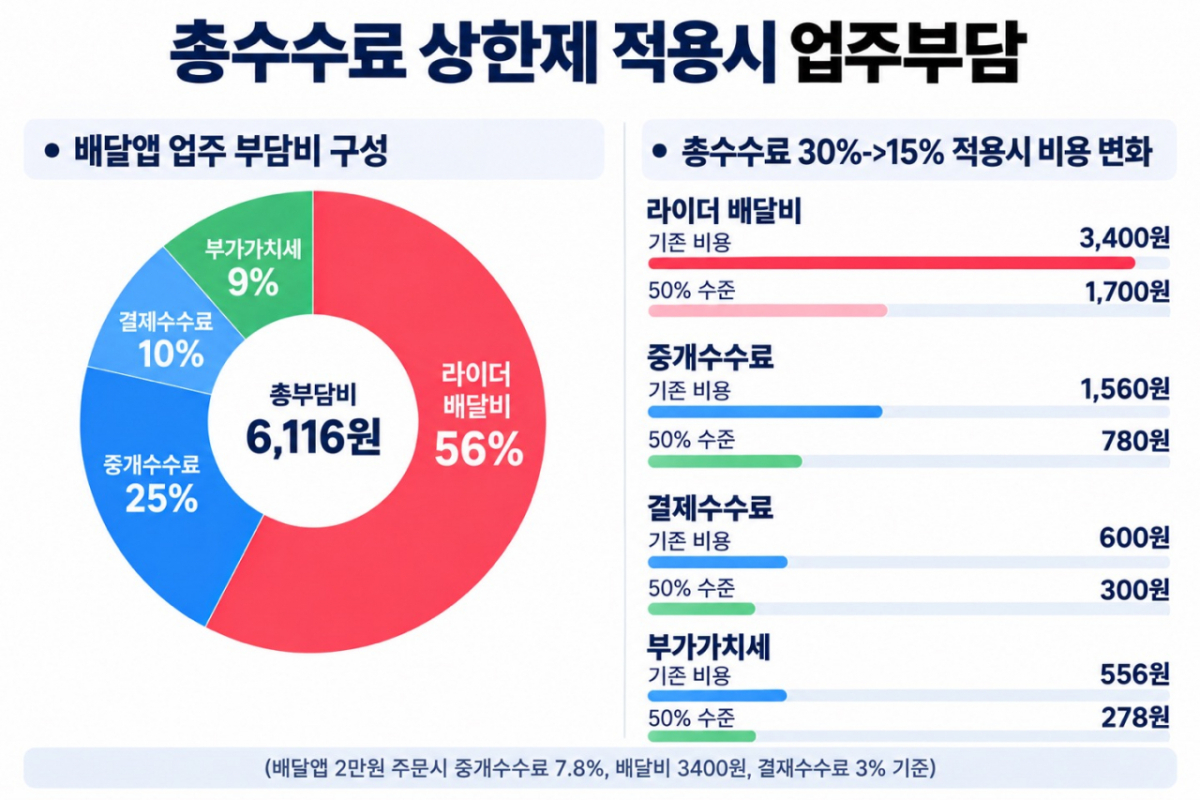
As discussions on a fee cap system for delivery apps have intensified in the National Assembly, controversy is brewing over whether to include delivery fees paid to delivery riders within the scope of regulation. Separate from the intent to reduce the burden on small business owners, there are concerns that capping delivery fees—which constitute rider wages—under the total fee cap could ultimately lead to a decrease in rider income.
The "Act on Fair Trading in Delivery Platforms," published on the National Participation Legislation Center on the 2nd, stipulates that the sum of delivery fees, brokerage fees, payment processing fees, and advertising fees charged by delivery platform operators to registered merchants must not exceed 15% of the sales amount for the relevant order.
The issue lies in the nature of delivery fees. While brokerage fees are charges collected by the platform for connecting merchants with consumers, delivery fees are closer to labor costs paid to riders who actually perform the deliveries. However, bundling these together with brokerage fees, payment processing fees, and advertising fees into a single "total fee rate" inevitably subjects delivery fees to the pressure of cap regulations.
For example, if the rider's delivery fee is 3,300 won on a 20,000 won order, the delivery fee alone accounts for 16.5% of the order amount, already exceeding the 15th% cap. If the delivery fee is set at 3,400 won, and a payment processing fee of 600 won and value-added tax of 400 won are added, the total burden becomes 4,400 won, or 22% of the order amount, even if the brokerage fee is zero. This means that as soon as delivery fees are included, the cap can be exceeded even in structures where no brokerage fee is charged.
In this case, the easiest way for platforms to avoid regulation would be to lower delivery fees. This is because even if brokerage fees are reduced or eliminated, including delivery fees could push the total fee rate above 15%. Consequently, it is pointed out that even if the cap system aims to alleviate the burden on small business owners, it may function in practice as pressure to reduce rider delivery pay.
The Delivery Platform Labor Union also raised issues regarding this point. In a statement on the 2nd, the union stated, "For delivery riders, the unit price of delivery fees is essentially wages," and added, "Mechanisms are needed to ensure that burdens do not shift to unit prices as fees decrease." The union's position is not against the fee cap system itself, but rather that the method of bundling delivery fees into the same framework should be viewed cautiously.
Regarding the delivery fee clause, the union stated, "While we agree on setting a minimum line, it is not an issue to rush in legally determining the upper limit of delivery pay that riders can receive." If there is a structure imposing sanctions on platforms that pay above the delivery fee cap, the act of paying riders higher delivery fees could itself conflict with regulations.
Delivery fees are not determined proportionally to food prices. For the same 3km delivery, rider costs are determined by travel distance and time, weather, waiting time, and regional demand, regardless of whether the order is for 10,000 won or 50,000 won. However, imposing a cap that prevents fees from exceeding a certain percentage relative to food prices means that delivery fees will easily exceed regulatory limits for orders with lower average ticket sizes.
Lee Yu-seok, [Professor] at Dongguk University Gyeong Yeong-hak-gwa (Prof.), pointed out that "in services where costs do not proportionally match transaction amounts, percentage-based caps Bank of Korea cannot reflect actual cost structures," and added, "Bundling services with different natures, such as brokerage, payment, advertising, and delivery, into a single percentage makes it difficult to reflect the characteristics of individual services."
The absence of rider participation in the process of determining delivery fees is also an issue. The union argued that while associations of shop owners are granted the right to request consultations with platforms regarding delivery fees, rider organizations performing deliveries do not have such rights. This means it must first be clarified who consults on delivery fees.
This is also linked to the minimum wage system for platform workers being discussed by the government. Policies aiming to guarantee a minimum delivery fee for riders and regulations on the lower limit of delivery fees converge in that they both protect riders' minimum income. The union stated, "Since the lower limit on delivery fees Bank of Korea is a mechanism similar to minimum wages, these two discussions should not be handled separately but together."
The starting point of the fee cap system for delivery apps is alleviating cost burdens for small business owners. Including delivery fees in the total fee changes the nature of the discussion. It becomes price control that includes rider labor costs, rather than just regulation of platform brokerage fees.
Kim Tae-young, a professor in the Department of International Logistics at Chung-Ang University, said, "When introducing a fee cap system, market contraction could lead to a decrease in riders' jobs and income," and added, "In an ecosystem where riders, consumers, shops, and platforms are all connected, balanced design is needed to ensure that the livelihoods and stability of one party are not compromised while alleviating the burden on another."

 in TECH
