

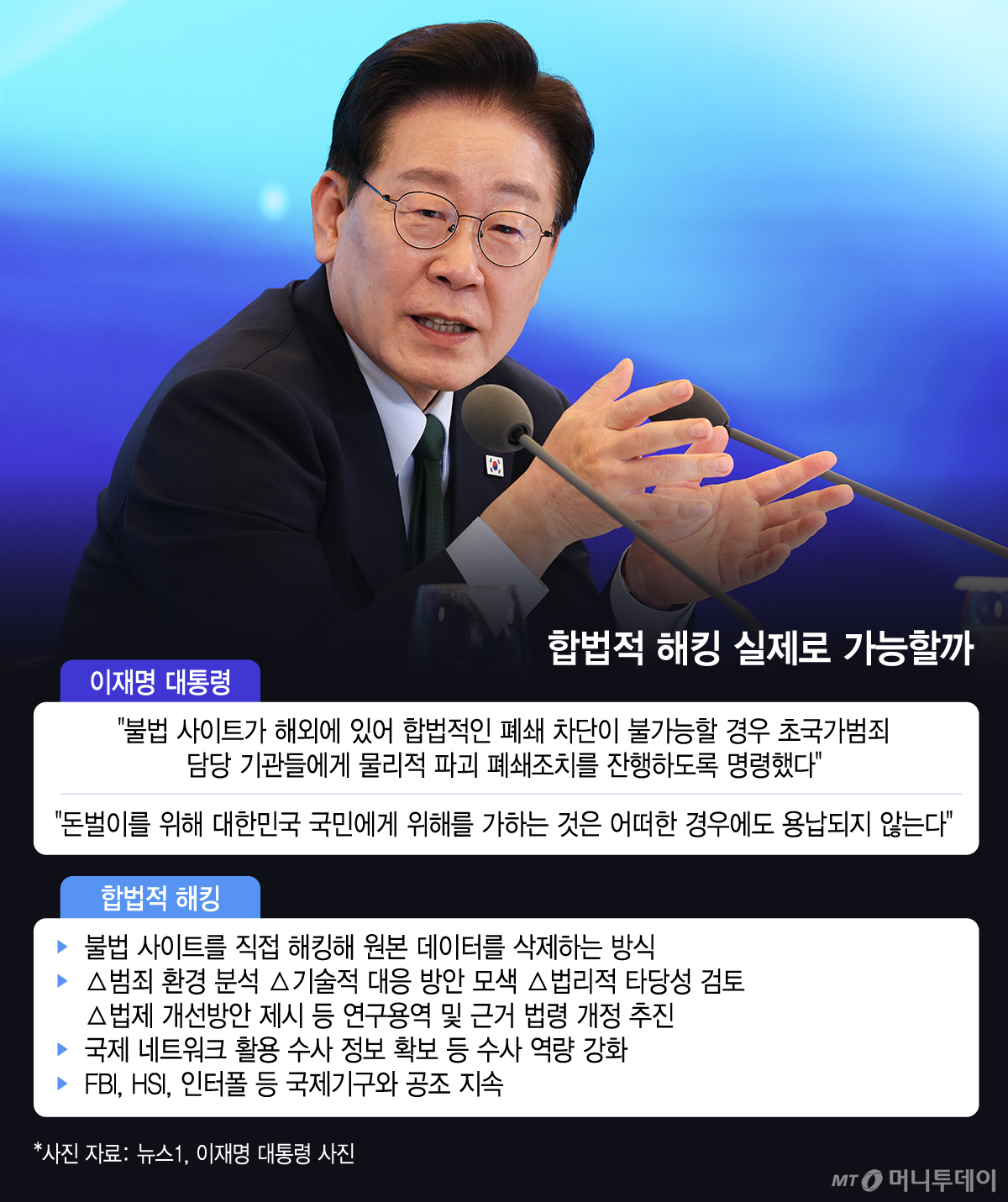
“In cases where legally compliant blocking is impossible, I have ordered institutional investors responsible for transnational crimes to carry out physical destruction and shutdown measures.”
President Lee Jae-myung brought so-called “legal hacking” into public discourse on social networking services (SNS). He stated that he had ordered the direct hacking of illegal sites to delete original data. The IT industry points out that establishing a legal basis and international cooperation are crucial.
Currently, for illegal sites where sexual exploitation content is shared or illegal gambling takes place, the government blocks access after review by the Broadcasting, Media and Communications Commission. However, since most illegal sites host their servers overseas, these measures remain temporary. The government has been attempting to block such sites in cooperation with overseas hosting providers, but its efforts have proven insufficient.
The “legal hacking” publicized by President Lee is interpreted as referring to the review of introducing an active defense system being jointly pursued by relevant ministries and agencies, including the Ministry of Gender Equality and Family, the Broadcasting, Media and Communications Commission, and the National Police Agency. In August, authorities argued that it was necessary to introduce an active defense system capable of swiftly halting digital sexual crime victims’ harm through collecting investigative leads via direct access to sites by law enforcement authorities and deleting original data.
Authorities announced they would pursue research contracts and amendments to underlying laws, including analyzing the criminal environment, seeking technical response measures, reviewing legal validity, and proposing legislative improvements. They also stated that they would strengthen investigative capabilities, such as securing investigative information through international networks, and continue cooperation with foreign law enforcement authorities like the U.S. FBI (Federal Bureau of Investigation) and HSI (Homeland Security Investigations), as well as international organizations such as Interpol. Additionally, they said they would utilize information received from entities such as the U.S. NCMEC (National Center for Missing & Exploited Children) and CRC (Child Rescue Coalition) for investigations into identifying operators of illegal sites.
Similar systems are already in operation overseas. In Australia, law enforcement authorities have been granted new powers to identify and disrupt criminal infrastructure to prevent and block criminal acts. These include the authority to add, copy, delete, or modify data stored on computers; the authority to collect information for exploring and identifying online criminal network infrastructure; and the authority to take control of online accounts and exclude account holders’ access. The United Kingdom also guarantees both remote access intrusion and system modification and control under its Investigatory Powers Act.
In the domestic security industry, voices are emerging that such legal hacking is technically feasible and would be effective.
A source in the security industry said, “If we can take control of an attacker’s servers and infrastructure to delete or neutralize illegal data, it could achieve substantial results, unlike existing site access blocking measures which can be circumvented.” The source added, “This process could also secure information about the attackers, aiding in the apprehension of criminals.”
Another source stated, “While legal hacking would greatly help in relieving crime victims, there appear to be many hurdles to overcome before it is actually implemented.” The source continued, “Various legal and technical reviews and research, as well as cooperation with the international community, must come first.”

 in TECH
