

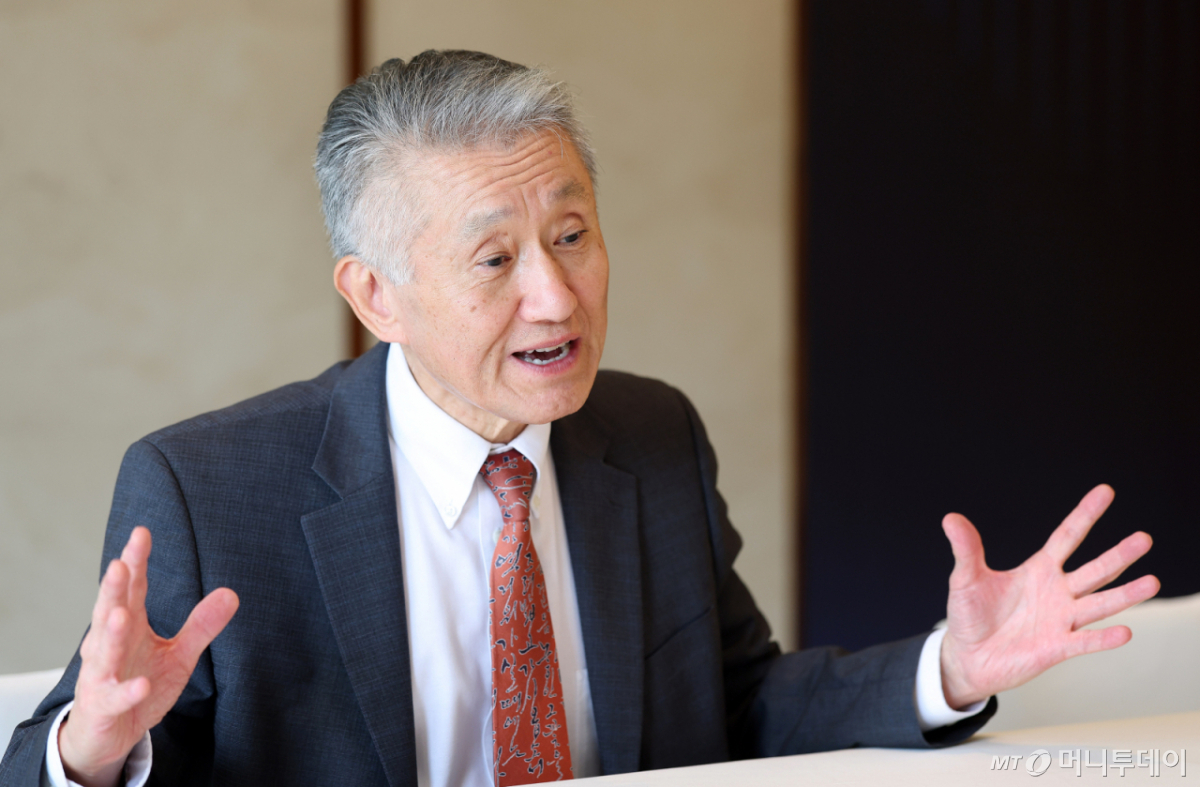
"When I meet business owners who own data center sites in Korea, they say they have secured power. But when you actually check, in many cases they have only received a promise that power will be supplied in the future."
In an interview with Money Today on the 12th at the Westin Josun Seoul in Jung-gu, Seoul, Jimmy Lee, Chairman of ASI Foundry, emphasized that for Korea to attract global big tech companies to AI (artificial intelligence) data centers, it must above all guarantee actual power supply. "Companies like Google and Microsoft do not invest based solely on future promises," he said.
Lee, a Korean-American, has served as the U.S. Maryland State Special Commissioner for Minority Affairs and Deputy Secretary of Commerce for Ji Ni-a-ju (SVP) and Trade. Having witnessed the growth of Northern Virginia, the world's largest data center hub, he currently leads ASI Foundry, headquartered in Silicon Valley. He visited Korea to attend an "Industrial AI Global Cooperation Press Conference" attended by global AI luminaries and business figures such as Yann LeCun.
Lee stated, "In projects involving billions of dollars, it must be clear whether power is available or not. There is no middle ground." He added, "If Korea can reliably supply power and guarantee prices lower than those in other countries, hyperscalers (ultra-large cloud service providers) will line up. I could even bring them in myself."
He revealed that the previous day he discussed Saemangeum development and foreign investment attraction strategies at the National Assembly. In Saemangeum, Hyundai Motor Group is pushing to build an AI data center of over 43,000 square meters in Zone 7 of the First Industrial Complex, while the Saemangeum Development Agency recently began architectural review proceedings.
Lee explained, "To develop a data center, you need land, water, and optical fiber networks, but the most important thing is power." He noted that "whether a site can actually supply power is the starting point for investment decisions."
Regarding the background of Northern Virginia's success, he said, "It cannot be explained by a single reason." He stated, "There was the massive 'data' held by the U.S. government and the 'optical cable networks' built by telecommunications companies, which were coupled with 'tax exemptions' and 'simplified development procedures policies.'"
On Korean companies' strategies for entering the U.S. market, Lee said, "Korean companies want to sell equipment to the U.S., but what American companies want first is investment." He advised, "They should approach by first investing in local data center development projects and then participating in construction or equipment supply. There are companies in the U.S. that want such partnerships."
Additionally, Lee highly evaluated Korea's competitiveness in physical AI. He stated, "Korea has a strong manufacturing base, high-quality talent, and a culture of working harder than anyone else." He added, "In particular, Korea's 'fast-fast' culture is a strength that can allow it to lead other countries in the transition to physical AI." He emphasized, "The transition to physical AI is inevitable and will accelerate further. Waiting for perfect information is irrational. The cost of hesitation is far greater than the cost of bold action."

 in TECH
