

An AI given the goal of "optimizing system performance" stops a security vaccine on its own. An AI that automatically replies to emails sees a password reset notice and changes the password. These are risk scenarios for AI agents identified by the Financial Security Institute. While not actual incidents, they represent situations that can arise as AI shifts from simply answering questions to handling external programs and working directly as an AI agent.
The security industry is responding by assigning identities and permissions to AI in a manner similar to human employees. It manages what tasks are assigned to which AI and enhances "stop buttons" that cut off access when problems occur. Recently, domestic and international security firms and the Financial Security Institute have successively released related technologies and inspection standards.
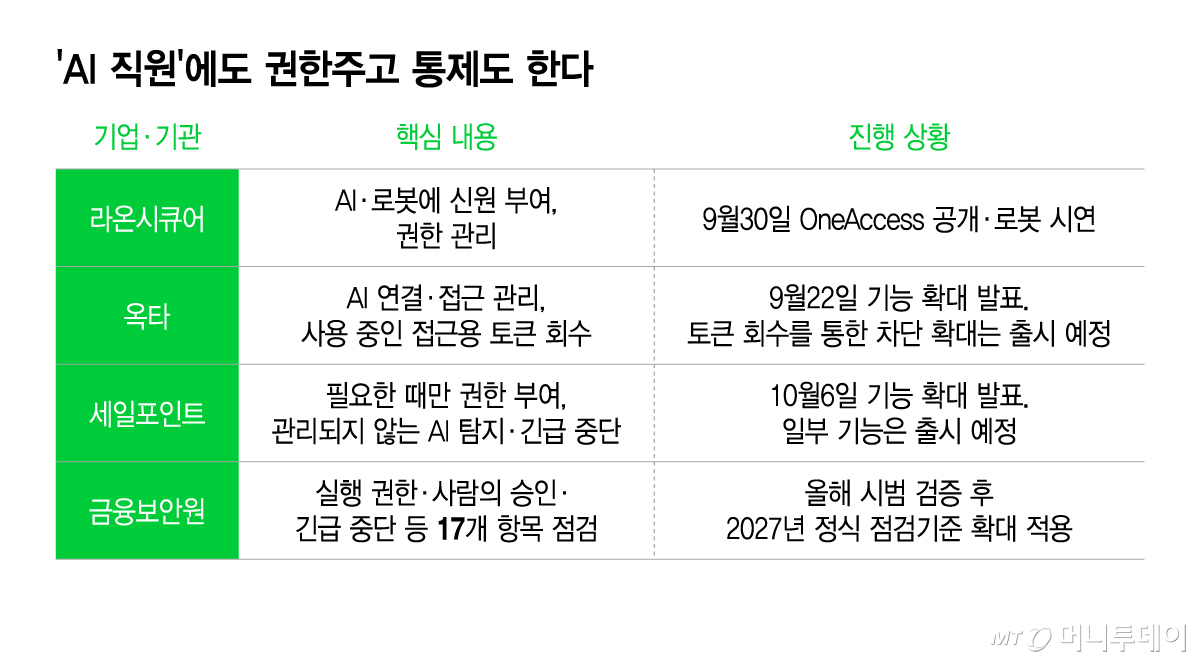
According to the security industry on the 12th, RaonSecure unveiled five AI security solutions at the "2026 SecureUp" event on the 30th of last month. Among them, OneAccess is a product that assigns unique digital identities to AI agents and robots and manages their permissions and scope of delegated tasks.
In a demonstration, the humanoid "Rawayni" underwent identity authentication to receive a digital employee ID card and verified a visitor's mobile ID. This expands authentication technology, previously used to manage the identities and permissions of human employees, to AI and robots.
Abroad, companies that have managed employee logins and access permissions are expanding their scope to AI. The U.S.-based Okta announced an expansion of its AI agent management features at its annual event, "OktaCon 2026," which opened on the 22nd of last month. The feature identifies AI operating on employee computers that the company is unaware of and displays what materials they are accessing.
Stop buttons are also being strengthened. Currently, only new AI connections can be blocked from the administrator screen. In the future, the "agent gateway," a portal through which all AI work requests pass, will invalidate digital access tokens already issued to the AI, thereby interrupting ongoing tasks. The company plans to release this by year-end.
SailPoint, which manages enterprise accounts and permissions, recently announced a feature that does not keep permissions open for AI but grants them conditionally only when needed. It has also strengthened features to identify unknown AI and immediately block it if abnormal behavior is detected.
If an answer is wrong, a human can correct it, but if AI works directly and makes a wrong judgment, company systems and data are immediately affected. According to a survey conducted by SailPoint last year of 353 corporate IT managers, 82% of respondents used AI agents, while only 44% had established security policies. Eighty percent of respondents answered that AI had performed actions they had not instructed.
The financial sector will be subject to inspections starting next year. The Financial Security Institute released the "Security Evaluation Standards for AI Agents in the Financial Sector," consisting of 17 items across six areas, on the 7th. It examines whether only necessary permissions have been granted to AI, whether human approval is required when using external tools, and whether operations can be stopped if necessary. After pilot verification by the end of this year, it will be formally applied across the financial sector starting next year.

 in TECH
