

Krafton plans to unveil a next-generation robot foundation model in early next year that can freely converse with people and alter its behavior depending on the situation. Unlike existing physical AI (artificial intelligence), which has focused on refining robotic movement, the company aims to implement "social intelligence"—the ability to understand human intent and communicate—within a single model.
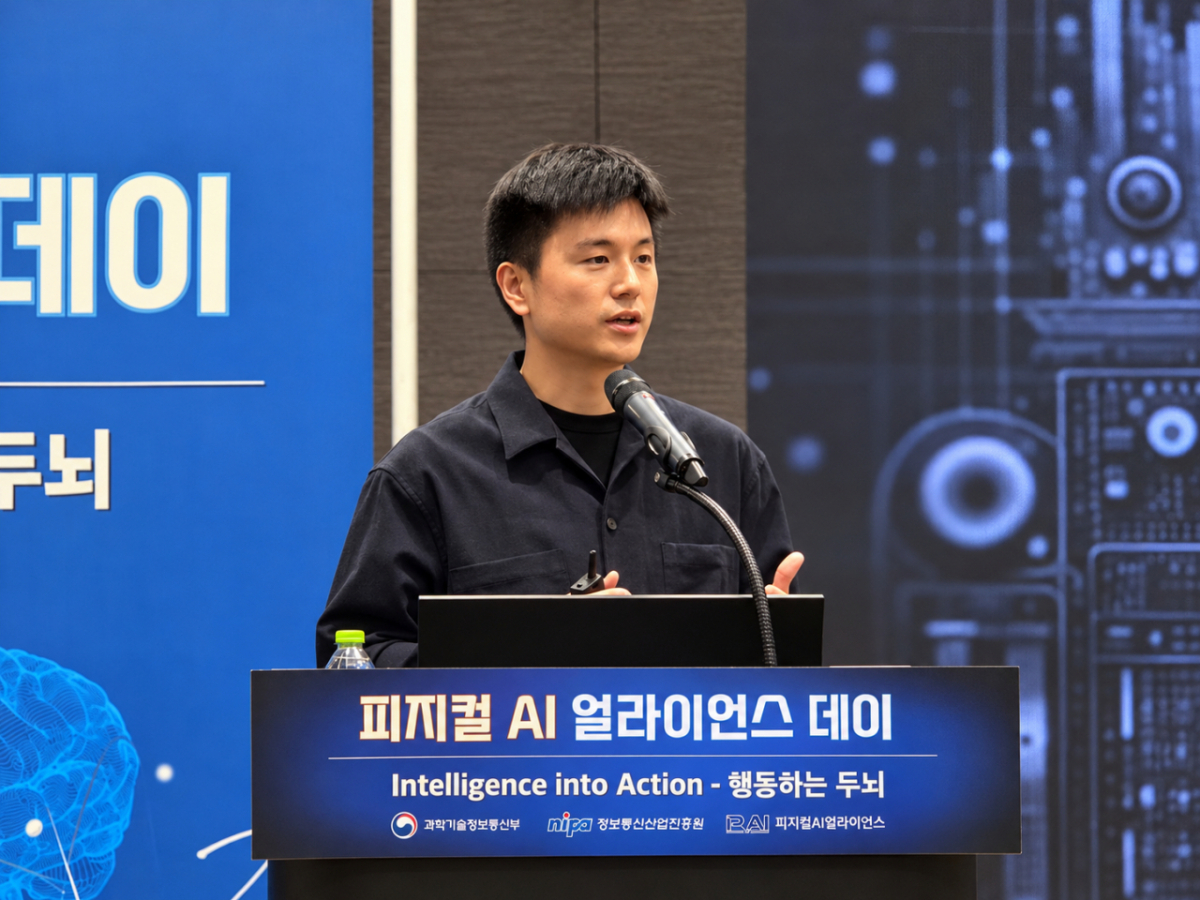
Lee Kang-wook, Chief AI Officer (CAIO) of Krafton, stated at the "Physical AI Alliance Day" held on the 13th at COEX in Seoul Gangnam-gu, "Our goal is to create a foundation model where a single model can generate both actions and speech," adding, "We expect to be able to unveil our model in early next year."
CAIO Lee categorized robotic capabilities into physical intelligence and social intelligence. While physical intelligence refers to abilities such as walking or grasping objects, social intelligence is the ability to understand human instructions, reconfirm ambiguous commands, and modify behavior in response to changing situations.
He noted, "In current physical AI, everyone is looking only at the X-axis (physical intelligence), and there are very few companies or research institutes focusing on the Y-axis (social intelligence)." He pointed out, "Although many robot foundation models are emerging in the world, a model that can work while conversing with people does not yet exist."
He further explained, "If a robot is good at just walking and grasping, it can perform a wide range of tasks, such as taking a dog for a walk or picking up children from an academy." He added, "Because the social intelligence problem has not been solved, robots are not yet widely used in daily life."
Krafton is developing related technologies through its physical AI robotics research institute, "Ludo Robotics," established in Palo Alto, United States. In August, the company unveiled "Rudy 01," a robot AI system that connects large language models (LLMs) with vision-language-action (VLA) models. Krafton currently has more than 120 AI researchers and is utilizing game and simulation data for robot AI training. The company also disclosed that it holds over 1,000 GPUs (graphics processing units).
A demonstration video shown on the day featured a robot immediately modifying its behavior when a person requested a different beverage while the robot was bringing one. CAIO Lee stated, "This video was shot in real time without any editing," emphasizing that it is an AI system where all models operate locally rather than in the cloud.
However, the current method has limitations because the language model and action model are connected separately. CAIO Lee explained, "The two systems are not fully integrated; they are weakly connected through a harness, making it difficult to share context accurately."
In response, Ludo Robotics is developing an integrated model that takes visual and audio inputs to generate speech and actions simultaneously. CAIO Lee expressed his expectation, saying, "When such a model emerges, we will be able to create robot AI that is far more natural and capable than building robots with social intelligence through a harness as we do now."

 in TECH
