

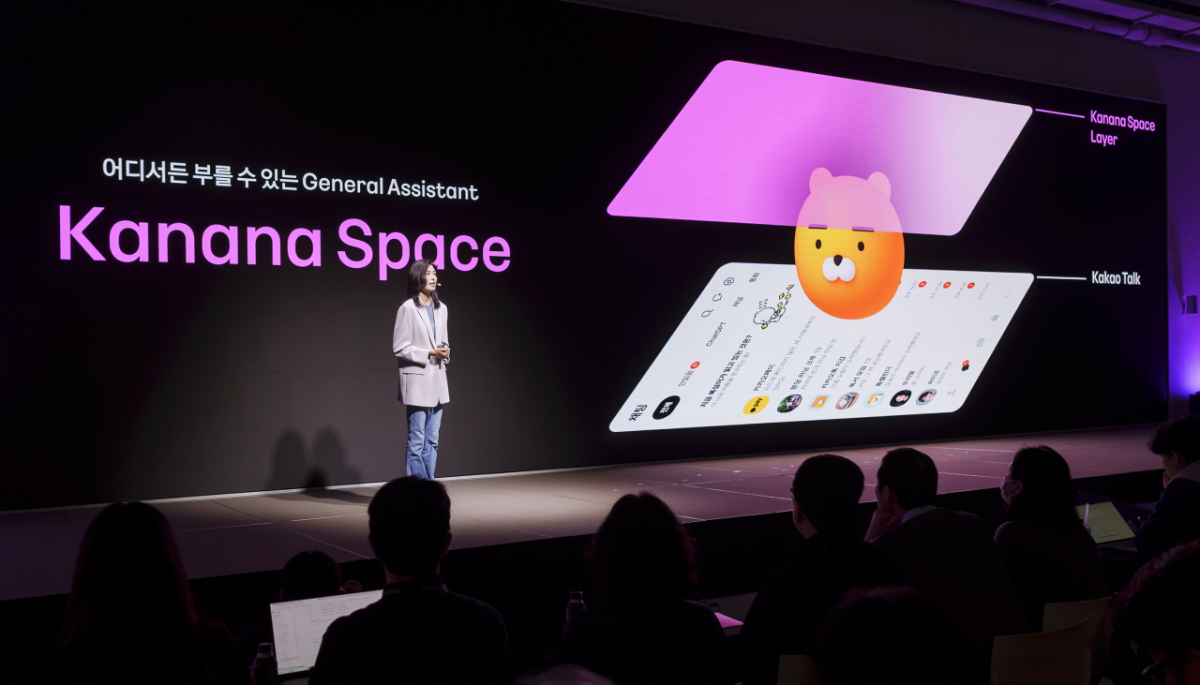
Kakao revealed “Canvas,” a service for building “personal AI agents,” and “Canana Space,” a Korean version of Muse. Both services aim to launch closed beta tests (CBT) within the year. Kakao plans to ensure safety by granting users final confirmation and decision-making authority.
“Autonomous AI agents are still difficult”… Lowering the barrier to entry
On the 13th, Kakao introduced two services at the developer conference “if KAKAO 26,” held at the Kakao AI Campus in Yongin, Gyeonggi Province. Canvas is a service that allows users to easily create and run personal agent teams on their PCs.
Kakao CEO Chung Shin-ah stated, “Although various autonomous agent frameworks emerged in the first half of this year, the process of directly installing them, understanding how they work, and instructing them to perform desired tasks remains unfamiliar and difficult for the general public,” adding, “We aim to lower the barrier to entry with Canvas.” The core elements of Canvas are △the Agent Core Engine, △separate browsers for each agent, and △a sandboxed execution environment. Chung explained that “these elements work together to ensure tasks are performed only within permitted limits.”
The Agent Core Engine allows users to configure and execute required functions even with simple task instructions. It uses local memory to retain context, enabling the performance of repetitive or scheduled tasks. During this process, browsers are separated for each agent to prevent information from individual agents from mixing with web services used in daily life. The sandboxed execution environment restricts security-critical tasks, such as authentication and payments, so they are executed only within permitted parameters.
On the same day, Chung demonstrated how to build an AI agent that handles tax filing and year-end settlement on behalf of users. The agent gathers scattered materials from the PC, inputs them into relevant websites, and then proceeds with filing and payment after user confirmation. Instead of managing every step directly, users only need to verify key moments.
If a useful agent is created, it can be shared with others, such as friends or colleagues. In the first half of next year, Kakao plans to provide a space within KakaoTalk where personal agent teams can be connected. The scope of connectivity will expand to include agents created in other development environments, not just those made with Canvas.
“Canana Space,” an agent residing within KakaoTalk
Canana Space is a service that appears when users swipe the KakaoTalk screen with two fingers, summoning the Kakao character “Ryan” to perform various tasks via voice or text, such as sending messages, managing schedules, web searches, and changing KakaoTalk settings. Kakao plans to enhance the service so that orders, gifts, reservations, and transfers can be executed with a single command.
Canana Space is built as an AI layer rather than a separate tab or screen, allowing it to open anywhere within the KakaoTalk interface. Kim Dae-nyeon, Kakao’s Design Head and Senior Leader, explained, “KakaoTalk has different structures on each screen, and new AI features could disrupt existing user flows, making it difficult to add Canana Space,” adding, “Solving this problem was the starting point for Canana Space’s UX (user experience).”
Canana Space goes beyond finding and summarizing necessary messages; it naturally executes subsequent actions. For example, if a user requests, “Please order bottled water,” the agent recalls previously ordered bottled water, applies available coupons, and completes the order and payment.
However, final selection and control remain with the user. Leader Kim explained, “Important actions, such as sending messages or making payments, follow a structure where users directly verify and give final approval,” adding, “While AI assists with necessary processes, the final decision is made by the user.”

 in TECH
