

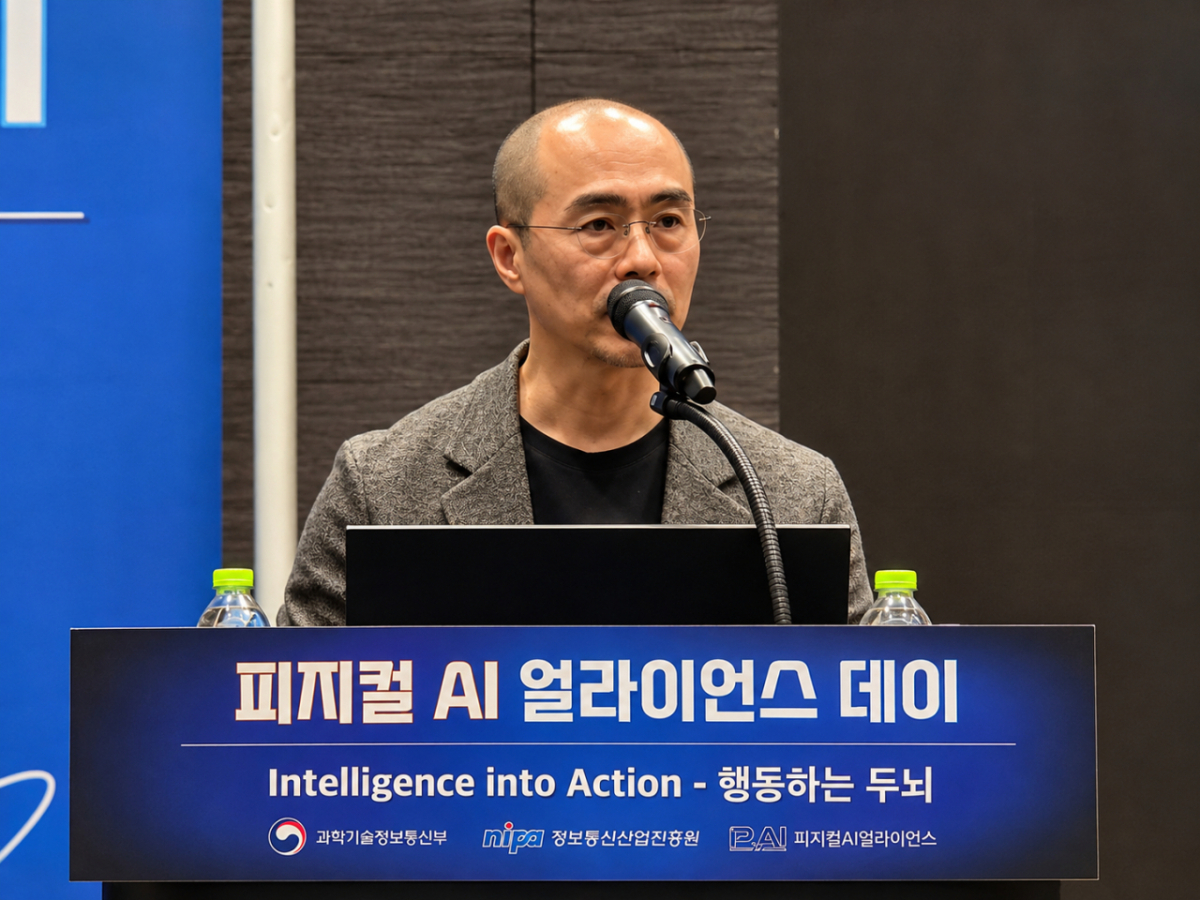
Jung So-young, President of NVIDIA Korea, forecast that as the physical AI (artificial intelligence) market grows, South Korean companies could take on a central role in the global supply chain. She also expressed expectations that meaningful results would soon emerge from collaborations with LG in the physical AI field, including humanoid robots.
At the “Physical AI Alliance Day” held on the 13th at COEX in Seoul Gangnam-gu, Jeong (CEO) stated, “In the traditional data center business, Taiwan has built a very important value chain,” adding, “If physical AI grows into a larger and more significant industry, I hope South Korea can fully take over such roles.”
Physical AI is a technology that combines AI with machines and systems operating in the real world, including not only humanoid robots but also autonomous vehicles and smart factories.
Jeong (CEO) explained, “Physical AI is a concept combining the intelligence of various physical objects existing in the real world with AI.” She noted that South Korea has the potential to grow into a major hub for the physical AI industry, given that it possesses both a manufacturing base and AI technological capabilities.
Citing LG as an example of collaboration with domestic companies, Jeong (CEO) said, “In August last year, LG announced that it would develop its upcoming humanoid robotics and physical AI using NVIDIA’s Isaac platform.” She added, “Currently, very diverse and close cooperation is being carried out based on this, and we expect meaningful results to come out soon.”
She identified data shortages and safety and cost issues as major challenges in the commercialization of physical AI. Jeong (CEO) stated, “Data existing in the real world is inevitably less abundant than what is used to train large language models (LLMs),” adding, “In the process of deploying AI into actual environments, there are far more constraints than with agent AI due to safety and cost issues.”
Simulation is a key technology for solving these problems. It involves generating robot motion data in virtual environments—data that is difficult to secure in real-world settings—and using it for learning and verification. Jeong (CEO) emphasized, “In physical AI, simulation is crucially utilized in every stage, from creating data to learning, verification, and actual deployment.”
She particularly noted, “Because physical AI must work based on 3D (three-dimensional) data, it requires far more computing power than the synthetic data needed for existing LLM (large language model) research,” explaining, “Through computing, we can generate insufficient data to enhance the quality of the entire model.”
Jeong (CEO) forecasted that “requirements for computing will inevitably continue to increase in physical AI as well.” This implies that the expansion of the physical AI market could lead to increased demand for computing infrastructure for data generation and simulation, in addition to semiconductors for robots.
Introducing “NVIDIA AI Day Seoul,” which will be held at COEX on the 9th and 10th of next month, Jeong (CEO) added, “Core executives and developers from our headquarters will attend to provide deeper explanations on various topics ranging from AI factories to agent AI and physical AI.”

 in TECH
