

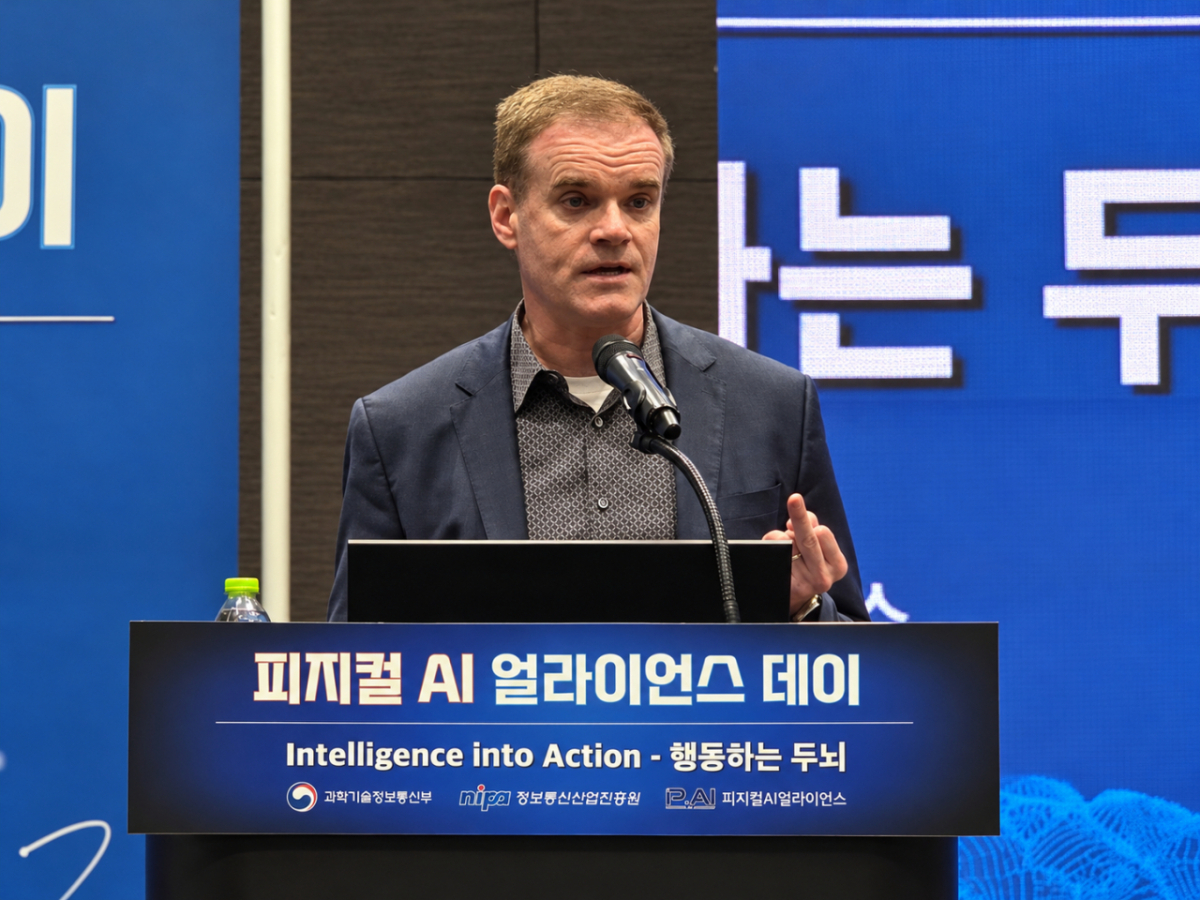
A senior Intel executive praised South Korea as a prime example of a physical AI (artificial intelligence) collaboration ecosystem. He stated that to spread robotics technology into industrial settings, an open ecosystem involving multiple companies is essential, not just the technological capabilities of individual firms.
Speaking at the 'Physical AI Alliance Day' held on the 13th at COEX in Seoul Gangnam-gu, Intel Vice President John Healey said, "To realize complex yet highly promising technologies like physical AI, collaboration among multiple stakeholders is absolutely necessary." He added, "In my opinion, there is no better example of an environment or ecosystem than South Korea."
Vice President Healey pointed out that companies' actual readiness levels are insufficient compared to the growth potential of the robotics industry. According to a survey Intel previously conducted with approximately 800 stakeholders across five global regions and six industrial sectors, only 40% had formulated strategies for large-scale robot adoption. He noted, "We must overcome various obstacles and challenges hindering robot adoption," adding, "This is not just a technological issue, but also one of organizational structure and workflow."
He particularly emphasized the difficulties in applying robots developed in laboratories to actual industrial sites. Vice President Healey stated, "When models or robots are implemented in a lab, they often look very impressive, but in the real world, it is much harder and more complex." He further explained that in the actual deployment process, it is necessary to ensure not only economic viability but also predictable operation and large-scale scalability.
Safety was also cited as a core challenge. He emphasized, "In situations where robots increasingly make their own decisions and act accordingly, especially in environments where they work alongside human workers, safety cannot be compromised." He added, "Safety is not something that can be added at the final stage," explaining that it must be reflected from the early stages of development through all phases.
To address these challenges, Intel is pursuing a strategy that combines open software and semiconductor platforms. The company allocates operations suited to specific tasks across CPUs (Central Processing Units), GPUs (Graphics Processing Units), and NPUs (Neural Processing Units), and supports the real-world application of robots using software tools such as OpenVINO.
Vice President Healey said, "In this market, one approach cannot meet all requirements," adding, "Product roadmaps must be aligned with the demands of actual usage environments, not the other way around."
He explained that progress is being made in showcasing physical AI solutions to the market with partners in various regions, including South Korea. He then emphasized, "There is a saying: if you want to go fast, go alone; if you want to go far, go together," adding, "An ecosystem is about going together."

 in TECH
