

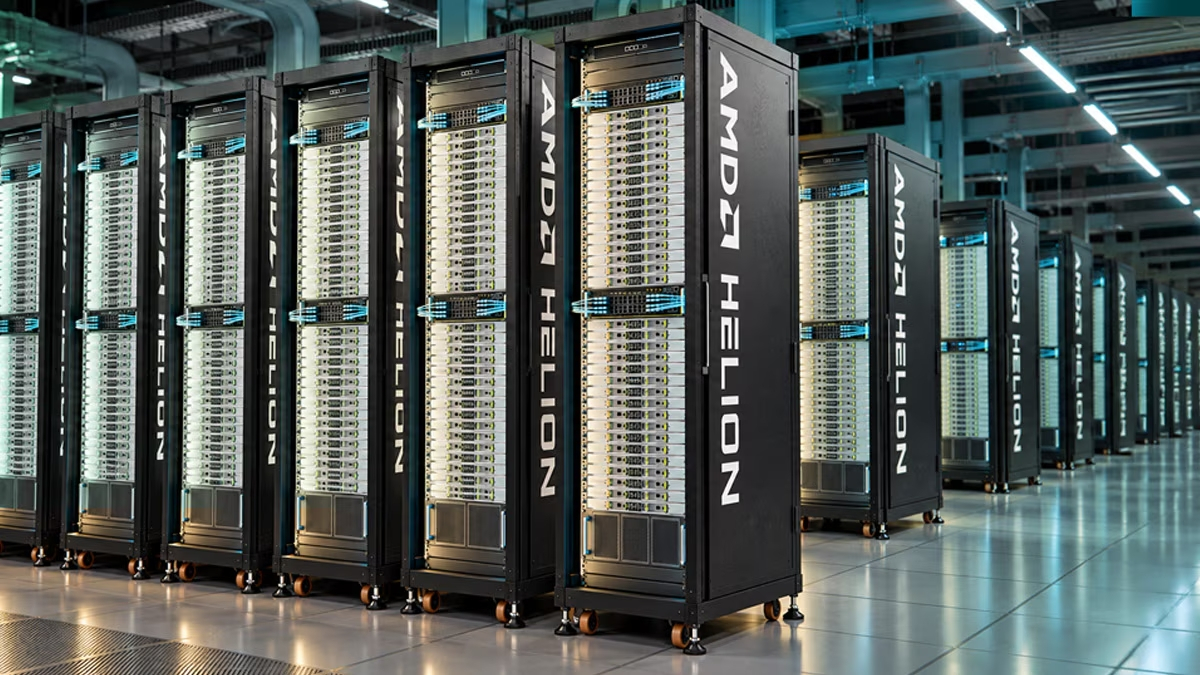
AMD has unveiled "Helion," an artificial intelligence (AI) server rack that supports up to 32,768 central processing unit (CPU) cores. The company introduced server infrastructure capable of leveraging both CPUs and graphics processing units (GPUs) in tandem, targeting the "agentic AI" market, where AI performs multiple tasks on behalf of humans.
AMD announced on the 13th that it had unveiled "AMD Helion," designed based on specifications from the Open Compute Project (OCP), an organization developing open hardware standards. Helion is a product developed for agentic AI, built upon the design approach of AMD's existing AI server rack solution, "Helios."
Agentic AI is a technology that goes beyond answering user queries to autonomously handling multiple tasks, such as searching for information and writing code. While GPUs are primarily used to run AI models, CPUs are also necessary to execute actual tasks and manage various programs. AMD has enabled customers to appropriately combine CPUs and GPUs depending on the type of workloads.
Helion can be configured in two forms: a CPU-only rack and an all-in-one rack combining CPUs and GPUs. The CPU-only rack is equipped with 6th-generation AMD EPYC processors, supporting up to 32,768 CPU cores. It is designed to run multiple AI agents simultaneously in large-scale data centers and can be used in conjunction with separate AI model inference systems.
The all-in-one rack integrates AMD EPYC CPUs and Instinct MI350P GPUs into a single system. This allows enterprises to handle both the running of AI models and the tasks performed by AI agents in one place. It also supports both air-cooling, which uses air to cool servers, and liquid cooling, which utilizes water.
Dan McNamara, Senior Vice President of AMD's Compute and Enterprise AI division, stated, "Agentic AI is not a single workload," adding, "Personal agents, enterprise applications, code execution, and complex business processing each have different computing requirements." He further explained, "Helion combines the performance of AMD EPYC with open software and flexible rack design to support partners in building systems that meet customer needs."
AMD is collaborating with global IT companies to expand Helion's market presence. Participants include Dell Technologies, HPE, Cisco, Lenovo, Supermicro, Hon Hai, and Wistron. These companies plan to support the development and supply of products utilizing Helion, based on their expertise in server manufacturing, system integration, networking, and cooling technologies.
AMD plans to propose Helion's design specifications to the OCP so that other companies can utilize and advance related technologies. The company is currently developing products with its partners and aims to launch them next month.

 in TECH
