

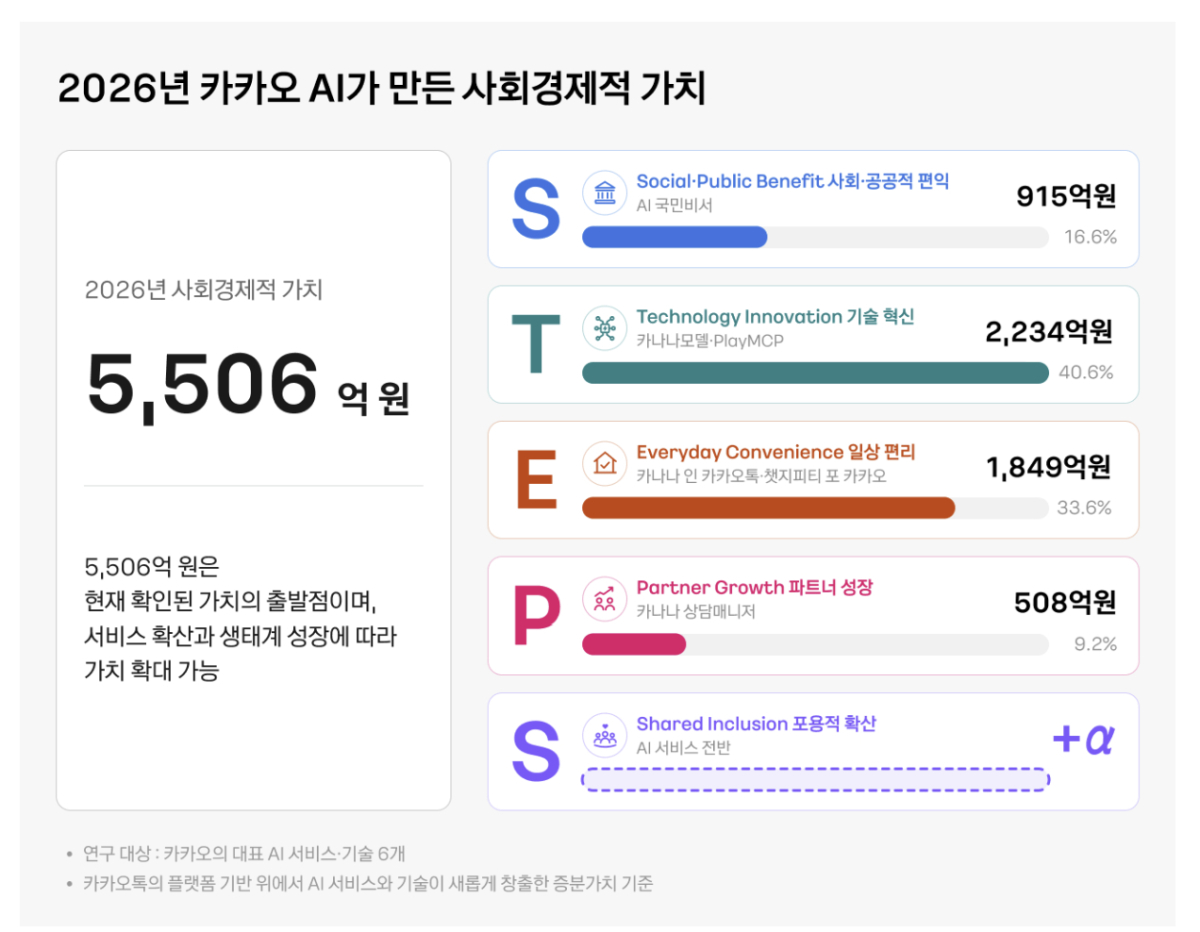
The socio-economic value created by Kakao’s AI services was found to reach approximately 550.6 billion won this year.
Kakao Policy announced on the 13th that it estimated this based on a joint study conducted with KAIST’s Digital Economy Research Center from December of last year through August of this year. It also projected that, with future ecosystem expansion, the value could grow to a maximum of 1.8225 trillion won annually by 2030.
Among the socio-economic value created by Kakao AI this year, the sector accounting for the largest share was the “technological innovation” area (223.4 billion won). The “Cana Model Family,” specialized in Korean context (154.9 billion won), and “PlayMCP,” which reduces service distribution and reach costs for developers (68.5 billion won), served as key drivers.
In the one-way convenience sector (184.9 billion won), it was confirmed that “Cana in KakaoTalk” (83.2 billion won) and “ChatGPT for Kakao” (101.7 billion won) significantly alleviated the burdens users face during information search and execution processes. The social and public benefit area (91.5 billion won) was found to provide an average time-saving effect of 53.2 minutes per document issuance through the “AI National Secretary.”
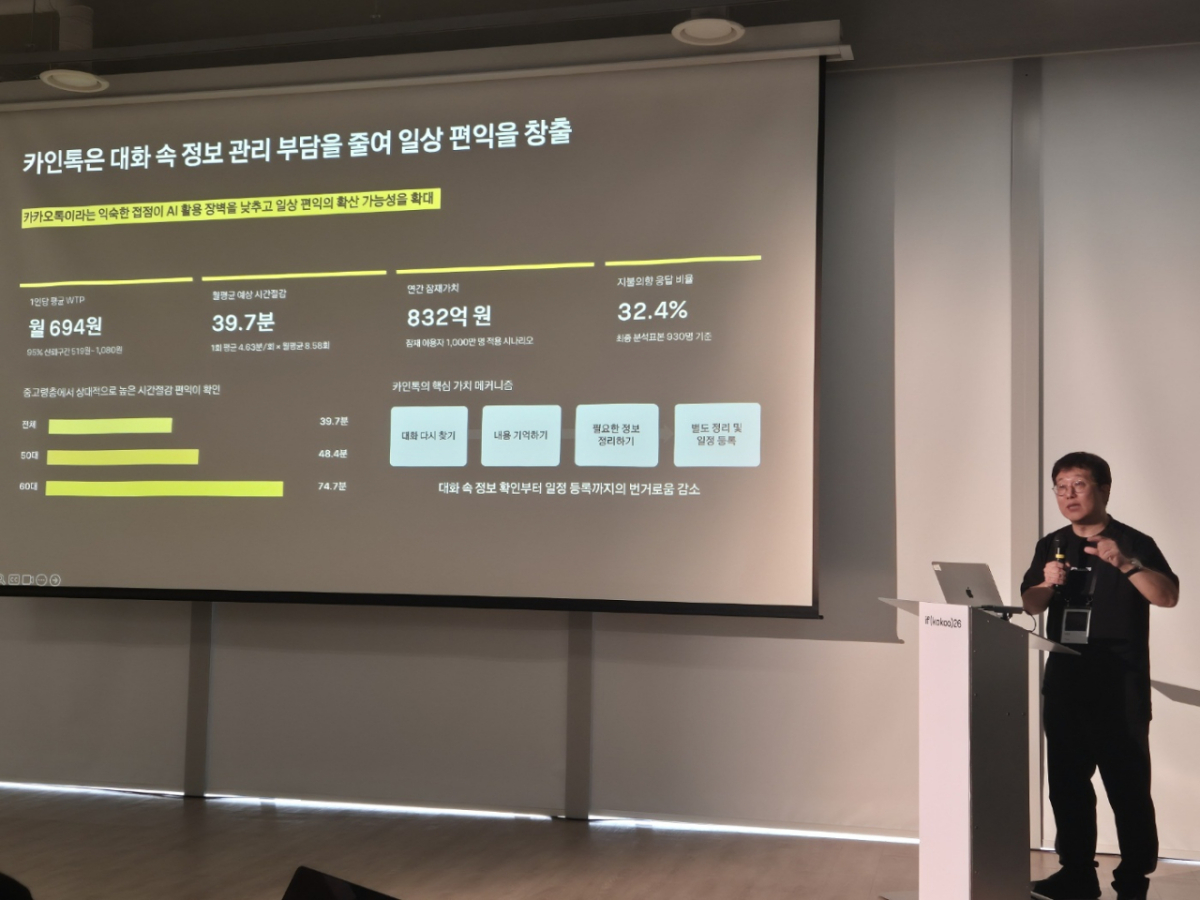
The partner growth area (50.8 billion won) reflected the value of filling gaps in 24-hour customer service and reducing workload burdens for small business owners through the “Cana Consultation Manager.” The inclusive expansion area for digitally underserved groups was denoted as “+α.” The average monthly time-saving effect for the elderly population aged 60 and above (74.7 minutes) reached approximately twice the overall average (39.7 minutes).
Lee Cheol-ho, a Technology Gyeong Yeong-hak-bu (Prof.) at KAIST, stated, “This study holds significant academic and practical importance in that it presents criteria for quantifying and evaluating the positive changes AI brings to various members of society.”

 in TECH

