

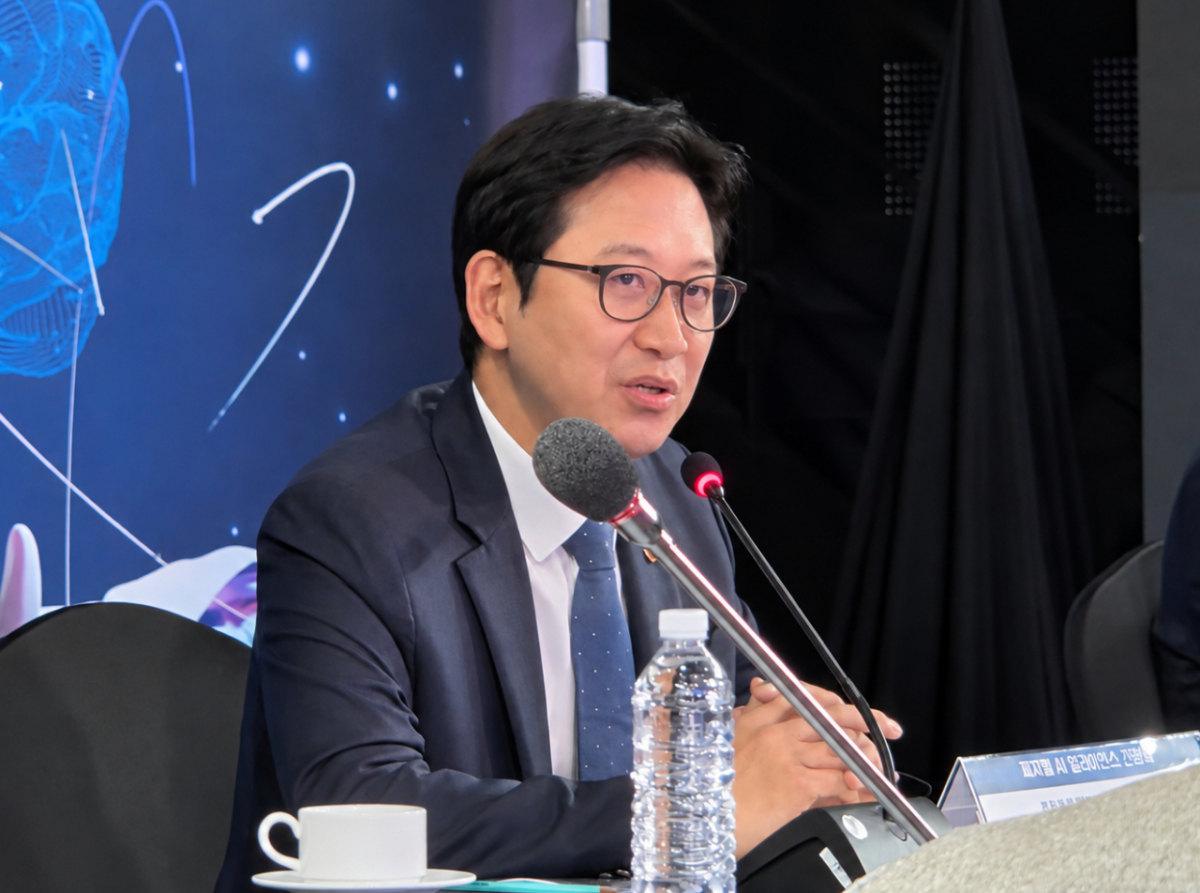
Deputy Prime Minister and Minister of Science and ICT Bae Kyung-hoon emphasized the need to accelerate investment and development speed in South Korea's domestic Physical AI (artificial intelligence) industry. He stated that, given China is rapidly introducing humanoid robots into industrial sites and accumulating data, it is necessary to assess whether South Korea's current plans are sufficient and to set higher goals.
At the 'Physical AI Tech Week' roundtable held on the 13th at COEX in Seoul Gangnam-gu, Deputy Prime Minister Bae said, "In the field of Physical AI, we must be prepared to the extent that we can dominate the global market," adding, "We are constantly pondering whether our established plans are sufficient and whether our current plans are truly adequate."
He noted, "China is also introducing more humanoid robots, applying them in the field, and collecting data," and revealed, "The Three Mega Projects are initiatives embodying the will to create South Korea's future livelihoods through current investments. However, my thirst for whether we are preparing with that level of desire and will has not been quenched."
Deputy Prime Minister Bae particularly urged raising goals and accelerating investment and development speed. He emphasized, "We must set goals at a level where we will not regret in three years, five years, or next year that we should have invested more," adding, "Since the government cannot support everything, I hope companies also make their own efforts and set maximum goals within what they can achieve."
He also mentioned that Physical AI is a field capable of creating new AI markets. Deputy Prime Minister Bae explained, "Although many AI models have been created, there are various limitations in the model itself opening up markets," adding, "I believe Physical AI is a field where artificial intelligence can create markets." This means that applying AI to robots and manufacturing equipment can generate demand in actual industrial sites.
He also positively evaluated the progress of domestic projects. Mentioning the Physical AI demonstration facilities in Jeonbuk and Gyeongnam provinces, he said, "Compared to when I visited the demonstration lab in January this year, it is being upgraded at a faster speed," adding, "I thought we needed to build our own model and software capabilities without relying on overseas solutions, and this part is also catching up quickly."
He also called for inter-company cooperation and export industrialization. Deputy Prime Minister Bae said, "It seems some companies are forming consortiums and developing them into export industries," adding, "I hope we can create a model that allows for more packaging, domestic generalization, and mutual cooperation." Regarding government investment, he stated, "Investment to lay the foundation should be gradually increased, and as actual markets are created, investment should also be further expanded."
Jo Jun-hee, Co-chair of the Physical AI Alliance and President of the Korea Artificial Intelligence and Software Industry Association, said, "In less than a year, approximately 400 companies have joined the alliance, and action plans for each field have been created," adding, "At first, I was anxious and lacked confidence, but now I feel it is worth trying." He then emphasized inter-company cooperation by stating, "If we do not move from inter-company solidarity to an alliance, it will be difficult to create a proper industry."

 in TECH
