

[For more diverse corporate information on the startups featured in this article, please visit the Unicorn Factory big data platform 'Data Lab'.]
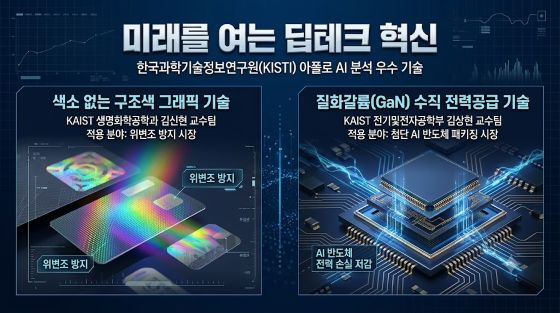
Structural color graphic technology that realizes colors without dyes, developed by Kim Shin-hyeon, Professor of Biomedical and Chemical Engineering at Korea Advanced Institute of Science and Technology (KAIST), and gallium nitride (GaN) vertical power supply technology that reduces power loss in artificial intelligence (AI) semiconductors, developed by Kim Sang-hyun, Professor of Electrical and Electronic Engineering at KAIST, have each been recognized for their commercialization potential in the anti-counterfeiting and semiconductor advanced packaging markets, respectively.
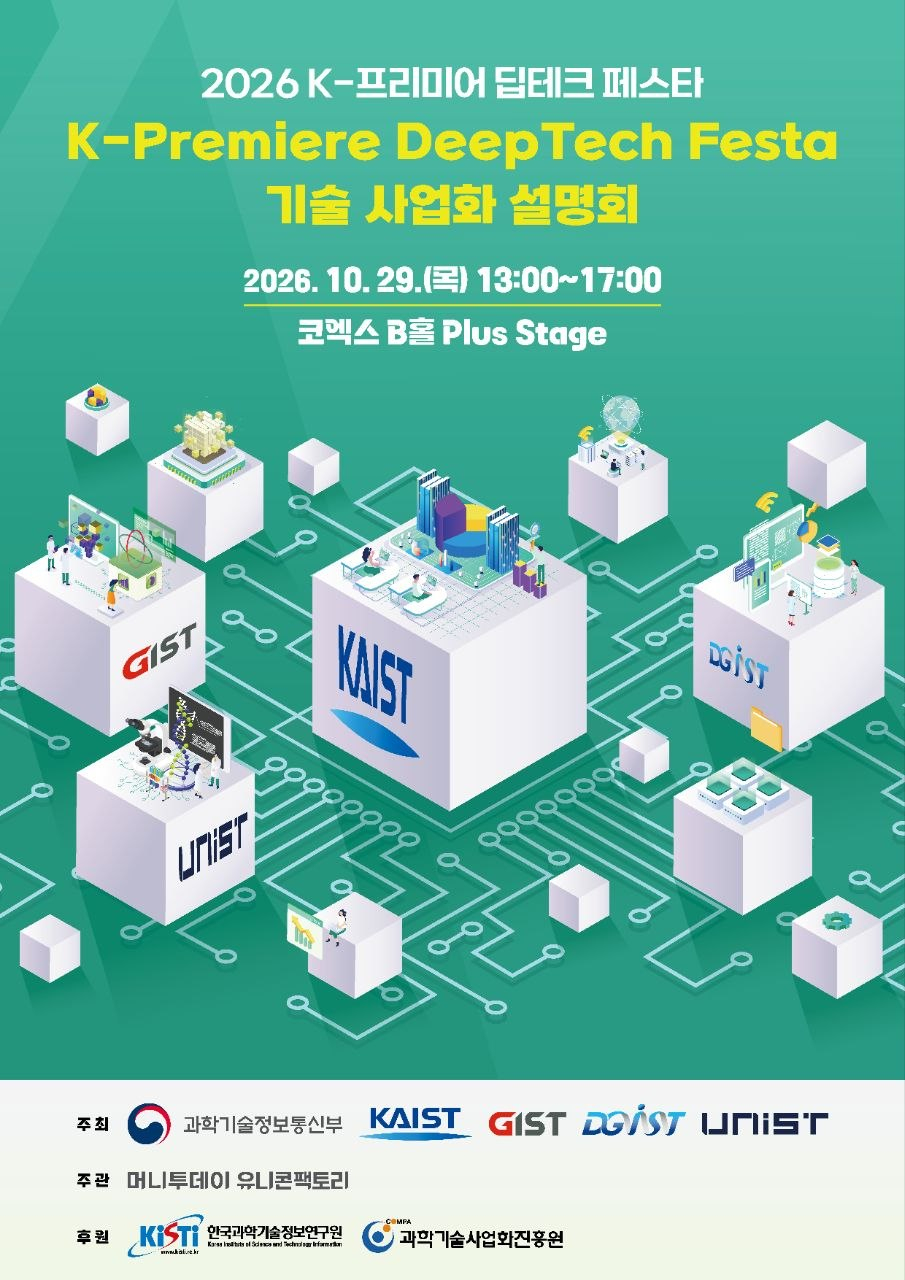
The Technology Commercialization Research Center at the Korea Institute of Science and Technology Information (KISTI) announced on the 13th that it analyzed the research achievements of Kim Sin-hyeon (Prof.) and Kim Sang-hyeon (Prof.) from KAIST using its in-house developed commercialization-specialized AI 'Apollo' and derived these results. The two professors will directly introduce the technologies at the '2026 K-Premier Deep Tech Festa (Click to apply for participation)' to be held on the 29th at Hall B of COEX in Seoul.
Structural color technology targets optical film and security packaging markets
The technology developed by the Kim Sin-hyeon (Prof.) team creates colors using light reflection and interference instead of pigments or dyes. It works by creating microscopic hemispherical structures on transparent materials, allowing light to reflect off these curved surfaces and interfere with each other to realize various colors. By not using chemical pigments, it can reduce the problem of color fading, and by precisely arranging the microstructures, it can create vivid multicolor graphics.
Apollo noted that this technology has overcome the limitations of existing structural colors. According to the Apollo technical analysis report, previously it was difficult to realize various colors while applying them uniformly over large areas, and the manufacturing process was complex. In contrast, this technology can create micro-hemispheres with different sizes and curvatures in a single heat treatment process, simplifying the manufacturing process and increasing the possibility of large-area production.
The domestic target market identified by Apollo is optical film. The domestic LCD optical film market is approximately 1.4 billion dollars (approximately 1.9 trillion won) as of 2024. Apollo analyzed that this technology can expand its application scope to not only existing optical films but also security films to prevent counterfeiting, authentication labels to verify authenticity, and decorative films used in high-end products.
Abroad, the anti-counterfeiting packaging market, which inserts difficult-to-forge visual marks into product packaging to verify authenticity, was presented as a promising commercialization field. This market is projected to grow from 227.7 billion dollars (305 trillion won) this year to 316.7 billion dollars (423 trillion won) by 2031.
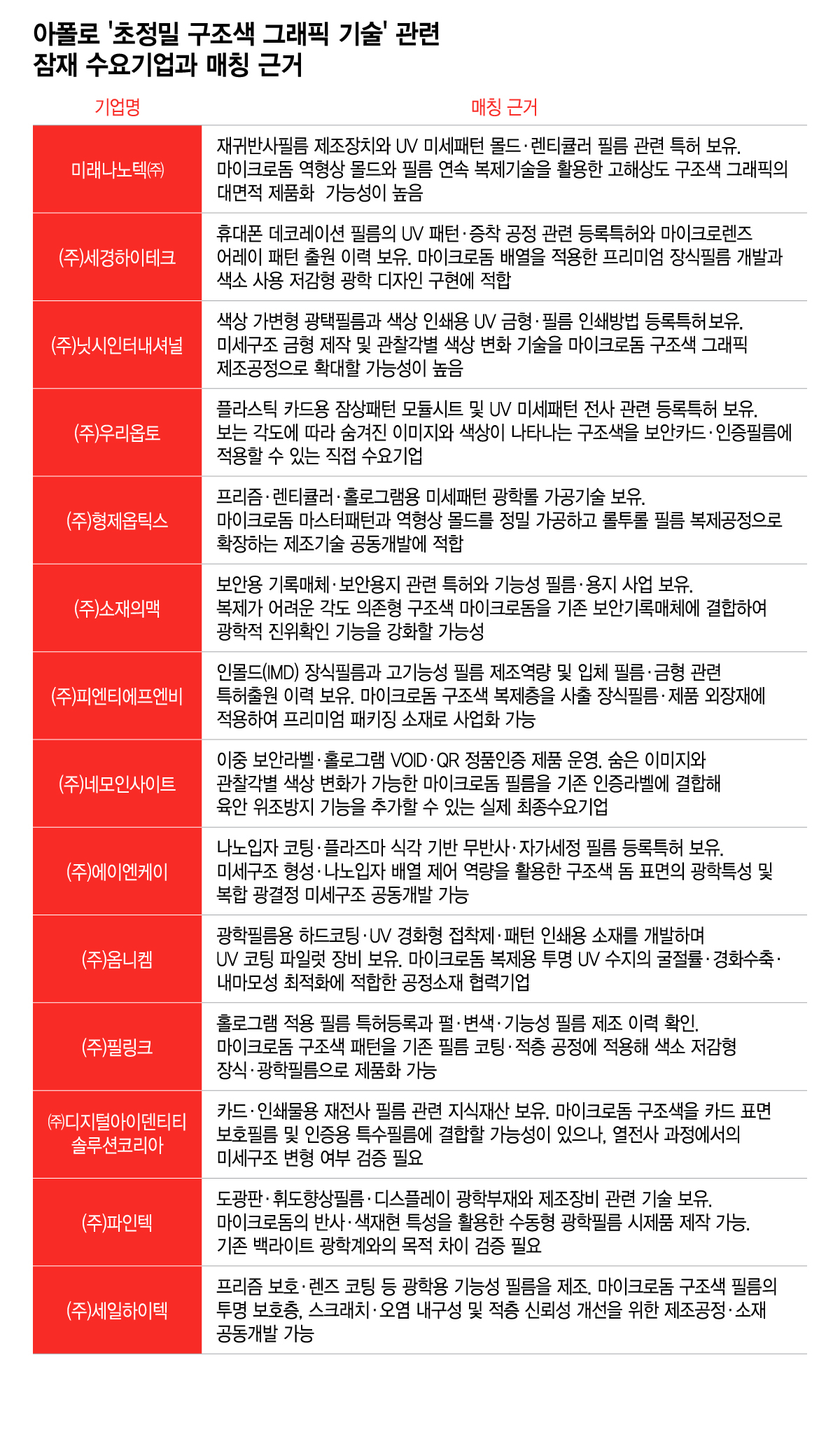
Potential demand companies include 'Mirae Nanotech,' which holds mold and film replication technology for stamping microscopic hemispherical shapes onto films, and 'Seyoung High-Tech,' which developed pattern technology arranging micro-lenses. 'Woori Opto,' capable of creating security cards where hidden images appear depending on the viewing angle, and 'Nemo Insight,' which manufactures authentication labels to verify product authenticity, were also presented as candidates. Abroad, optical security companies such as Switzerland's 'Alpvision,' the United States' 'Authentics,' and Austria's 'Hueck Folien' were mentioned as potential partners.
In addition, the report listed Nitsi International, Hyungje Optics, Sojaeui Maek, PNTFNB, ANK, OmniChem, Fillink, Digital Identity, Solution Korea, Fine Tech, Sail High-Tech, DIT, World Polymer, Oplex, Jcom Information and Communication, Hanel, and Media Space as potential demand companies.
GaN vertical power supply technology aims at semiconductor advanced packaging and Power Management IC (PMIC) markets
The technology of the Kim Sang-hyeon (Prof.) team shortens the path for supplying electricity to AI semiconductors to reduce power loss. The core of the technology is stacking gallium nitride (GaN) power devices that supply lowered voltage in a three-dimensional structure beneath the semiconductor chip.
Because AI semiconductors consume significant power, losses and heat are generated even during the process of converting electricity to the required voltage for supply. The longer the power transfer path between the voltage conversion device and the chip, the greater the loss becomes.
Apollo, which analyzed the technology of Professor Kim's team, evaluated in its report that it "focused not only on placing power devices close to the chip to shorten the distance electricity travels and reduce voltage drop and power loss, but also featured the use of a heat diffusion layer to spread heat to the surroundings, thereby reducing heat generation."
Apollo identified semiconductor advanced packaging as the domestic target market. Advanced packaging is technology that efficiently connects and stacks semiconductor chips and various components to enhance performance and power efficiency. Apollo projected that the relevant domestic market will grow at an annual average rate of 6.4% from approximately 1.44 billion dollars (2 trillion won) last year to approximately 2.35 billion dollars (3.1405 trillion won) by 2033.
Abroad, the Power Management IC (PMIC) market was presented as a major commercialization target. Power management semiconductors are chips that regulate voltage and current required for electronic devices to supply power stably.
Potential demand companies include 'Wooshin Gyeon,' which holds equipment technology for precisely bonding semiconductor chips, 'Bestbon,' suitable for testing technology that directly attaches gallium nitride power devices onto chips, and 'Genersem,' which is developing equipment for stacking semiconductors in three dimensions. 'Power Master Semiconductor,' equipped with design technology to effectively cool heat generated from power devices, and 'Nextgen Power,' which manufactures switching devices that regulate the flow of power, were also presented as potential partners.
Semiconductor assembly and packaging specialist 'Amkor Technology Korea,' semiconductor manufacturer DB Hitek, and semiconductor equipment company Hanmi Semiconductor were also mentioned as candidates for joint development.
In addition, the report listed Onsemi Korea, Orostechnology, Protech, RFHIC, Ajin Electronics, Itda Semiconductor, NH&C, Dongwon Anatek, S&I Solution, Aifact, Taejin Technology, and Amosense as potential demand companies.
Abroad, U.S. power semiconductor companies EPC, Peric, and Alpha & Omega were identified as potential partners. Apollo projected that by combining with these companies' bonding, stacking, and power semiconductor technologies, it can be developed into a technology that efficiently supplies the power required for AI and high-performance computing (HPC) semiconductors close to the chip.
Apply to participate in 'K-Premier Deep Tech Festa (Technology Transfer and Commercialization)'
[MoneyToday startup media platform Unicorn Factory]

 in TECH


