

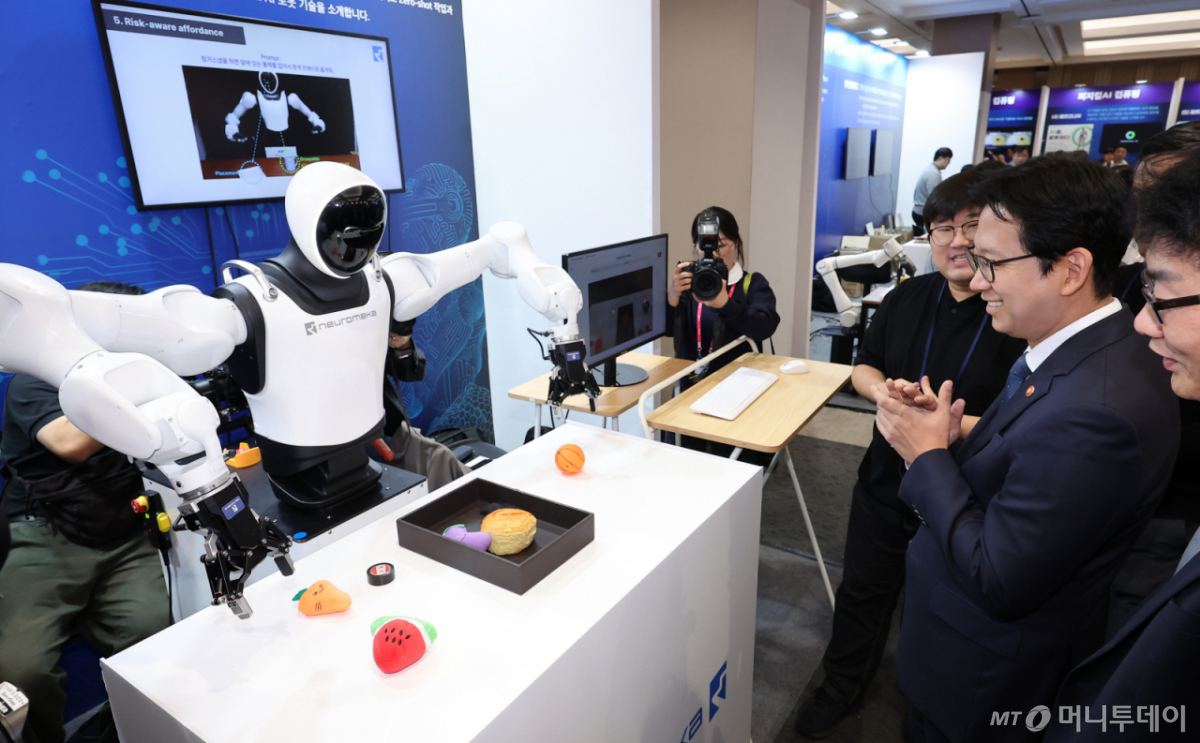
"If we combine our AI (artificial intelligence) and ICT (information and communication technology) capabilities with world-class manufacturing foundations, we can secure sufficient competitiveness in the field of physical AI and leap to become a global leader."
Bae Gung-hoon, deputy prime minister and minister of the Science and ICT, emphasized this at a meeting with industry and research sector officials at the "Physical AI Tech Week" held on the 13th at COEX in Seoul Gangnam-gu. The plan is to consolidate domestic AI and manufacturing capabilities to leap to become a global leader.
Bae said, "Physical AI is one of the three major mega-projects that will lead the future of South Korea, alongside semiconductors and AI data centers," adding, "Now that global competition has fully intensified, it is important who first creates and spreads technology that works in industrial settings." He continued, "Since the Physical AI Alliance has shifted 'from discussion to action,' it is now time to show results that people can actually feel. We will actively link related ministry projects and policy finance so that companies can plan and verify tasks together, and those results lead to investment and commercialization."
More than 20 people attended the meeting, including Cho Jun-hee, Chairman of the Korea Artificial Intelligence and Software Industry Association. The three divisions of the Alliance discussed securing domestic AI models, semiconductors, and robot technology; verification in manufacturing, defense, and maritime sectors; standardization; and global cooperation methods. Participants presented expanding verification opportunities, joint data utilization, and securing specialized personnel as major tasks.
Earlier that morning, at the "Physical AI Alliance Day," domestic and international companies introduced their technology development status and commercialization challenges. Additionally, at the "2027 Inter-ministerial Physical AI Business Briefing," the Ministry of Science and ICT, Ministry of SMEs and Startups, Ministry of Agriculture, Food and Rural Affairs, and Ministry of Oceans and Fisheries introduced business directions by industry such as manufacturing, logistics, agriculture, and ports, as well as investment and commercialization support plans.
Lee Kang-wook, Chief AI Officer (CAIO) of Krafton, announced plans to release a next-generation robot foundation model capable of acting while conversing with people in early next year. He stated, "Our goal is to create a foundation model where a single model can generate actions and speak."
Jung So-young, President of NVIDIA Korea, predicted that if the physical AI market grows, South Korea could take on a crucial role in the global supply chain, similar to Taiwan. Regarding cooperation with LG, she stated, "I expect meaningful results will come out soon." John Helliwell, Vice President of Intel, said, "To realize complex yet highly promising technology like physical AI, cooperation among multiple stakeholders is essential," adding, "In my opinion, there is no better environment or ecosystem example than South Korea."
Meanwhile, KAIST held "Physical AI Korea 2026" at its Daejeon main campus on the same day. KAIST unveiled five physical AI models, including Park Hae-won (Prof.)'s humanoid (human-shaped) robot. President Bae Chung-sik of KAIST directly wore a wearable robot developed by the Gong Gyeong-cheol (Prof.) research team and demonstrated the potential applications of physical AI, such as walking assistance and health information analysis.

 in TECH
